
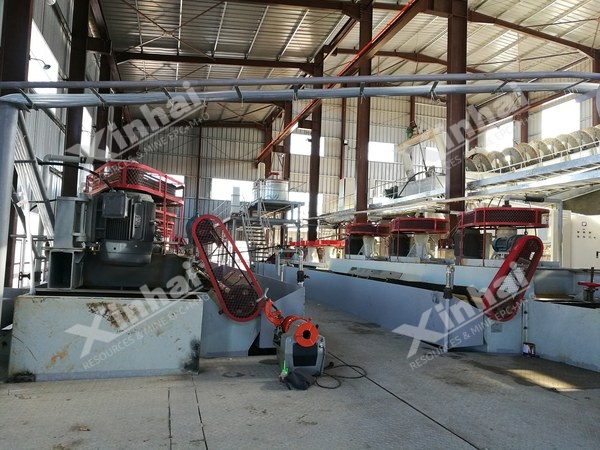
Silver is not one ore. It occurs as native metal, as silver sulfide, as silver chloride, in solid solution inside galena, and locked in pyrite or arsenopyrite. Each occurrence points to a different recovery route, and the route chosen at design fixes the recovery ceiling the plant will live with.Xinhai designs and builds silver plants across that range, from mineral testing and flowsheet development to equipment supply, construction and commissioning.
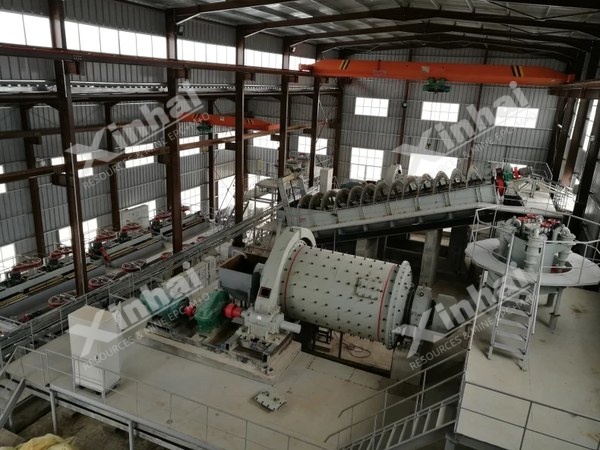
Ball mill, thickener and flotation cells in one silver plant
Silver ore processing turns run-of-mine ore into a product someone pays for: a silver concentrate, a lead, zinc or copper concentrate carrying silver, or a pregnant solution feeding a bullion circuit. The physical work is crushing, grinding and separation; the commercial work is getting silver into whichever product carries the payment.
Those aims pull apart. A circuit tuned only for recovery pushes silver into a low-grade concentrate a smelter discounts; one tuned only for grade leaves it in the tailings. The flowsheet must satisfy the buyer's spec and the ore's mineralogy at once — a balance settled in testwork.
The basic sequence is stable across ore types.
Crushing and screening → Grinding and classification
→ Beneficiation (flotation / gravity) or Leaching
→ Concentrate dewatering or precious-metal recovery
→ Tailings and water management
What changes between projects is the third stage. Everything upstream is preparation; everything downstream handles what the separation produced.
Ore type is the first sorting question: it determines which mineral carries the silver and therefore which process can reach it. The table sets out the six types covering most silver production, with the usual recovery approach for each.
| Ore type | Typical characteristics | Usual processing approach |
|---|---|---|
| Lead-zinc ore | Silver in galena, minor amounts in sphalerite and iron sulfides | Selective flotation; silver reports in the lead concentrate |
| Copper ore | Silver in copper sulfides or as sulfosalts such as freibergite | Copper-silver bulk or selective flotation |
| Silver sulfide ore | Argentite and acanthite as the main carrier | Grinding and flotation, with leaching where sulfides are fine |
| Oxidized ore | Cerargyrite and other halides; oxidized surface chemistry | Flotation with sulfidization, or direct cyanidation |
| Refractory ore | Silver finely locked, or with arsenic, antimony or carbonaceous matter | Pre-treatment (ultra-fine grinding, oxidation, decarbonization) then flotation or leaching |
| Polymetallic ore | Silver with lead, zinc, copper and gold in one orebody | Staged selective flotation, silver tracked through each concentrate |
The first row covers the largest share of world silver production, because most silver comes as a by-product of lead-zinc mining. In that ore the silver circuit is the lead circuit, and silver recovery is capped by lead recovery.
The refractory row is where projects go wrong most often. Silver locked in pyrite or arsenopyrite cannot be floated free at any economic grind, and carbon adsorbs silver back out of the pulp. Both need a pre-treatment decision, justified in testwork before the flowsheet is fixed.
Every silver plant runs the same five stages. What varies is how each is configured.
| Stage | What it does | What decides the configuration |
|---|---|---|
| 1. Crushing and screening | Reduces ore to a size the mill accepts | Ore hardness and clay content; two-stage closed circuit is common |
| 2. Grinding and classification | Liberates silver from gangue | Liberation size from testwork; usually two-stage closed circuit |
| 3. Beneficiation or leaching | Separates silver into a concentrate or solution | Which mineral carries the silver |
| 4. Dewatering or recovery | Produces a shippable concentrate or recovers silver from solution | Product destination: smelter, leach or bullion |
| 5. Tailings and water | Recovers water and manages residue | Permitting, water balance, closure liability |
Two points matter here. Crushing and grinding take more than half the equipment capital and 60–70% of plant energy, so stage two outweighs any other single decision. And over-grinding is the common error: finer grinding buys little recovery and costs concentrate grade. In one silver ore, moving from 72.6% to 94.45% passing 200 mesh raised recovery from 83.36% to 85.15% — under two points — while concentrate grade fell from 1,242 to 1,063 g/t. The selected grind was 86.5%.
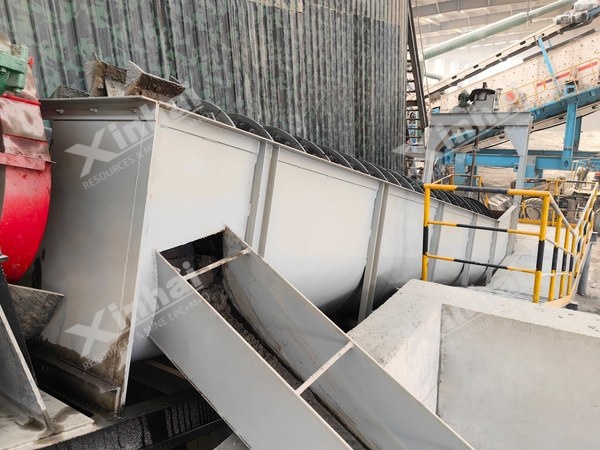
Spiral classifier on the grinding circuit of a lead-zinc-silver plant
Five methods cover the field. Each is given with the condition that makes it the right choice — a method without its operating condition is not a recommendation.
| Method | Applies when | Typical outcome |
|---|---|---|
| Flotation | Sulfide ores; silver carried in galena, copper sulfides or sulfosalts. The main route for most silver production. | Silver in a base-metal concentrate; 87.84% on a copper-silver ore at pH 9 |
| Gravity separation | Native silver as coarse, liberated grains | 0.34% mass yield at 17,576 g/t, 19.10% of silver |
| Cyanidation | Silver dissolves readily; low cyanide-consuming minerals | 85.00% at a manganese-silver ore after magnetic preconcentration |
| Flotation + cyanidation | Flotation leaves leachable silver in concentrate or tailings | Concentrate reground and leached, silver recovered as bullion |
| Pre-treatment + flotation | Silver finely locked, or with arsenic, antimony or carbon | Decarbonization first gave 753.66 g/t Ag at 94.05% recovery |
Cyanidation carries the most design decisions of the five: reagent demand, leach time, solution recovery, washing and testwork each change the plant. A companion piece covers the five design points that decide silver cyanidation recovery.
Pulp chemistry is worth more than any single reagent choice. A copper-silver ore in Anhui ran conventionally at pH above 12, where freibergite and malachite were heavily depressed and both metal recoveries suffered. A weakly alkaline circuit at pH 9 with a combined pyrite depressant lifted the closed-circuit result to 20.17% Cu at 92.39% copper recovery and 87.84% silver recovery.
Refractory ores show the other end. For a lead-silver ore in Yunnan with about 1.66% carbon, testwork put decarbonization ahead of lead-silver flotation; the carbon product held only 2.12% of the silver. The lead concentrate graded 63.68% Pb and 753.66 g/t Ag, at 94.84% lead and 94.05% silver recovery with a 70% passing 0.074 mm grind.
Flotation bank in a silver concentrator
Silver projects fail in testwork more often than in operation. Recovery depends on facts a head assay cannot show: which mineral carries the silver, what size it liberates at, and how much silver no process can reach. A test programme establishes the following.
Assay and deportment. Head grade says nothing about recoverability. The study separates free, locked and enclosed silver — Jinshan gave 74.2% / 16.2% / 9.6%.
Mineralogy and grain size. Which minerals carry the silver, in what order, and at what size the grains come free. Galena first, then oxidized lead minerals, sphalerite, arsenopyrite and pyrite is typical — and it decides which concentrate gets paid.
Grind size series. Recovery and grade run in opposite directions as grind gets finer. The test finds where extra grinding stops paying.
Route comparison. All routes run on the same sample in closed circuit. Open-circuit results overstate plant performance: single flotation came to 80.88% open while gravity plus flotation reached 83.95% closed.
Reagent and pulp chemistry. Whether lime or sodium carbonate suits the ore is a test result, not a house standard.
Flowsheet confirmation and sizing. Output is a flowsheet, a predicted recovery and grade, equipment sizing and an order-of-magnitude capital estimate.
Send an ore sample or assay report for a preliminary evaluation. A 20–30 kg representative sample supports a bench programme that answers the route question.
Equipment follows the flowsheet stage by stage — each item only makes sense in its position in the sequence.
Crushing and screening: jaw crusher for primary reduction, cone crusher for secondary and tertiary duty, vibrating screen closing the circuit.
Grinding and classification: grid ball mill for the primary stage where discharge needs to be protected, overflow ball mill for fine secondary grinding, hydrocyclone clusters for classification.
Flotation: conditioning tanks ahead of the circuit, air-inflation flotation cells for roughing and scavenging, self-aerated cells where the duty suits them, and a reagent preparation system.
Gravity: jigs for coarse fractions, shaking tables for cleaning.
Leaching: leaching agitation tanks, with washing thickeners in counter-current arrangement.
Concentrate dewatering: deep cone thickener followed by filter press.
Tailings: thickener for water recovery, dewatering screen or filter press for dry stacking, and a lined storage facility.
Two decisions carry the most consequence. The grinding circuit sets liberation and slime load and is the largest energy consumer. Flotation cell selection sets residence time and the practical lower particle-size limit — fine silver in a coarse-duty circuit reports to tailings whatever the reagent scheme.
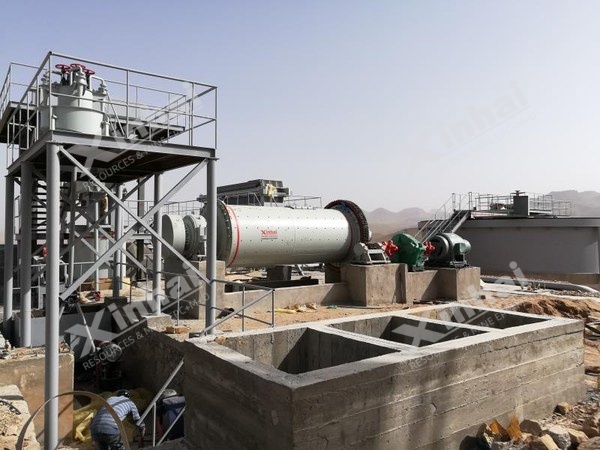
Ball mill and steel-framed plant structure at a silver site
Silver plants range from tens of tonnes per day to several thousand where silver is a by-product. Capacity follows the orebody; there is no standard size. Scope can be set anywhere along that range:
Single equipment supply where the client holds the process design.
Process design and equipment package where the flowsheet is Xinhai's but construction is local.
Full EPC covering design, equipment, construction and commissioning, including civil works where the site requires it.
Operation and maintenance support after handover, with spare parts supply and remote or on-site technical assistance.
A retrofit is assessed differently from a new plant. The Henan project below covered only a dewatering workshop at an existing 700 t/d plant plus wash-water handling at a 3,000 t/d plant — a small package built around live production.
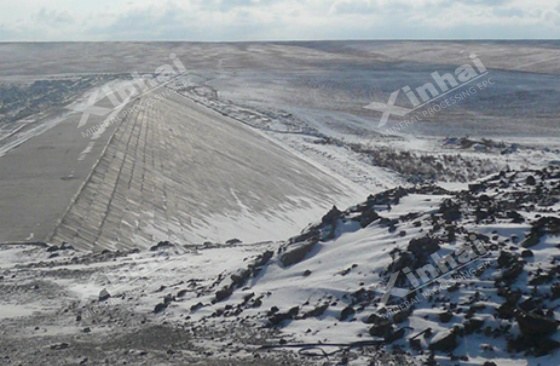
Raised tailings dam at a silver operation
Two plant records follow, both Xinhai projects.
The client built a 300 t/d cyanidation plant in 2012. As mining went deeper the ore changed, equipment aged, and the flowsheet no longer matched it; throughput fell short and silver recovery declined year by year. The decision was to rebuild.
Testwork settled on two-stage semi-closed crushing, two-stage grinding, flotation (one roughing, three scavenging, two cleaning) and two-stage dewatering. Jaws handled primary and secondary crushing, a cone the tertiary. The first grinding stage ran a grid ball mill with jig and shaking table gravity separation plus a high-weir spiral classifier; the second ran an overflow ball mill with a cyclone cluster. Grind was 55–60% passing 74 µm, then 85–90%.
| Item | Detail |
|---|---|
| Ore | 317.22 g/t Ag; native silver with pyrite and limonite; Pb 0.14%, Zn 0.47% |
| Capacity | 500 t/d |
| Flowsheet | Two-stage crushing — two-stage grinding — gravity plus flotation — two-stage dewatering |
| Silver recovery | 83.95% (gravity concentrate 19.10%, flotation concentrate 64.85%) |
| Concentrate grade | Gravity 17,576 g/t; flotation 3,962 g/t; cake moisture ~20% |
| Outcome | Cost 15% below the previous plant; capital 5% under budget |
Two design choices were site-driven. The plant sits on bare rock where concrete is expensive, so buildings were steel-framed — cheaper and faster to erect. The circuit was also arranged to reuse existing plant and equipment where the ore allowed.
The 83.95% is the outcome. How the gravity and flotation split was set, and where the loss sits by size fraction, is set out in free silver versus silver in galena.
A polymetallic operation in Henan treats lead-zinc-silver-gold ore through two plants, silver reporting in the lead concentrate. Flotation runs at the ore's natural pH of 6.5–7.0 in micro-bubble cells, with published figures of 95.5% lead, 95% silver and 92% zinc recovery. Thickener overflow and impoundment water are recycled to a zero-discharge target.
Xinhai built the third 1,500 t/d flotation series at the 3,000 t/d plant as an EPC package in 2024, taking it from 1,500 to 3,000 t/d. A 2025 package covered the dewatering workshop retrofit at the 700 t/d plant — a new 12 m thickener, dewatering building and expanded concentrate store — plus wash-water and fine-sludge handling at the larger plant. Both packages came from the same client after the first was delivered.
The comparison with Morocco is not a comparison of plant quality. In Morocco silver is the only payable metal, occurring as native silver with a fine fraction no circuit recovers. In Henan silver rides in galena and lead recovery runs at 95.5%. The 11-point gap between 83.95% and 95% comes from the ore, not the engineering.
The claims that matter are the ones that can be checked.
Testwork before design. Every flowsheet above started from a test programme on the client's ore — the Moroccan case began with a 30 kg sample before any flowsheet was drawn.
Full-scope engineering. Design, manufacturing, construction and commissioning sit in one contract, which is why the Moroccan retrofit could reuse existing plant without interface disputes.
Experience across the ore types on this page. Native silver with cyanidation, silver in galena with selective flotation, manganese-silver with magnetic separation — three different answers to the same question.
Continuity after handover. Spare parts, remote support and on-site service, with expansion and retrofit work carried out on plants Xinhai originally built.
There is no single best method; the ore type decides. Sulfide ores go to flotation, coarse native silver rewards gravity, low-cyanide ores leach directly, and refractory ores need pre-treatment. Testwork distinguishes between them.
Yes, and most of the world's silver is recovered this way. Silver in galena reports to the lead concentrate, so silver recovery tracks lead recovery — 95.5% lead and 95% silver at a Henan operation.
Published figures range from 83.95% for a native silver ore with a fine fraction to 95% where silver rides with galena, with copper-silver ores at 87.84% and decarbonized lead-silver at 94.05%. Deportment sets the number.
No. Coarse free silver can be partly recovered by gravity, and some oxidized ores leach directly. Flotation is the default because most silver occurs in sulfides, which is a consequence of the mineralogy rather than a rule.
Grinding finer raises recovery slightly and lowers concentrate grade sharply. Moving from 72.6% to 94.45% passing 200 mesh gained under two points of recovery while grade fell by 179 g/t.
Ore type and location, silver grade and associated metals, oxidation state, throughput, and any assay or mineralogy report. A 20–30 kg representative sample allows a bench programme; an assay alone supports only an opinion.
Yes, often the cheaper route. The Moroccan plant reused its buildings and most equipment, adding the gravity and flotation stages the ore needed. Retrofit scope is assessed against live production rather than an empty site.
A preliminary flowsheet needs four things: ore location, silver grade and associated metals, whether the ore is oxidized or sulfide, and planned throughput. An assay or mineralogy report shortens the process considerably.
Send your ore analysis and we will come back with a route recommendation, an indication of achievable recovery and grade, and the next step in testing.
Request a preliminary flowsheet — with ore type, grade and throughput.
Send your assay report — for a first read on recoverability.
Talk to a mineral processing engineer — on testwork scope and plant configuration.

 +86 13811510145


