If you want to know more information (such as product/process price, etc.), please contact us 24-hour telephone
Five design points decide what a silver cyanidation plant recovers: cyanide demand, leach residence time, how silver leaves the pregnant solution, how thoroughly the residue is washed, and what the testwork established before the flowsheet was drawn. The chemistry is fixed. These five are choices, and they account for most of the recovery gap between one silver operation and another.
Silver dissolves as dicyanoargentate, Ag(CN)2-, and that formula sets the floor on reagent: two cyanide ions for every silver atom, in alkaline pulp at pH 10 to 11, where cyanide stays stable and lime holds the circuit there.
Consumption then climbs above the floor. Silver halides in oxidized ore dissolve quickly and take reagent with them. Sulfide minerals in the same pulp consume their share, and sulfur species formed during leaching tie cyanide up in compounds that no longer dissolve metal. Plants hold free cyanide at a set concentration in the last leach tank and dose against that reading, which turns consumption into a figure per tonne of ore.
Design consequence: mixing, storage and dosing sized on that figure, plus a recovery step on barren solution so unconsumed cyanide returns to the leach before the tailings reach detoxification.
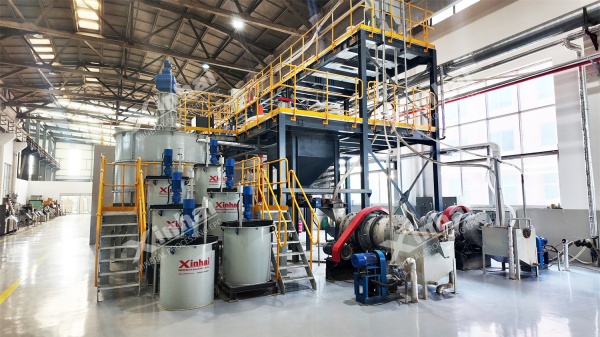
Pilot-scale cyanidation testwork
A silver leach runs at two speeds. The easily dissolved fraction comes out within the first hours. The remainder, locked in sulfide or coated by reaction products, dissolves slowly and then stops. Total leach time is set by that slow tail of the curve, so a circuit sized on the fast fraction leaves silver in the residue while its tanks hold pulp that has nothing left to give. Oxygen matters as much as cyanide in the first tanks and is consumed fastest there, which is why those tanks carry aeration or oxygen sparging.
Design consequence: leach volume and stage count, which in practice means the size and number of leaching agitation tanks the circuit carries. A single stage gives the slow fraction one pass at a gradient that weakens as it travels. Two stages with a wash between them keep the concentration difference working twice. At a silver plant in Inner Mongolia, splitting one leach and one wash into two of each raised silver recovery on the same feed.
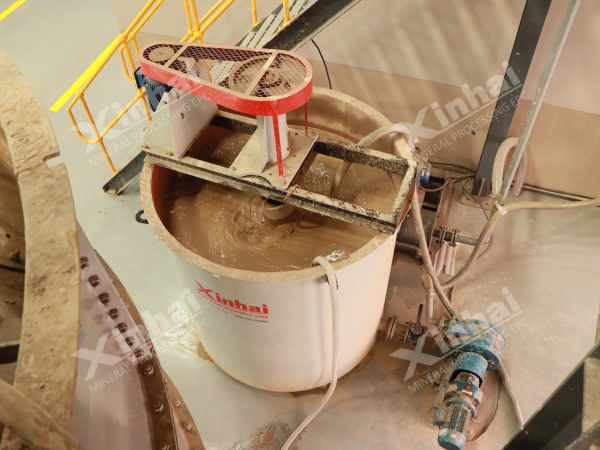
Agitation leach test
Pregnant solution from a silver leach carries grams per cubic metre, and that tenor decides the route out. Carbon adsorbs silver readily, yet loaded carbon strips and electrowins poorly, so high-tenor solutions go to zinc cementation, the Merrill-Crowe process: clarify the solution, strip oxygen under vacuum, dose zinc dust, and filter out the silver cement that forms. Zinc consumption follows the silver in solution, so the reagent bill tracks the head grade.
Design consequence: a clarification train, a deaeration tower, zinc dust feed, a filter press and a refinery. In Xinhai's silver flowsheets the cement is retorted and electrolysed into bullion on site.
Leached residue leaves every thickener carrying solution in its voids, and that solution holds the same silver grade as the pregnant liquor. A plant that leaches well and washes badly hands its recovery to the tailings. Counter-current decantation (CCD) runs wash water against the solids so each stage returns most of the entrained value to the circuit; the loss shows up in the final residue assay, not in the head grade.
Design consequence: stage count and thickener area. Wash ratio, the water volume per tonne of solids, sets how much solution the residue still carries out at a given stage count. Two- and three-layer washing thickeners stack several stages into one footprint, which matters where the leach building is already up and the site has no room to spread out.
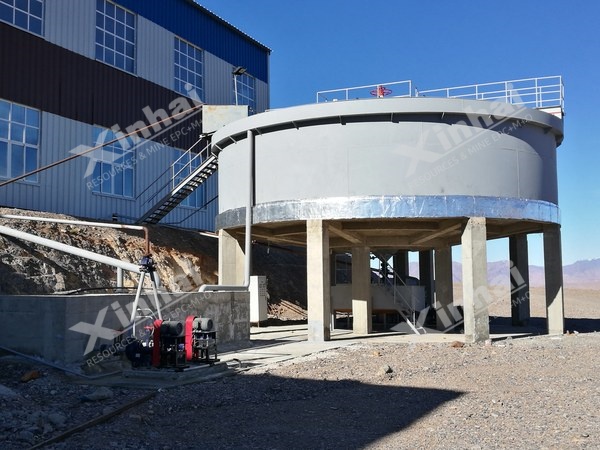
Washing thickener, Morocco silver plant
Head grade answers whether a deposit is worth mining. It does not answer whether the silver leaches, which depends on where the silver sits in the rock. Three results decide the route:
Mineralogy: which mineral carries the silver, and how finely it is locked.
Cyanide-soluble silver: the share of total silver that reports to solution in a leach test on a representative sample.
Residue assay by size: what stays behind, and at which grind the locked silver begins to open.
The choice of route starts from silver ore processing basics: cyanidation suits free silver and ores with low cyanide-consuming minerals. One manganese-silver ore Xinhai tested returned 85.00% silver by cyanidation after magnetic preconcentration removed the manganese ahead of the leach. Where silver sits in sulfides, flotation comes first and the concentrate is reground before it reaches the leach tanks.
Design consequence: the test programme sets the flowsheet. A bottle-roll leach at two or three grinds, followed by a locked-cycle test on the selected route, is the minimum before equipment is sized.
| Design point | What drives it | What it changes in the plant |
|---|---|---|
| Cyanide demand | Two ions per silver atom; halides; sulfide side reactions | Reagent storage, dosing, cyanide recovery |
| Residence time | The slow residual fraction | Leach volume and stage count |
| Solution recovery | Silver tenor in pregnant solution | Zinc cementation, clarification, refining |
| Washing | Entrained solution in the residue | CCD stages and thickener area |
| Testwork | The mineral form of the silver | Route: direct leach, or flotation then leach |
The Morocco project treats 500 t/d of ore grading 317.22 g/t silver, with native silver as the main metallic mineral alongside pyrite and limonite. Testwork compared three routes on the same sample. Single flotation at 86.5% passing 200 mesh returned 80.88%. Gravity ahead of flotation did better: a gravity concentrate at 0.34% mass yield, grading 17,576 g/t, recovered 19.10%, and flotation on the gravity tailings added 64.85% from a concentrate at 3,962 g/t, for 83.95% in closed circuit.
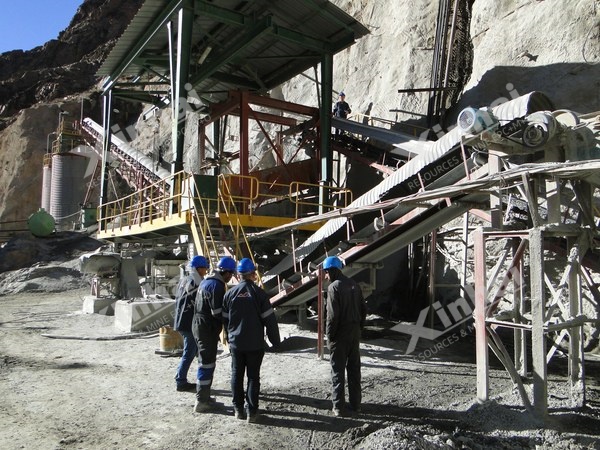
Crushing and conveying, Morocco plant
The size analysis of the tailings explains where the remainder sat. The -0.030 mm fraction was 43.18% of the tailings mass and held 49.81% of the lost silver, at 60.23 g/t, the highest grade in the table. Fine native silver floats poorly and settles slowly, so the last of the recovery sits in the wash circuit and the slimes rather than in the reagent scheme.
The plant runs a flotation and cyanidation flowsheet: flotation, then regrinding and cyanidation of the concentrate, counter-current washing and zinc precipitation, with the cement electrorefined into bullion. The gravity split came from the testwork, and the leach stage handles the silver that flotation could not lift.
Two cyanide ions bind each silver atom, and halide or sulfide minerals in the same pulp take their share. Plants hold a set free-cyanide level in the last tank, so consumption shows up per tonne of ore. Recovering cyanide from barren solution returns part of it to the leach.
For high-tenor silver solutions it usually is: zinc cementation takes the grade and yields a cement that refines on site. Carbon loads silver but strips and electrowins poorly. Low-tenor solutions can still go to carbon, and the choice belongs in the testwork.
Long enough for the slowest fraction to stop paying. Pilot leach curves show most silver dissolving early and the rest flattening out; the design point sits where the curve flattens, and testwork sets it for each ore.
Mineralogy on the carrier, a cyanide-soluble assay, a bottle-roll leach at two or three grinds, and a locked-cycle test on the chosen route. Without the first two, the flowsheet gets designed for the wrong silver.
Send an assay and a mineralogy report, and our process team will outline the leach circuit your ore supports, with the stage count and reagent demand those results imply.
Sources
Morocco ore and testwork figures (317.22 g/t Ag head, native silver with pyrite and limonite; single flotation 2,689 g/t at 80.88%; gravity concentrate 0.34% mass yield at 17,576 g/t for 19.10%; flotation on gravity tailings 64.85% at 3,962 g/t; 83.95% closed circuit; tailings size analysis with 43.18% of mass and 49.81% of silver loss in the -0.030 mm fraction) — Xinhai silver ore test report, April 2016, for a 500 t/d Moroccan silver project.
Inner Mongolia plant (design 500 t/d, operating 750 t/d; one leach and one wash changed to two of each) and the Morocco flowsheet sequence — Xinhai project records for silver flotation and cyanidation plants.
Manganese-silver ore at 85.00% silver by cyanidation after magnetic preconcentration — Xinhai test record.
Cyanide stoichiometry at two ions per silver atom, the pH 10 to 11 operating window, oxygen demand in the first leach tanks, and the behaviour of carbon and zinc cementation on silver-rich solutions — Marsden and House, The Chemistry of Gold Extraction, 2nd edition, Society for Mining, Metallurgy and Exploration, 2006.
Both plants are Xinhai projects; the figures describe ore and circuit, not a guaranteed plant performance.
 +86 13811510145
