If you want to know more information (such as product/process price, etc.), please contact us 24-hour telephone
Tailings design limits copper output because storage, water and permitting decide how much a plant produces — not ore grade. Output from 49 producers, 72.3% of global mined copper, fell 4.3% year on year to 8.196 Mt in H1 2026, a drop of 371,000 t, according to Sinolink Securities research published 6 September. LME copper held near US$14,408/t on 7 September.
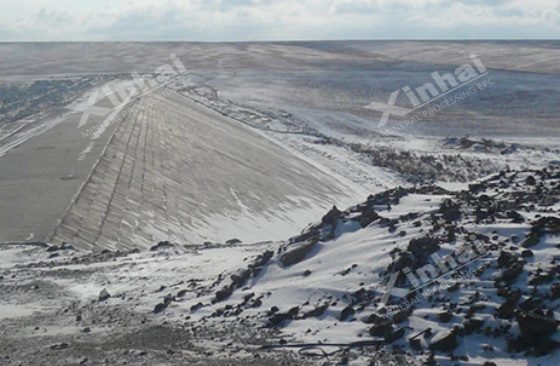
Tailings storage facility, embankment dam
The shortfall is concentrated. Freeport, Ivanhoe, Codelco and BHP together cut 427,000 t. Only 6 of 35 companies raised capital expenditure.
The constraints named are permitting, water, power, tailings facilities and build cycles. Three of the five are about what gets built on the surface, not what comes out of the ground. Tailings is the one most often left late.
A concentrator gets the attention. A tailings storage facility (TSF) gets the schedule.
When research lists tailings facilities alongside permitting and power as reasons capacity cannot land, the constraint has moved. Storage, water and approval now decide how much copper a project produces, and when.
| Constraint named | What it means for design |
|---|---|
| Permitting | Closure plan and water balance first |
| Water | Fixes the dewatering route |
| Power | Filtration vs slurry is an energy trade-off |
| Tailings facilities | Storage capacity sets the expansion sequence |
| Build cycles | Often sits on the critical path |
Water balance (the accounting of every cubic metre entering and leaving a site) decides the dewatering route before anything else. Where water is scarce or costly, high-rate thickening or dry stacking pays for itself in recovered process water. Where water is abundant and terrain is flat, conventional slurry deposition may still be cheaper. The answer is site-specific, and it has to be settled before the dam is sized.
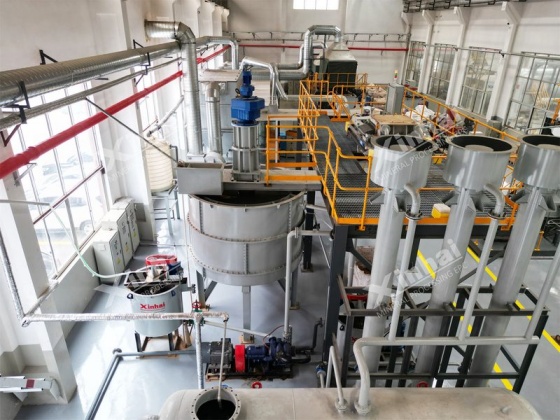
Xinhai center-drive thickener at the pilot centre
Equipment follows the same logic. High-efficiency, deep cone and tilted plate thickeners recover 60–80% of process water; with filtration, recovery reaches 85–95% and leaves a stackable cake. Filter presses typically deliver 8–12% moisture, changing water balance and haulage cost.
A TSF is not one build. It is a sequence: a starter dam, then staged raises as the facility fills. Every raise has to be funded, permitted and built while the plant keeps running.
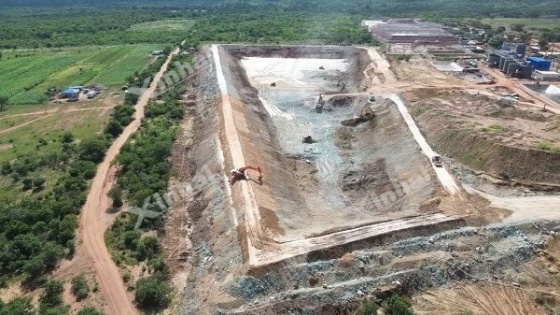
Starter dam under construction, looking downstream.
That is where the ceiling appears. Size the starter dam for nameplate throughput with no margin, and a later expansion needs a new cell, a fresh approval and usually another geotechnical investigation. Storage, not mill capacity, becomes the constraint.
Regulators increasingly want the closure plan before the first discharge, not at the end. The design has to account for final landform, cover, drainage and reclamation while the starter dam is still being drawn.
Monitoring belongs to the same package — surface displacement, phreatic line (the level at which water sits inside the dam), beach length, water level and rainfall, online and manual. Instrumentation installed during construction costs far less than retrofitted.
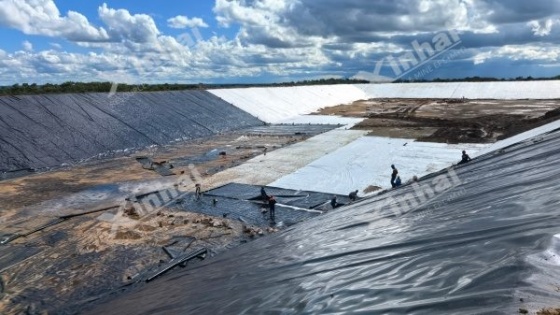
Slope seepage prevention on the dam face during construction
Xinhai Mining designed the tailings storage facility for a 3,000 t/d graphite processing plant in Tanzania. The scope ran from the transfer pump station through the pipeline, discharge system and return-water facilities to the facility itself — starter dam, staged embankment, flood discharge, seepage recovery, monitoring and a management station.
The design settled three numbers:
7.79 million m³ total storage, 5.84 million m³ effective
a total dam height of 56 m — a 26 m starter dam plus 30 m of staged raises
about 8.7 years of storage at roughly 937,000 t of tailings a year
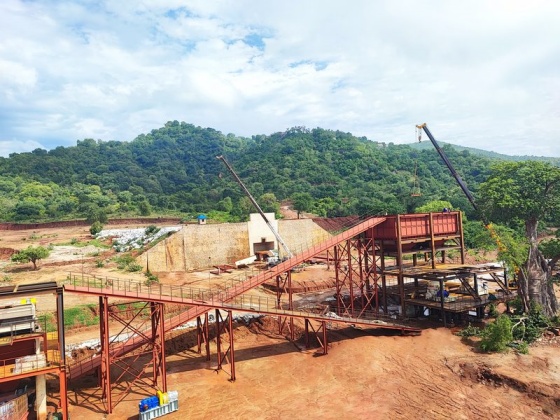
3,000 t/d graphite project site in Tanzania
Flood handling was sized against a maximum 24-hour rainfall close to 260 mm over a 1.6 km² catchment, using a shaft-and-tunnel system with three intake shafts. Slope stability was checked by finite-element seepage modelling coupled with limit-equilibrium analysis, with the phreatic line held at 3.0 m depth.
The point is not the numbers. It is the order: catchment and water first, storage second, then the dam that delivers it.
A tailings facility can cap output as directly as mill capacity. Storage determines when the next raise or cell is needed; if that approval slips, throughput is throttled to fit available storage. In practice, storage and water cause below-nameplate running more often than grinding capacity.
Dry stacking dewaters tailings to a filter cake that is stacked rather than pumped as slurry. It suits water-scarce sites, seismic areas and difficult closure profiles, recovering more process water and avoiding a large impoundment. The trade-off is higher filtration cost.
Before the flowsheet is frozen. Water balance, tailings rheology and particle size come from metallurgical testwork, and they fix the deposition method, dam type and water recovery system. Starting later usually means redesign.
Often yes, through staged raises or an additional cell, and usually cheaper than a new site. The constraint is geotechnical: each raise needs fresh stability analysis, and the original design may not have anticipated the final height.
If you are weighing a tailings facility for a copper project, we'd be glad to discuss the technical questions — water balance, storage and closure.
At Xinhai, we believe the right tailings solution is built around your site conditions, not a standard template.
Share your project with us. Let's work through the constraints together.
 +86 13811510145