If you want to know more information (such as product/process price, etc.), please contact us 24-hour telephone
Copper is at its most expensive level in history. The mines that would normally answer that price signal cannot.
LME three-month copper set records on three straight trading days in early September, touching an intraday high of $14,858.50 per tonne on September 9 and settling at $14,812. The metal is up about 19% this year and roughly 47% over the past twelve months.
At those prices, the economics of what is worth processing move too. Old tailings and low-grade material written off years ago can become ore again — without mining a single new tonne. The price has moved. The rock has not.
Copper demand is no longer just construction and power grids. Morgan Stanley expects AI data centers alone to consume 740,000 tonnes of copper in 2026, doubling to 1.3 million tonnes by 2028. A single liquid-cooled rack can hold 800 to 1,000 kilograms of pure copper.
New mines, meanwhile, are slower to deliver — deeper, lower-grade and tied up in longer permitting. So the next tonne has to come from material the industry used to ignore. That is what reprocessing steps into.
Tailings are the residual material left after the valuable minerals are recovered. Low-grade ore is material that sits below the cut-off grade — the minimum grade at which material is economic to process. Reprocessing is treating them again to recover what was left behind.
Three routes sit under that umbrella:
Re-treating old tailings deposits to recover residual copper.
Leaching low-grade stockpiles and oxide material.
Lifting recovery in an existing concentrator so less copper reaches the tailings in the first place.
The reason record prices matter is simple: the cut-off grade moves with price. When copper was cheap, a 0.3% Cu tailings pile was waste. At today's prices, a large part of it can be ore again.
Recovery rate — the percentage of the valuable mineral recovered into concentrate — works like a multiplier. On a 5,000 t/d plant, lifting recovery from 85% to 90% adds five extra tonnes of copper for every 100 tonnes of feed, without mining a single new tonne of rock.
That is the quiet arithmetic behind the headlines. The deposit has not changed. The economics have.
The flowsheet follows a predictable path, and every step is a place where money is either recovered or lost.
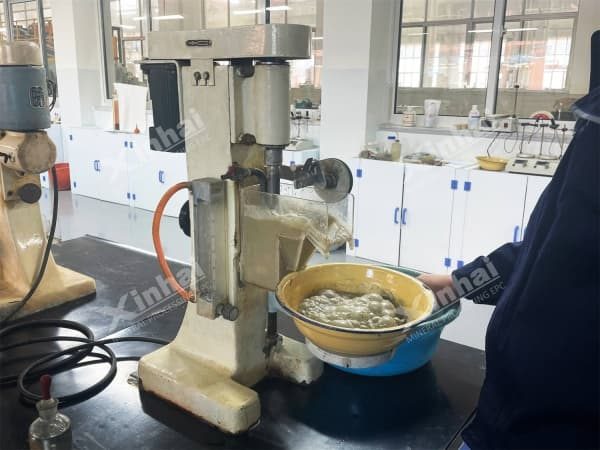
First, testwork. A metallurgical test determines the flowsheet and design parameters for a specific ore, instead of guessing. Grinding is usually the first lever — too coarse and copper stays locked in gangue; too fine and you waste power.
Then flotation, the workhorse for sulfide copper. It exploits differences in the surface chemistry of minerals to float copper-bearing particles away from waste. A typical sulfide circuit grinds to a P80 of 75–150 μm and runs one roughing, three scavenging and three cleaning stages.
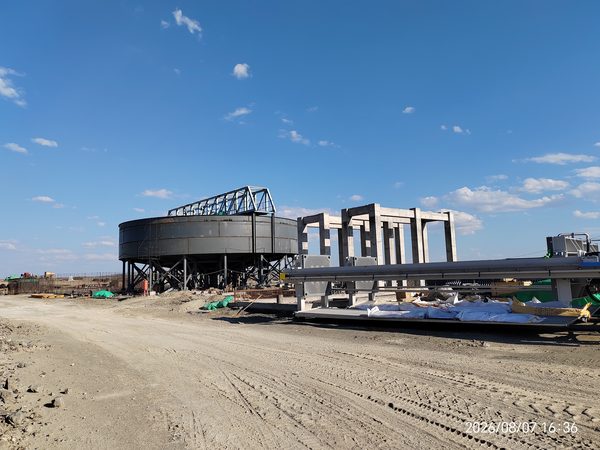
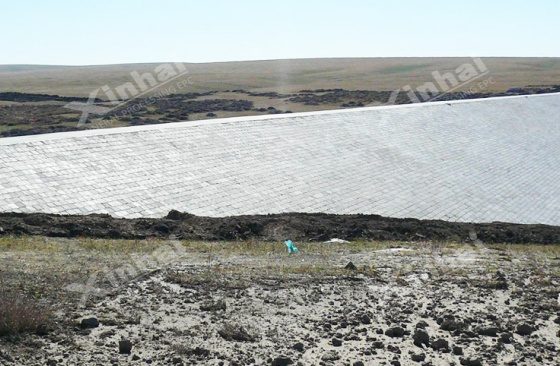
Finally, the tailings. Thickening and dewatering recover water and leave a filter cake that can be dry-stacked instead of pumped to a dam — cutting both water use and dam risk. That matters because reprocessing often means handling large volumes of re-ground material.
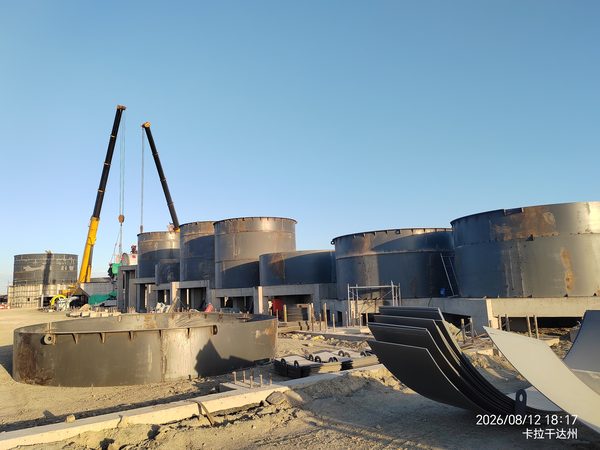
Flotation cells being assembled on site.
None of this is theoretical. Xinhai Mining delivered a 1.5 Mtpa (about 5,000 t/d) copper flotation plant in Kazakhstan with an average feed grade of just 0.86% Cu. The flowsheet turns that into a 22% Cu concentrate at 90% recovery.
| Plant | Scale | Feed grade | Concentrate grade | Recovery |
|---|---|---|---|---|
| Kazakhstan (EPC) | 1.5 Mtpa / 5,000 t/d | 0.86% Cu | 22% Cu | 90% |
| Yunnan, China | 1,000 t/d | 0.87% Cu | 23% Cu | 91.21% |
| Philippines | 200 t/d | — | 26.5% Cu | 95% |
These results apply only to the submitted sample and should not be presented as guaranteed plant performance.
It depends on grade, recovery and cost, but record prices push the cut-off grade down, which turns more old tailings into economic feed. A project that failed at $8,000 per tonne can work at $14,000 per tonne. The only reliable way to know is a metallurgical test on a representative sample.
Re-treatment processes material already sent to storage, while recovery gains keep copper from reaching the tailings in the first place. Both add metal without new mining. The cheaper option usually depends on how much copper is already sitting in the tailings.
Sulfide copper is usually recovered by regrinding and flotation. Oxide and mixed material may instead go to leaching, which dissolves copper with a reagent solution. The right route is set by testwork, not assumption.
Sulfide copper concentrators typically reach 85–95%. Tailings reprocessing often sits lower, because the easy copper was already removed the first time. Each project's number comes from its own testwork, and results apply to the sample, not as a guarantee.
If you are sitting on a tailings deposit or a low-grade resource that suddenly looks interesting at today's copper price, the first step is a metallurgical test — not a leap of faith.
At Xinhai, we believe the right answer is always written in the ore.
Share your copper project with us. Let's work out whether the economics actually close.
 +86 13811510145