If you want to know more information (such as product/process price, etc.), please contact us 24-hour telephone
Glencore is weighing a sale of its 70% stake in Kazzinc, Kazakhstan's largest zinc-copper-gold producer, according to AK&M on 9 October 2026 — a package spanning mines, concentrators, roasting, electrowinning and refining. Bloomberg put the earlier valuation band at $4–4.5 billion (February 2026), and the latest reporting notes interest from Chinese companies. Talks are preliminary; nothing is signed.
Read past the deal itself, and an ownership change raises a practical engineering question. When a full-chain multi-metal package changes hands, the buyer's first capital requests rarely target the mine. They target the plant — and the queue inside the plant has a logic worth setting out before anyone prices an upgrade.
Long-held assets drift. Under a single owner, a mill liner runs past its book life, a flotation cell's air system gets patched rather than replaced, and records migrate from paper to nobody. None of it stops production, so none of it gets funded — until a new owner arrives with fresh budgets and no institutional patience.
Kazakhstan has seen this pattern twice already with Kazakhmys and ERG ownership shifts. The plant questions surface together: what does the grinding circuit actually deliver today, and how far is that from design?
Comminution (the combined crushing and grinding of ore) is the largest electricity consumer in most concentrators, which makes it the fastest place for an aging plant to lose margin. Three checks come before any purchase decision.
Liners and media tell the truth the nameplate hides: worn shell liners and incorrect ball charge curves shift the grind away from its target. Classification follows — hydrocyclone apex and vortex finders wear unevenly, and a drifted P80 (the size 80% of particles pass) quietly costs recovery downstream. Finally, demand the energy baseline: kilowatt-hours per tonne over the last three years, not the commissioning figure.
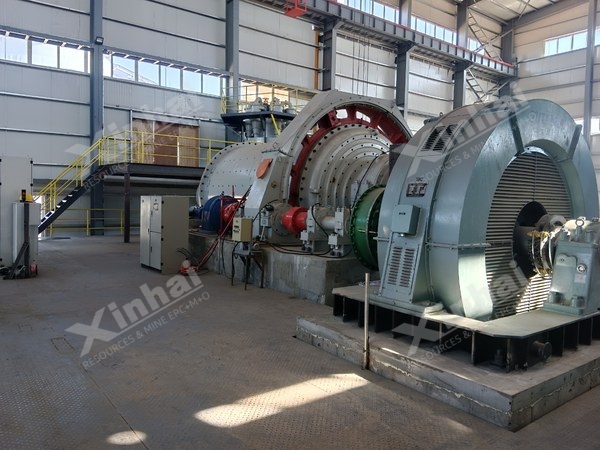
Ball mill and cyclone cluster at a Xinhai zinc plant in Mongolia
Flotation (a separation process that exploits differences in mineral surface chemistry) fails slowly and visibly — if you know where to look. For a copper-lead-zinc circuit, four items lead the list:
Impeller–stator clearance — beyond tolerance, air dispersion degrades and the froth lies about grade
Air delivery — blower curves and sparger blockage logs, not just "cells running"
Reagent scheme archives — collector and depressant changes made quietly under the previous operator
Middlings recycle loops — where selective separation between copper, lead and zinc is won or lost
Where records cannot be produced, treat the gap as a finding. A flotation train whose reagent history nobody can reconstruct will need a test program before it needs new machines.
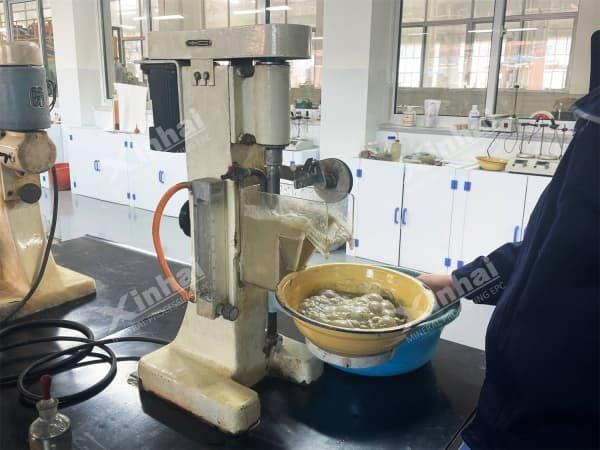
Batch flotation tests before any machine is bought
Hydrometallurgical zinc adds a section dry processing never has: leaching, solution purification and electrowinning. The inspection logic differs. Acid balance across the circuit, the disposal path for purification residues, and cell-house condition dominate — impurities like copper and cadmium that slip past purification show up directly in cathode quality. Public reporting does not detail Kazzinc's current configuration; buyers should expect the same three-question structure wherever a zinc plant sits in the package.
What does competent plant-level intervention look like on zinc? Xinhai's EPC contract for a 1,000t/d zinc flotation plant in Mongolia answers with execution facts. Site conditions: −30°C winters, water scarcity, and a deposit whose grades had matured downward.
The delivery moved seasonal construction around the climate — outdoor erection closed before winter, indoor installation and pipe work after heating. Tailings went to filtered dry stacking with a closed-circuit water system, recovering process water through thickeners and press filters. Two bolted thickeners, 15 m and 20 m in diameter, were the largest the company had installed on an EPC site to date. As of the latest project update, installation is complete and commissioning is underway.
The quiet signal: the same owner had contracted a 3,500t/d iron plant through Xinhai in 2018 and returned seven years later. Repeat orders are the only endorsement a plant builder can cite.
The grinding circuit. It carries the largest power bill in most concentrators, and its drift — worn liners, wrong media, shifted P80 — silently moves every number downstream. Fix the grind, and flotation and leach results read true again.
A walk-down shows what exists; records show how it got there. Liner change dates, reagent adjustments and trip histories explain whether a machine is near end-of-life or merely mis-run. Missing records are themselves a finding — they convert unknowns into testwork budget.
Solution purification and residue handling. Leaching and electrowinning look mechanical; purification chemistry is not. Copper and cadmium slipping past zinc dust cementation land straight in cathode quality, and purification residue disposal is a permit item, not a consumables line.
Not necessarily. Circuits run in parallel trains, so replacement proceeds train by train during planned maintenance windows — the sequencing that a cold-climate zinc site packs into its winter shutdown. Full-stop projects exist, but phased retrofit usually protects revenue while the work runs.
| Circuit | What to inspect | Records to demand |
| Grinding & classification | Liners, media charge, cyclone apex/vortex wear | P80 trend, kWh/t over 3 years |
| Flotation | Impeller–stator clearance, air system, middlings loops | Reagent scheme history, trip logs |
| Zinc leach & electrowinning | Acid balance, purification train, cell-house condition | Cathode quality trend, residue disposal permits |
Before any steel is ordered against an acquired plant, buy the data: sampling, testwork, a mass balance. The cheapest line in a modernisation budget is almost always the one spent before the other ninety percent.
 +86 13811510145