If you want to know more information (such as product/process price, etc.), please contact us 24-hour telephone
Uzbekistan's Navoi Mining and Metallurgical Company (NMMC) reported net profit of $2.38 billion for the first half of 2026, up 57% year on year, while the unit cost of an ounce of gold rose 41.5% to $1,647 (Daryo.uz, 5 October 2026). The company is still spending: its five-year plan targets 4 million ounces of gold a year by 2030, against roughly 3.1 million in 2024, with annual investment of up to $600 million.
At the centre of that programme sits Muruntau — the gold deposit with the largest resource base in the world — where a new ore processing complex rated at 30 million tonnes per annum (Mtpa) is part of the expansion, alongside open-pit pushbacks and two long conveyor lines under construction (NMMC; AK&M).
A cost line up 41% beside a profit line up 57% tells one story: at this gold price, scale and plant efficiency still win. What 30 Mtpa demands of grinding, leaching and tailings follows below.
NMMC's numbers explain the motive. Revenue reached $7.07 billion in H1 2026 (+49.9%) on gold output of 1.51 million ounces (-1.8%), with royalties taking 31% of costs. Output was flat; profit grew anyway. High gold price plus a rising cost base leaves an operator two levers: more tonnes, and better recovery per tonne.
The five-year answer is concrete: a 30 Mtpa processing complex at Muruntau, mine pushbacks, and conveyor lines 5 and 6 — 7.7 km combined — under construction in phase two of the fifth-stage programme, with equipment localised at Navoi machine works (NMMC).
Thirty million tonnes a year is roughly 82,000 tonnes of ore every day. Most gold plants in operation worldwide process between 1 and 5 Mtpa. A 30 Mtpa complex is not a bigger version of those plants — several stages change character at that scale.
| Plant scale | Ore per day | What changes |
| Typical 1–5 Mtpa gold plant | 3,000–14,000 t | Ball-mill circuits, standard CIL tanks, truck or belt haulage |
| Muruntau complex (planned) | ~82,000 t | SAG-class grinding, tank farms in rows, conveyor logistics, water balance becomes a design driver |
| Xinhai single-line capability ceiling | up to 50,000 t | Reference point for what one engineered line can carry |
One honest caveat: published reporting describes the 30 Mtpa figure as part of NMMC's investment programme. Confirm scope and schedule against company disclosures before building engineering assumptions on it.
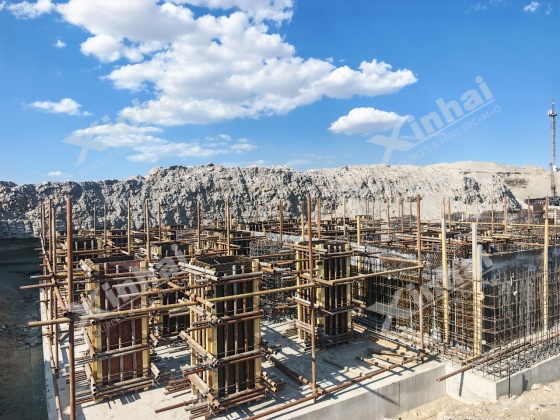
Comminution (the combined crushing and grinding of ore) typically owns the largest single electricity bill in a gold plant, and at 82,000 t/d the bill becomes the project. Plants at this scale move from ball-mill-only circuits to semiautogenous grinding (SAG) mills paired with ball mills: a SAG mill takes coarser feed, so fewer machines carry the throughput.
Two second-order effects follow. First, "more crushing, less grinding" — high-pressure grinding rolls before the mill train cut installed grinding power. Second, grind size decides everything downstream: gold liberation (how finely ore must be ground before gold is free to react) sets the P80 target, and at this volume a few microns either way move megawatts.
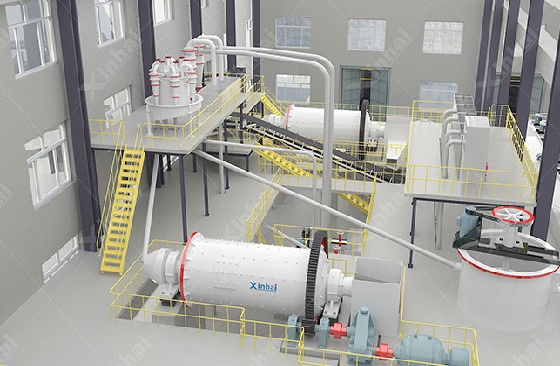
The cyanidation route itself does not change at scale — carbon-in-leach (CIL, where leach tanks also hold carbon that adsorbs dissolved gold) and carbon-in-pulp (CIP, leaching and adsorption in separate tanks) stay the workhorses. What changes is geometry: dozens of tanks in rows, carbon moved counter-currently between them, screening at every transfer point to protect pumps.
The stage that earns extra weight at Muruntau-class volumes is gravity recovery. Coarse free gold settles in long tank trains and escapes to tailings unless intercepted early; centrifugal concentrators ahead of the leach circuit pull that fraction out while it is still coarse. The larger the plant, the more expensive each lost gram becomes.
Almost everything that enters a gold plant leaves as tailings. A 30 Mtpa complex produces a tailings stream in the tens of millions of tonnes a year, and the tailings storage facility (TSF, an engineered impoundment for mine tailings) becomes a second plant beside the first — with its own thickening stage, pumps and permit file.
In Uzbekistan's climate the water balance is unforgiving. High-efficiency thickeners return a large share of process water directly, and filtration lifts recovery further — in dry-stack layouts, thickener recovery of 60–80% rises to 85–95% once filtered, cutting both dam risk and makeup water. Closed-circuit systems let arid-region plants grow without out-competing agriculture.
Xinhai has delivered into this country already: a 1 Mtpa tungsten tailings project in Uzbekistan moved into installation in July 2026, covering civil works through equipment setting under EPC+M+O (engineering, procurement and construction plus mine management and operation).
About 82,000 tonnes of ore a day on continuous operation. That is six to eight times the throughput of a typical gold plant, which usually runs between 1 and 5 Mtpa.
Brownfield expansion uses an existing permit envelope, workforce, power and water infrastructure, so each incremental tonne of capacity costs materially less than greenfield construction — and capacity can be added in phases matched to ore depletion.
By intercepting it before leaching. Gravity concentrators ahead of the cyanide circuit recover free gold while particles are still coarse; gold finer than the liberation size dissolves and carbon handles it. Long tank trains make late interception harder, so early gravity gains weight with scale.
Navoi Mining and Metallurgical Company (NMMC), Uzbekistan's state-majority gold producer, operates Muruntau in the Navoi region of central Uzbekistan. The deposit holds the largest gold resource base reported worldwide.
Scale is not a specification on a datasheet; it is a set of decisions repeated at every stage — grinding, carbon, water, tailings. The cheapest answers for an expansion come from testwork and a mass-balance study, long before steel is ordered.
 +86 13811510145