If you want to know more information (such as product/process price, etc.), please contact us 24-hour telephone
A gold wash plant and a chrome wash plant can look like the same building from the road. Scrubber, screen, spirals, a water sump. What separates them is not the equipment list. It is what the buyer does with the output.
Gold is sold on how much of it you recovered. Chrome concentrate is sold on its chemistry — how much Cr2O3, how high the Cr:Fe ratio, how low the silica. A chrome wash plant that chases recovery the way a gold plant does can run perfectly and still ship concentrate that a smelter will not take.
A gold wash plant is a capture problem. Free gold grains are already liberated; the plant's job is to catch them before they leave with the tailings. Recovery percentage is the score.
A chrome wash plant is a chemistry problem. Chromite arrives intergrown with serpentine and talc, and often coated in clay. The plant's job is to reject the silicate gangue and lift the ratio of chromium to iron. A plant can recover 90% of the chromium and still fail, because the concentrate carries too much silica or too much iron.
That single difference runs through every decision downstream of the scrubber.
The gravity equipment is nearly the same in both plants. Its role is not.
| Equipment | Particle range | Capacity | Concentrate Cr2O3 | Role in a chrome plant |
|---|---|---|---|---|
| Jig | 0.5–25 mm | 50–100 t/h | 40–45% | Coarse roughing at the head of the circuit |
| Spiral chute | 0.1–2 mm | 10–30 t/h | 42–47% | Middlings and scavenging |
| Shaking table | 0.02–0.5 mm | 1–5 t/h | 48–52% | Final cleaning to saleable grade |
In a gold plant, these devices are arranged to lose as little gold as possible. In a chrome plant, they are arranged to reach a grade. That is why a chrome circuit usually runs three stages of gravity — jig, then spiral, then table — rather than the single sluice that carries most alluvial gold.
The grade column above is the point. A jig concentrate at 40–45% Cr2O3 is not a saleable metallurgical product on its own. It becomes one only after cleaning on a table, or after magnetic separation.
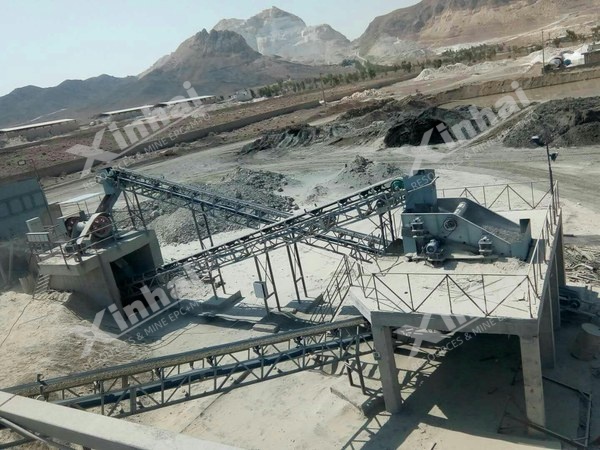
Screening and conveying ahead of gravity separation
Three habits carry over from gold and cost chrome operators money.
Optimising for recovery alone. Adding water, widening the screen, and pushing tonnage raises chromium recovery, but it also drags silicate into the concentrate. The result is more tonnes of a lower-grade product that has to be sold at a discount, or blended.
Assuming liberation is already done. Alluvial gold is free. Chromite in hard rock and in weathered bedrock is often locked with gangue, and a wash plant cannot break that lock. Without a grind, the locked fraction simply reports to tailings.
Treating the tailings as finished. Chrome tailings frequently carry recoverable chromite, and in some deposits platinum-group metals as well. A wash plant that discharges straight to a pond writes that value off.
Clay is a problem for both plants, but it hurts chrome differently.
In a gold plant, a clay coating hides a gold grain from the sluice. In a chrome plant, clay does that and one more thing: it carries fine chromite into the overflow as a slime, and it blinds the spiral troughs so the separation inside them degrades. Weathered chromite ore — the kind most wash plants are built for — is exactly where clay content is highest.
A drum scrubber or an agitator washer breaks the clay before sizing. The check is simple: look at the screen oversize for mud smears, and watch whether the wash water turns cloudy soon after start-up. Either sign means the scrubbing stage is undersized, or missing.
A South African chrome concentrator shows what happens when the goal shifts from recovery to spec. The plant ran 360,000 t/y on gravity, and the concentrate had drifted below the metallurgical specification as the ore changed.
Xinhai rebuilt the circuit around high-intensity magnetic separation, using a vertical ring separator in roughing, cleaning and scavenging with the scavenger concentrate returned to the cleaner. Capacity went to 480,000 t/y, concentrate grade rose by more than 20%, and moisture came out below 15%. The magnetic tailings were then reground and floated to recover platinum and palladium, a stream the original gravity-only circuit discarded.
The magnetic stage is what a gold-derived wash plant usually lacks. Gravity separates by density; it cannot strip the iron-bearing minerals that hold the Cr:Fe ratio down. Magnetics can.
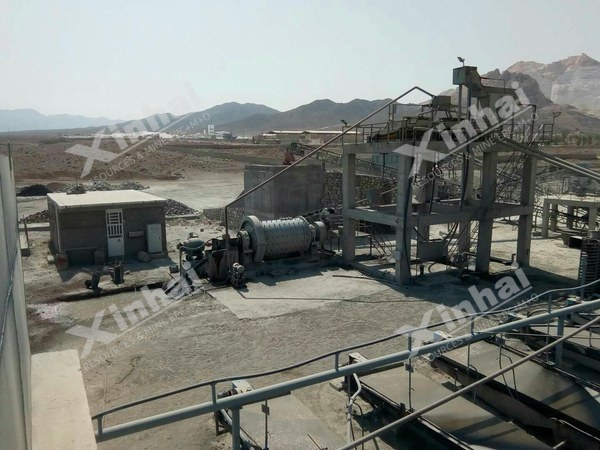
Ball mill and plant structure at the chromite site
It is a water-based circuit for weathered or alluvial chromite: scrubbing, screening and gravity concentration, usually followed by magnetic separation, built to raise Cr2O3 content and the Cr:Fe ratio to a saleable level.
The equipment can, but the circuit usually cannot. A gold layout is tuned for recovery and stops after gravity, which rarely reaches metallurgical chrome specifications without a magnetic stage.
It depends on the deposit and the mining rate rather than on a standard size. Small operations run tens of tonnes per hour; larger alluvial and weathered deposits run several hundred.
Clay coats fine chromite and blinds spiral troughs. Without scrubbing, that chromite leaves as slime and the downstream gravity stages work on a dirtier feed than they were designed for.
A wash plant is a means, not a goal. What matters is the concentrate that leaves the gate.
At Xinhai, we believe a chrome plant should be designed backwards from the buyer's assay.
Share your chrome project with us. Let's start from the concentrate you need to ship.
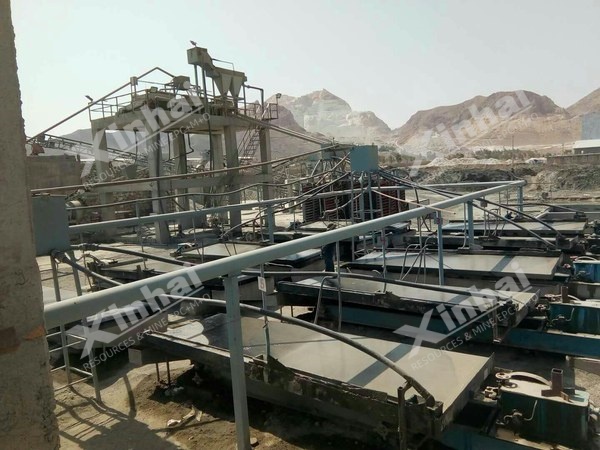
Shaking tables at a chromite plant
Sources
Chromite density around 4.2–4.8 g/cm3 against silicate gangue at about 2.6 g/cm³; jig, spiral chute and shaking table particle ranges, capacities and typical concentrate grades (jig 40–45% Cr2O3, spiral 42–47%, table 48–52%) — Xinhai documentation on chrome gravity separation as published on drytailingmachine.com.
The five-stage structure of a wash plant (feed sizing, screening, scrubbing, gravity recovery, water and tailings) — Xinhai article on gold wash plant setup, October 2026. Used here as the reference the chrome circuit departs from.
South African chrome concentrator upgrade (360,000 t/y to 480,000 t/y with high-intensity magnetic separation, concentrate grade up more than 20%, moisture below 15%, magnetic tailings reground and floated for platinum and palladium) — Xinhai project records.
Chromite concentrate specifications referenced for the metallurgical grade — published trade specifications, indicative and subject to contract.
Plant photographs are from Xinhai's 300 t/d chromite gravity project in Iran, supplied as a reference circuit. The South African case described in the text used a magnetic circuit, not the gravity layout shown.
 +86 13811510145
