If you want to know more information (such as product/process price, etc.), please contact us 24-hour telephone
A number crossed the news on 25 September: at the first China–Kazakhstan Investment Forum in Almaty, the two sides confirmed that Chinese investment in Kazakhstan now exceeds $29 billion, and President Tokayev named mining and metallurgy among the priority sectors for further cooperation (Chinese Embassy in Kazakhstan; Sohu, 29 September 2026).
The forum also attached names to the money. Xinfa Group intends to develop the Koljhat deposit on a comprehensive basis; a gold processing plant at Gagarinskoye with 1 million tonnes per annum (Mtpa) of capacity is on the list; Yonggang Group plans a $1.2 billion steel plant (Sohu, 29 September 2026).
For plant owners and equipment buyers, the useful question is not the headline total. It is which processing plants are actually moving, and what each build requires.
The Almaty forum was the first of its kind between the two countries. Beyond confirming the $29 billion cumulative figure, it put mining and metallurgy in the priority tier of cooperation — alongside the named projects a gold plant, a deposit development and a steel mill (Chinese Embassy in Kazakhstan; Sohu, 29 September 2026).
Read as a signal rather than a contract, the forum matters for one reason: it names processing capacity, not only extraction. When capital moves from exporting raw ore toward plants built in-country, the demand that follows is for testwork, design, equipment and construction.
Four projects with processing at their centre are moving in Kazakhstan right now. Three were named at the forum; the fourth was already under construction and has since changed hands:
| Project | Focus | Scale | Status |
| Gagarinskoye gold plant | Gold processing | 1 Mtpa | Named at the forum |
| Koljhat deposit (Xinfa Group) | Comprehensive development | Not stated | Intended |
| Yonggang steel plant | Steel | $1.2 billion | Planned |
| Raygorodok plant (Zijin) | Gold processing | 10 Mtpa, $600M+ | Under construction |
Sources: Chinese Embassy in Kazakhstan and Sohu (29 September 2026) for the forum projects; Zijin Mining's completion announcement for Raygorodok.
A processing plant of pipeline scale is delivered as a chain, and the order of the chain is fixed:
Metallurgical testwork — laboratory and pilot testing that fixes the flowsheet and design parameters for the specific ore
Design — process flowsheet, equipment selection and construction drawings
Equipment — manufacturing, procurement and shipment of the full plant
Construction — civil works, steel structure, mechanical installation
Commissioning and handover — process commissioning, training and ramp-up support
The first link decides the rest. A flowsheet fixed by testwork rather than by assumption is what keeps recovery targets, reagent consumption and equipment sizing honest — the alternative is designing by guess. Under an EPC+M+O model (an integrated delivery model covering engineering, procurement, construction, plus mine management and operation), one team carries the chain end to end, so the testwork conclusions flow into design without handover loss.
Kazakhstan's construction calendar is shorter than the map suggests. Winters freeze the civil-works season, so the usable window within a year is limited, and the schedule is built backwards from it.
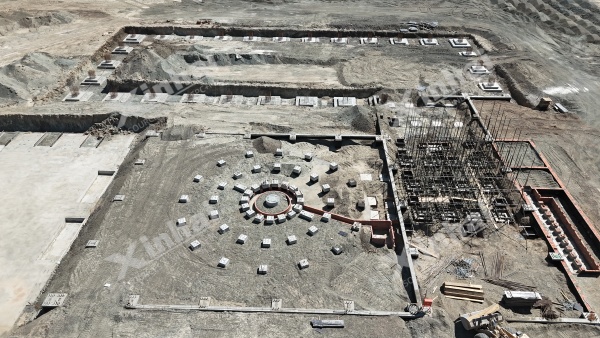
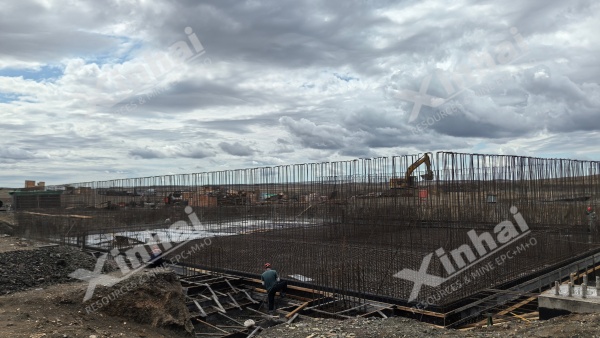
What that pace looks like in practice can be seen on Xinhai's 1.5 Mtpa copper flotation EPC site in the country: within roughly the first 50 days of the works, about 15,000 m³ of earthwork, 260 tonnes of rebar and 2,700 m³ of concrete were placed, with a site team of around 100 people (project progress report, August 2026). Winter, not willingness, sets the deadline on such sites.
Logistics and local employment rules add their own constraints — cross-border equipment shipments and local-content expectations shape both the procurement plan and the staffing plan before ground is broken.
The same copper project shows what a completed chain looks like in Kazakhstan. Design feed for the plant averages about 0.86% Cu, with a target concentrate grade of 22% Cu at 90% recovery. The testwork behind it — a 2025 sulfide flotation programme — ground the sample to 50% passing 200 mesh and ran one roughing, two scavenging and three cleaning stages, producing a 22.07% Cu concentrate at 90.09% recovery. These results apply only to the submitted sample and should not be read as guaranteed plant performance.
For a gold plant in the same country, the practical meaning is narrower and more useful: a team that has already worked through Kazakhstan's logistics, winter scheduling and compliance does not start from zero.
The forum confirmed that Chinese investment in Kazakhstan exceeds $29 billion and named mining and metallurgy a priority sector, with a 1 Mtpa gold plant at Gagarinskoye, the Koljhat deposit development and a $1.2 billion steel plant on the project list (Chinese Embassy in Kazakhstan; Sohu, 29 September 2026).
The plant is listed at 1 million tonnes per annum of processing capacity. At pipeline scale this puts it in the mid-range of the country's current builds — Raygorodok, for comparison, is a 10 Mtpa plant under construction with over $600 million invested.
Winter sets the pace: the civil-works window within a year is short, so large plants are multi-year builds. On Xinhai's 1.5 Mtpa copper site, about 15,000 m³ of earthwork and 2,700 m³ of concrete went in within roughly the first 50 days — the schedule then bends around the cold months.
It covers engineering, procurement and construction, plus mine management and operation — from testwork and flowsheet design through equipment supply, installation, commissioning and onward into production management, under one responsible team.
For anyone holding a project on this pipeline, the first working step is the same: a testwork programme on the actual ore, before any flowsheet is fixed. Xinhai Mining runs such programmes as the entry point of its EPC+M+O services.
 +86 13811510145