If you want to know more information (such as product/process price, etc.), please contact us 24-hour telephone
A 10 Mtpa gold processing plant is not built by pouring concrete first. Zijin Mining's new plant at the Raygorodok mine in Kazakhstan's Akmola region — over $600M invested, 10 Mtpa throughput, gold output rising from 6 to 12+ tonnes a year — shows where Central Asia's gold sector is heading (Kazakhstan Invest / Seetao, 28 September 2026).
Kazakhstan plans about $470M in exploration for 2026–2028, and neighbouring Uzbekistan is bundling gold mines into a 1,000-person cluster. The money is moving; the real question for any owner is what the plant behind it should look like.
The answer starts with the flowsheet. A CIL or CIP route, fixed before steel is ordered, decides recovery, grade and tailings-permit approval.
Central Asia's gold development has shifted from single mines to larger, integrated plants. Raygorodok's 10 Mtpa scale and its jump from 6 to 12+ tonnes of gold a year mark that shift. A 10 Mtpa plant is a multi-year, full-industry-chain engagement — testwork, design, build, commission, operate.
The upstream signal is clear: Kazakhstan's 2026–2028 exploration spend equals its past two decades combined, focused on gold, copper, rare earths and uranium. New deposits become plants needing flowsheets, equipment and crews.
Oxide ore suits CIL/CIP directly; sulfide or refractory ore — gold locked in sulfide, often with carbon or arsenic — needs flotation and sometimes roasting or bacterial oxidation first. Picking the route from a press release, not a sample, is how projects miss recovery targets.
That is why metallurgical testwork (laboratory and pilot testing that fixes the flowsheet and design parameters for a specific ore) comes first. A sample is checked for head grade, gold association and liberation size — how finely it must be ground before gold is free. The result sets grind size, reagent scheme and circuit layout before any equipment is ordered.
For leachable gold, the CIL/CIP flowsheet runs through a fixed sequence:
Crushing and grinding — ore is crushed, then ground in SAG and ball mills to liberation size (often P80 75–150 µm for gold).
Gravity concentration — a centrifugal concentrator recovers coarse free gold before leaching, protecting it from loss.
Leaching and adsorption — in CIL, leach tanks also hold carbon that adsorbs dissolved gold; in CIP the two run in separate tanks, counter-currently.
Desorption and electrowinning — gold is stripped from loaded carbon and plated onto cathodes.
Smelting — the cathode sludge is melted into doré bullion.
Tailings — barren slurry goes to a tailings storage facility, often dewatered for dry stacking.
CIL and CIP differ mainly in tank configuration: CIL suits straightforward ores, while CIP separates leaching from adsorption where carbon would load with gangue.
| Criterion | CIL | CIP |
|---|---|---|
| When to use | Leachable oxide gold, clean slurry | Ores where carbon loads unwanted material |
| Tank setup | Leach + adsorption in same tanks | Leach tanks separate from adsorption tanks |
| Carbon handling | Fewer tanks, simpler flow | More tanks, flexible |
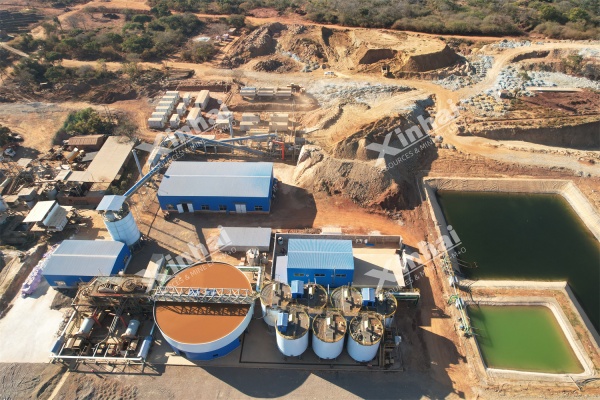
An EPC+M+O approach (an integrated model covering engineering, procurement, construction, plus mine management and operation) puts one team on testwork, design, equipment manufacturing, installation, commissioning and operation.
Xinhai has delivered gold plants from 1,000 t/d in Mongolia to 6,000 t/d in Guinea, and is building a 1.5 Mtpa copper flotation plant in Kazakhstan under EPC. That track record matters for a gold plant in the same country.
| Project | Scale | Role | Status |
| Mongolia gold mine | 1,000 t/d | EPC delivery | Delivered |
| Guinea gold plant | 6,000 t/d | EPC delivery | Delivered |
| Kazakhstan copper flotation | 1.5 Mtpa | EPC (engineering to commissioning) | Under construction, 2026 |
The common thread: testwork fixes the flowsheet, then one organisation carries design, equipment, installation and commissioning to operation. See our gold CIL/CIP processing approach and EPC+M+O model.
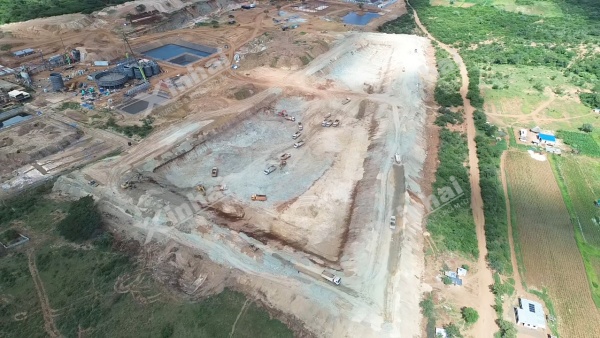
Gold plants produce far more tailings than bullion. A 10 Mtpa plant discharges several million tonnes of barren slurry a year; a tailings storage facility is now a permit condition. In Kazakhstan's cold, water-scarce interior, dry stacking and closed-circuit water recovery matter more than elsewhere.
Dewatering and thickening (removing water from slurry to produce a handleable product) can return 60–80% of process water at the thickener and 85–95% after filtration, cutting both dam risk and makeup-water demand. Design the TSF with the plant, not after it — see our tailings treatment and gold tailings dry stacking guidance.
Both dissolve gold and capture it on activated carbon. CIL leaches and adsorbs in the same tanks; CIP leaches first, then pumps slurry to separate adsorption tanks. CIP suits ores where carbon would load with gangue.
Head-grade and gold-association analysis, grind-liberation tests, and bottle or carbon-in-leach tests to set reagent dose and residence time. These fix grind size, circuit type and recovery before equipment is ordered. Testwork is cheaper than rework.
It scales with capacity and ore complexity. A 1,000 t/d plant can run on a 12–18 month programme covering design, equipment, installation and commissioning; a 10 Mtpa plant is a multi-year build with a long procurement phase.
Cold climate and limited water make dry stacking and water recovery practical necessities, not options. A tailings storage facility is a permit condition, and its design shapes mine-life compliance and cost. Plan it with the plant.
If you are planning or upgrading a gold processing plant in Central Asia, we can take the flowsheet question from sampling to commissioning.
At Xinhai, we believe the plant should be built around the ore, not the other way around.
Share your gold project with us — let's fix the flowsheet before steel is ordered.
 +86 13811510145