If you want to know more information (such as product/process price, etc.), please contact us 24-hour telephone
Most gold mine owners share the same troubles:
Low gold recovery rate causes massive loss of valuable metals.
Complex ore composition makes it hard to choose between gravity separation, leaching, or flotation.
Blind process copying and random equipment matching lead to high upfront investment without high-grade gold concentrate output.
Planning to build a processing plant, yet worrying about wrong process and equipment selection, resulting in rework losses and operational dilemmas.
In fact, gold processing is not complicated. Gold ores from different mining areas vary greatly in ore properties and gold dissemination characteristics. A single process can hardly achieve ideal recovery results. The combined process of gravity separation + leaching + flotation is a mature solution suitable for most gold mines.
This article elaborates on the complete processing logic, full workflow, and standard equipment configuration. You can follow proven practical experience to avoid detours and unnecessary investment waste.
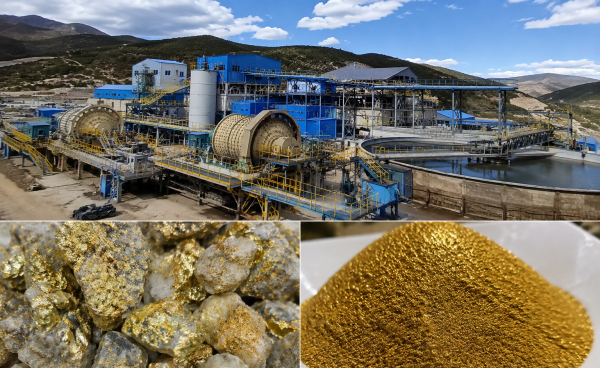
Many mine owners make the mistake of copying a single processing flow from other mines. However, primary gold ore, oxidized gold ore, and polymetallic associated gold ore differ completely in ore structure and gold occurrence form.
Coarse free gold: Best recovered by gravity separation
Fine and encapsulated gold: Leaching delivers better gold extraction performance
Sulfide-associated ore: Flotation is adopted first for enrichment and impurity removal
These three technologies are not mutually exclusive, but complementary:
Gravity separation recovers coarse free gold, flotation realizes mineral enrichment and impurity removal, and leaching recovers fine refractory gold. The coordinated application maximizes gold recovery while stabilizing concentrate grade and overall economic benefits.
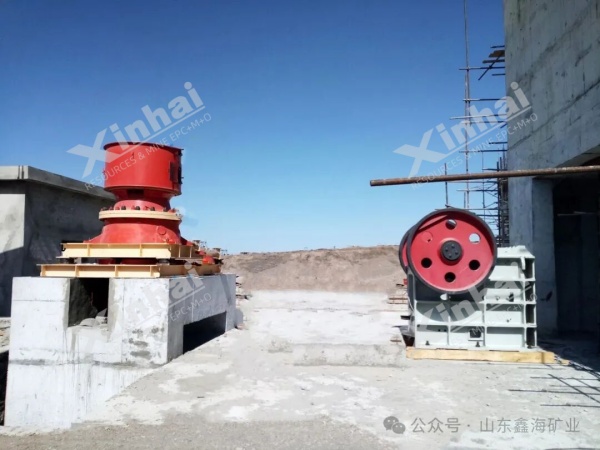
Run-of-mine gold ore is firstly coarsely crushed by a jaw crusher, then medium and finely crushed by a cone crusher to a proper particle size, meeting the feed requirement of subsequent grinding.
Screening equipment is selected according to on-site conditions:
Ore with high mud and moisture content: Adopt a drum screen with an additional ore washing operation
Clean ore with low moisture: A circular vibrating screen is preferred for stable operation and lower investment
Proper pre-treatment avoids interference from mud and impurities on subsequent gravity separation, flotation, and leaching effects.
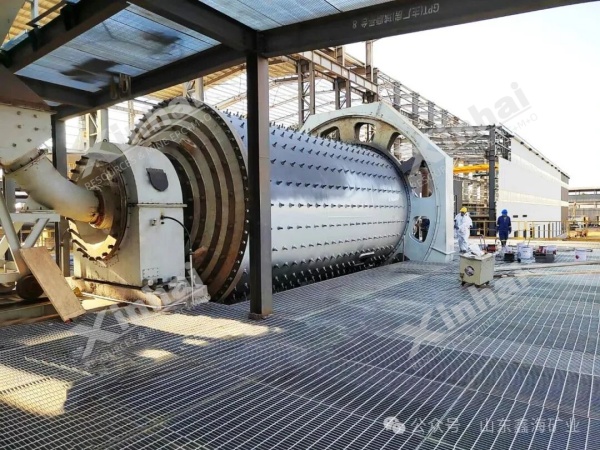
Crushed ore is sent to a ball mill for grinding. Single-stage or two-stage grinding is selected according to fineness requirements. A closed-circuit system is formed with a spiral classifier and a hydrocyclone. Coarse particles are returned for regrinding, while qualified fine particles are delivered to the next separation process.
Reasonable grinding fineness fully liberates monomer gold. Without qualified grinding performance, even mature gravity separation, flotation, and leaching processes cannot improve the recovery rate effectively.
Gravity separation realizes mineral separation by density difference, featuring low operating cost, low reagent consumption, and environmental friendliness. It is the optimal choice for coarse native gold.
Common equipment: Centrifugal concentrator, shaking table, spiral chute, jig machine.
It is widely applicable to vein quartz gold ore and placer gold ore with coarse disseminated structure. It recovers most coarse gold in advance and reduces the production load of subsequent flotation and leaching.
For polymetallic associated gold ore, such as pyrite and chalcopyrite, flotation is applied to enrich gold-bearing sulfide minerals.
By reasonably configuring collectors, frothers, and regulators, gangue impurities are effectively separated to produce high-grade gold concentrate. Harmful impurities are removed in advance to lay a solid foundation for subsequent leaching operations.
After gravity separation and flotation, fine encapsulated gold and low-grade oxidized gold are still difficult to recycle, where the leaching process is required.
Qualified leaching reagents dissolve gold-bearing minerals, and finished gold is extracted via displacement, electrolysis, and smelting. It makes full use of resources that cannot be recovered by conventional processes and improves overall resource utilization.
Complete supporting equipment for a standard gold concentrator:
Crushing & Screening: Jaw Crusher, Cone Crusher, Circular Vibrating Screen, Drum Screen
Grinding & Classification: Ball Mill, Spiral Classifier, Hydrocyclone
Gravity Separation: Centrifugal Concentrator, Shaking Table, Spiral Chute, Jig Machine
Flotation: Flotation Machine, Agitator Tank
Leaching System: Leaching Tank, Thickener, Displacement & Tailings Treatment Equipment
There is no need for excessive equipment stacking. Matching equipment properly according to ore type, production capacity, and investment budget achieves cost savings and high efficiency.
Gold mines differ greatly in ore structure, associated impurities, and gold dissemination grain size. A process suitable for other mines may not fit your own ore characteristics.
It is essential to conduct mineral processing tests before plant construction and equipment ordering. Professional ore testing determines the optimal combination scheme, reagent regime, and workflow of gravity separation, flotation, and leaching. It fundamentally avoids mismatched processes, substandard technical indicators, and rework losses after commissioning.
With years of experience in gold mineral processing and complete qualification for mine engineering design and EPC general contracting, Xinhai provides integrated EPC services including mineral testing, process design, customized equipment, installation & commissioning, and operation management in accordance with domestic and international standards.
We never apply generic process templates. Customized combined schemes of gravity separation, leaching, and flotation are formulated based on actual ore properties, production planning, and investment budget, ensuring stable gold recovery, controllable production cost, and reliable return on investment.
The core of professional gold processing lies in four key points: selecting a matched combined process, stabilizing grinding fineness, configuring suitable equipment, and conducting mineral processing tests before production.
Gravity separation recovers coarse gold, flotation realizes mineral enrichment, and leaching supplements fine gold recovery. Scientific coordination makes full use of gold resources and steadily maintains the concentrate grade and recovery rate.
A mature processing scheme is far better than blind repeated investment; properly configured professional equipment saves years of inefficient trial operation costs.
If you hold gold ore resources and are troubled by low gold recovery, uncertain process selection, improper equipment configuration, and investment risks in plant construction, feel free to contact Xinhai.
We provide professional ore assay, process planning, equipment selection suggestions, and cost estimation. With rich practical project experience, we help you build a qualified processing plant, improve concentrate grade, and achieve long-term stable profitability.
 +86 13811510145