If you want to know more information (such as product/process price, etc.), please contact us 24-hour telephone
Three things pick the route. How much tailings the plant makes. Which forms of cyanide the stream carries. What reagent the site can get. Chlorination, SO2/air and peroxide all destroy cyanide. They do not cost the same, and they do not suit the same plant.
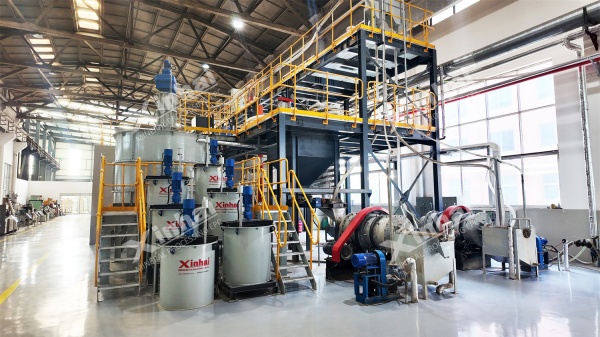
Pilot cyanidation circuit, Xinhai test centre.
Start with tonnage. A 2,000 t/d plant needs a continuous circuit. A 120 t/d plant can run batch tanks.
Then characterise the cyanide. Free cyanide oxidises easily. Weak acid dissociable complexes take more reagent. Thiocyanate and iron cyanides resist most routes.
Last, check reagent supply. Chlorination needs hypochlorite delivered and stored. SO2/air needs sulphur dioxide, metabisulphite or elemental sulphur. Peroxide needs H2O2 in drums.
| Route | Reagent | pH window | Handles | Main constraint |
|---|---|---|---|---|
| Chlorination | Hypochlorite (bleach) | Alkaline, two stages | Free and WAD cyanide | Chlorine lost to thiocyanate and sulphides |
| SO2/air | SO2 or metabisulphite, Cu catalyst | 8 to 9 | Free, WAD and some complexes | Copper catalyst and air supply |
| Peroxide | H2O2, Cu catalyst | Alkaline | Free and WAD cyanide | Reagent cost per tonne |
| Natural breakdown | None | Not applicable | Slowly, in a pond | Time, sun, storage volume |
Hypochlorite oxidises cyanide in two stages. The first turns CN- into cyanate, CNO-. That product is far less toxic than cyanide. The second stage drives cyanate further, to nitrogen and carbon dioxide.
Each stage has its own setpoint. The first runs strongly alkaline and stops at a set oxidation potential. The second runs closer to neutral and needs a higher potential. Both are held by dosing against a meter reading.
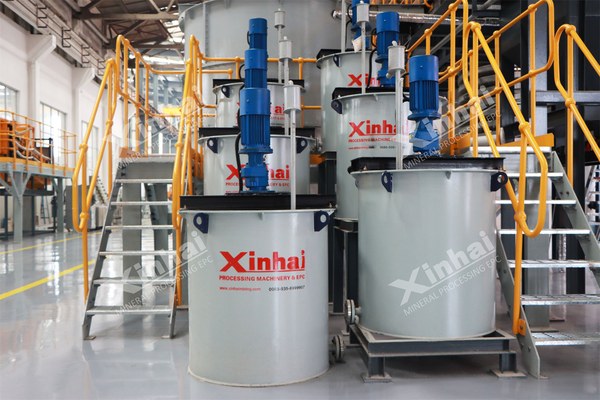
Double-impeller agitated tanks, pilot centre.
A 120 t/d gold tailings project in Mongolia runs this route. Tailings leave the cyanide leach at about 20% moisture and 400 ppm cyanide. A belt feeds them to a high-shear conditioner, where bleach and return water go in.
The pulp flows to a second agitated tank to finish the reaction. A pump sends it to a plate-and-frame press. Cake leaves by truck. Filtrate returns to the first conditioner for reuse.
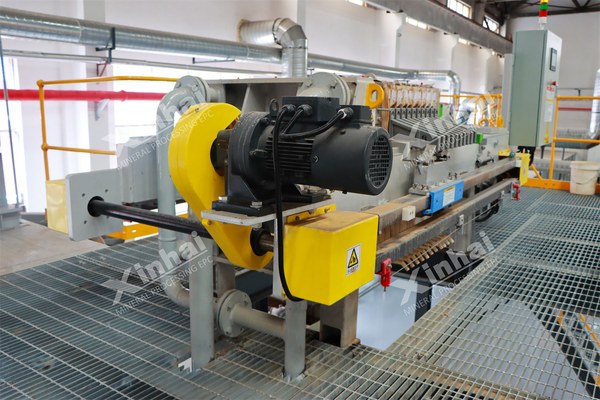
Automatic chamber filter press, pilot circuit.
That layout is the point. Two tanks, one press, and the filtrate closes back on itself. No new water is drawn to dilute the pulp.
The weakness is reagent. Chlorine reacts with thiocyanate and with sulphide minerals as well as cyanide. A stream carrying either burns more bleach per tonne of cyanide destroyed.
SO2 and air, with a copper catalyst, oxidise cyanide to cyanate at pH 8 to 9. Lime holds the pH, and the acid formed in the reaction is what makes that control necessary.
The published results are consistent. At a gold project in Nova Scotia, the circuit took tailings above 160 ppm cyanide down to under 1.0 ppm weak acid dissociable cyanide. Retention was under 90 minutes.
Sodium metabisulphite is the usual way to carry the SO2. It ships as a white salt and dissolves on site. Copper sulphate supplies the catalyst. Lime holds the pH. A smelter or sulphur burner nearby makes SO2 gas the cheaper source at scale.
This route suits tonnage. Reagent cost per tonne of cyanide is lower than chlorination, and it removes weak acid dissociable complexes as well as free cyanide. Treated effluent from these circuits typically runs below 1 ppm total cyanide.
The trade-off is infrastructure. SO2 supply, air blowers, copper dosing and lime addition all have to run together. Lose one and the reaction stalls.
Hydrogen peroxide destroys cyanide without adding chlorine. That removes the residual chlorine problem entirely. No dechlorination step, no chlorine discharge limit to meet.
Performance depends on the same variables as the other two. Cyanide species, dose, pH and catalyst all move the result. Copper-catalysed peroxide works faster than uncatalysed.
The constraint is cost. H2O2 carries more value per tonne than bleach, and side reactions in a real pulp consume part of it. This route fits plants where chlorine discharge is the binding limit.
A slurry is not a clear solution. The solids buffer the pulp. Part of the cyanide sits in complexes, not free in solution.
That is why published pH windows differ between studies. One laboratory study on Muteh tailings water removed 270 mg/L cyanide completely at pH 12.3. The SO2/air projects above ran at pH 8 to 9.
Different reagents, different chemistry, different setpoint. Neither number transfers to a new ore without a test.
One rule does transfer. Below about pH 9.5, cyanide leaves solution as hydrogen cyanide gas. Any circuit needs the pH held above that line, and needs gas detection where operators work.
Reagent is priced per kilogram of cyanide destroyed, and that figure comes from speciation, not from the total cyanide number.
Free cyanide is the cheapest fraction. Each molecule takes a known dose.
Weak acid dissociable complexes cost more. The metal has to be released before the cyanide can be oxidised, so the circuit carries extra reagent for the same tonnage.
Thiocyanate and iron cyanides are the expensive ones. Chlorination barely touches iron cyanide. SO2/air reduces iron from ferric to ferrous and precipitates it, which is why this route handles a wider range.
A plant that sizes its circuit from total cyanide will under-dose. Total cyanide includes fractions no route can destroy quickly.
Four results decide the route and the dose.
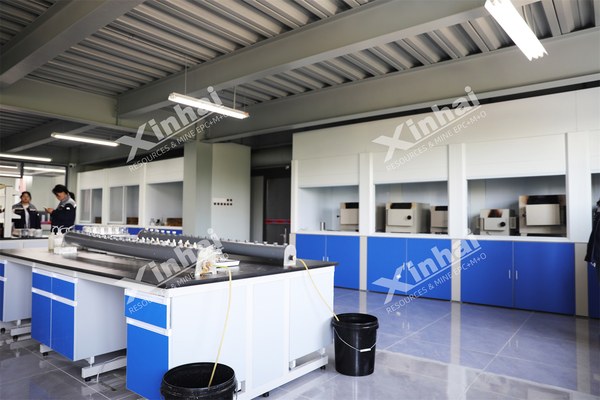
Cyanide speciation work starts in the lab.
A speciation analysis splits total cyanide into free, weak acid dissociable and strong complexes. That tells you which route can work at all.
A dose curve on the actual pulp gives reagent per tonne at the target residual. Run it at the pH the circuit will hold, not at a laboratory default.
A pH and oxidation potential check confirms the two setpoints can be held in the plant's tanks. Agitation and residence time both affect that.
A residual oxidant test covers the last step. Excess chlorine or peroxide has to be neutralised before discharge, and that cost belongs in the model.
| Test | What it answers | Feeds which decision |
|---|---|---|
| Speciation analysis | Free, WAD, thiocyanate, iron cyanide | Route shortlist |
| Dose curve | Reagent per tonne at target residual | Operating cost |
| pH and ORP check | Whether setpoints hold in the tank | Tank count, agitation |
| Residual oxidant test | Neutralisation dose | Discharge compliance |
SO2/air dominates large continuous plants. It handles free and weak acid dissociable cyanide at lower reagent cost. Chlorination holds the small and batch end, where a plant runs intermittent shifts and bleach is easier to supply.
Partly, and slowly. Sunlight, volatilisation and microbial action all work on it. That needs freeboard, retention time and a climate that cooperates. It does not replace in-plant treatment where a permit sets a discharge limit.
Below about pH 9.5 cyanide leaves solution as hydrogen cyanide gas. That is a safety event, not a compliance miss. Dosing more reagent at low pH adds cost and raises the hazard at the same time.
No. It depends on the permit and where the tailings go. A gold plant in Laos sends its leach tailings through a press to a dry stack with no destruction stage. The same plant under a different permit would need one.
The route follows the stream, not the metal. Speciation first, then dose, then the tank layout.
Send a tailings sample with a speciation analysis, and our process team will size the circuit those results support.
Sources
Nova Scotia Environment. Environmental Assessment Registration Document, Touquoy Gold Project. SO2/air destruction circuit, 160 ppm to under 1.0 ppm CN WAD in under 90 minutes. novascotia.ca
Khodadad A., Teimoury P., Abdolahi M., Samiee A. (2008). Detoxification of cyanide in a gold processing plant tailings water using calcium and sodium hypochlorite. Mine Water and the Environment 27(1), 52-55. doi.org
Canadian Mining Journal. INCO R and D: process development, product development and cyanide destruction. SO2 carriers, copper catalysis, effluent below 1 ppm total cyanide. canadianminingjournal.com
Xinhai project record, 120 t/d gold tailings cyanide destruction, Mongolia, 2018. Feed 400 ppm at 20% moisture, two-stage bleach, filter press, filtrate recycled to the first tank.
 +86 13811510145
