If you want to know more information (such as product/process price, etc.), please contact us 24-hour telephone
A gold plant at 3,500 m is not a sea-level plant with a different postcode. Thin air, hard cold and a short construction season change the grinding duty, the flotation circuit and the calendar at once.
Kyrgyzstan's Altyn-Tor gold plant entered production in September 2026 at the Solton-Sary deposit in Naryn Region, at 3,500–3,600 m. Its scope explicitly includes processing historical stockpiled tailings and waste rock alongside fresh ore. Investment reached $34.2 million by the end of August, and the operation is run by Avelum Partner (Deccan Gold, 65%) with the state company Kyrgyzaltyn (35%). Refined gold must be sold to Kyrgyzaltyn and cannot be exported independently.
The project stacks two hard problems in one flowsheet: altitude, and a feed that is partly old tailings rather than freshly mined ore.
Altitude is usually treated as a site condition to be managed during construction. In practice it reaches into the flowsheet.
Air is thinner, so every duty that depends on gas volume loses capacity: flotation aeration, pneumatic conveying, and the combustion side of any thermal duty. Lower atmospheric pressure also lowers the boiling point, which matters wherever a process relies on evaporation.
A circuit sized at sea level will not deliver nameplate throughput at 3,500 m without derating and re-checking.
The table below groups the effects that most often force a redesign.
| Factor | Effect on the plant | Design response |
| Reduced air density | Flotation aeration and pneumatic duties lose capacity | Re-rate blowers and cells against site conditions |
| Lower boiling point | Evaporation and slurry temperature control shift | Enclose and heat where the process depends on temperature |
| Cold and wind | Freezing in pipes, slurry lines and water systems | Move thickeners and water tanks indoors |
| Short construction season | Outdoor work must finish before the cold sets in | Sequence installation against the calendar |
Equipment selection cannot be copied from a sea-level plant, and the construction plan becomes a design input: if outdoor installation misses the cold season, the project loses a year.
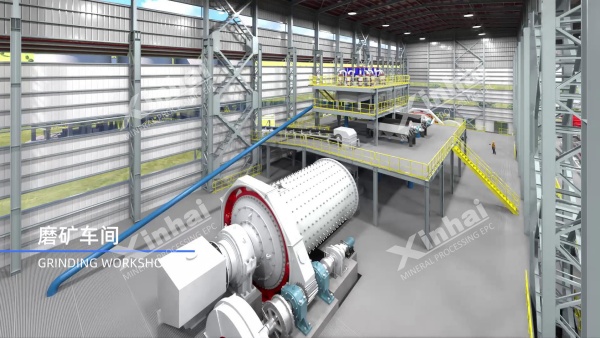
Cold-region projects are usually defeated by the schedule rather than the process. Xinhai's 1,000 t/d zinc flotation plant in Mongolia illustrates the pattern. Winter temperatures there drop below minus 30 degrees Celsius, so from the design stage the large thickeners and water tanks were placed inside the main workshop, where heating holds the indoor temperature at around 3 to 4 degrees Celsius.
The installation sequence followed the weather. Shipments began in August 2025 and the team mobilised on 22 September. The first phase ran to 22 November, during which the crew grew from 9 to 20 people in four work groups; all outdoor installation was completed before the November cold and high winds. Once heating was commissioned at the end of December, a 14-person team returned for a four-month indoor phase covering the 15 m and 20 m thickeners, piping, reagent preparation and automatic control.
That plant also used the first large-diameter bolted thickeners Xinhai manufactured. The units are assembled and seal-tested at the factory, then bolted together on site, which avoids on-site welding in bad weather and cuts transport cost.
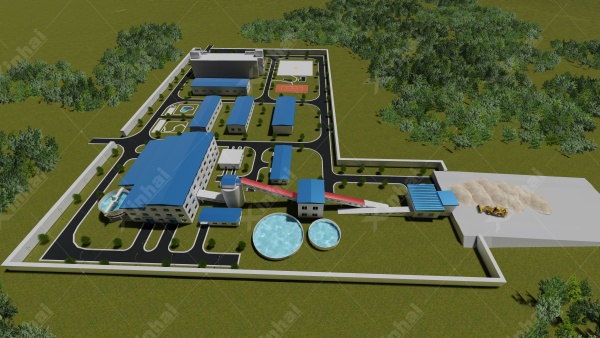
Processing historical tailings alongside fresh ore changes what the testwork must answer. A stockpile is not a deposit: it was placed by an earlier operation, often with variable recovery, so grade and mineralogy vary horizontally and with depth, and the fine fraction may have oxidised.
Three things follow. Sampling: a stockpile must be sampled as a three-dimensional body, not by a few surface pits. Blending: if the material varies more than the plant can absorb, the design needs a blending strategy rather than a wider operating window. Metallurgy: the flowsheet for a tailings stream is set by tests on that stream, because the minerals that survived the first pass are by definition the harder ones to recover.
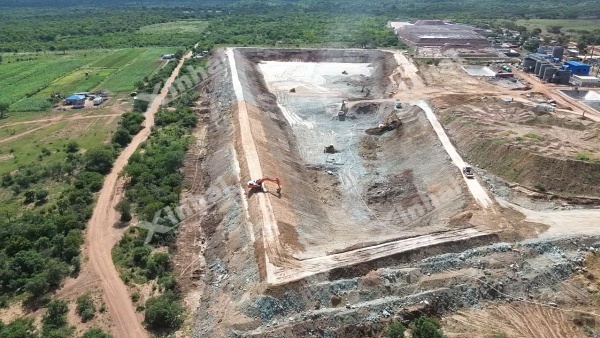
Four choices recur in high-altitude and cold-region plants.
Enclosure over exposure: putting thickeners, water tanks and reagent preparation inside a heated building removes a class of winter failure.
Bolted over welded: factory-assembled bolted thickeners shorten site work and remove weather-dependent welding.
Automation and on-site laboratory: remote sites struggle to attract specialist staff, so automated control and a lab that verifies production indices in real time reduce reliance on manual work.
Reserve space early: planning the site for a later phase costs little at design stage and avoids a rebuild later.
Reduced air density lowers the capacity of flotation aeration and pneumatic systems, and lower pressure shifts boiling point. Grinding, pumping and reagent duties need re-rating against site conditions rather than copied from a sea-level reference.
Because the schedule, not the process, usually decides whether a project finishes on time. Outdoor installation must be complete before the cold season, and heating then allows indoor work to continue.
Yes, if the tailings are sampled as a three-dimensional body and tested separately. Stockpiled material varies in grade and mineralogy and may have oxidised, so its flowsheet is set by tests on that stream, and blending may be needed.
Xinhai built a 1,000 t/d zinc flotation plant in Mongolia, where winter temperatures fall below minus 30 degrees Celsius. Outdoor work was completed before the November cold, with indoor work resuming after heating was commissioned.
Altitude and cold are not obstacles bolted onto a project at the end. They are engineering inputs, and they belong in the flowsheet and the schedule from the first design pass.
If you are assessing a plant in a high-altitude or cold region, the useful first step is to define the site conditions and the feed together, then let both shape the design.
 +86 13811510145