If you want to know more information (such as product/process price, etc.), please contact us 24-hour telephone
Silver cyanide tailings leave the leach tanks wet. They also leave carrying silver in solution. A filter press squeezes the water out and sends it back. A pond stores water and solids together. Three things decide the route. How thick the pulp is at the last tank. How much water the plant can take back. What the site has room for.
Start with pulp density at the last leach stage. Everything downstream gets sized off that number. Next, count the cyanide and thiocyanate the return water can carry before flotation or leaching starts to suffer. Then look at the site. Is there land for a stack? Is there a valley for a dam?
Silver adds one more item. It dissolves slowly, and at low concentration. Residue liquor still holds payable metal after the last thickener.
| Decision factor | Dry stacking | Wet storage |
|---|---|---|
| Where the water goes | Pressed out, returned to circuit | Enters the pond with solids |
| Water recovery | High, at the filter | Lower, from pond surface |
| Land | Stack footprint | Valley plus dam |
| Closure | Stack surface rehabilitation | Dam, spillway, pond management |
| Capital focus | Thickeners, filters, conveyors | Earthworks, liner, monitoring |
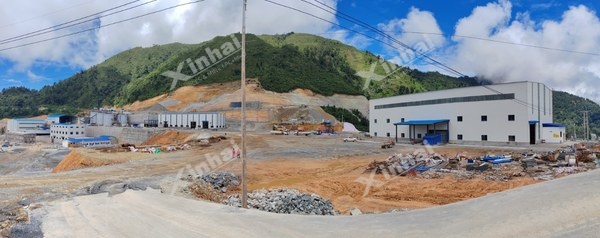
Laos 2,000 t/d cyanidation plant
A press takes water out of the pulp. It does not take cyanide out of the water. The filtrate coming off still holds the same dissolved silver and free cyanide the pulp carried in. Send it back to the thickener. Never send it to a drain.
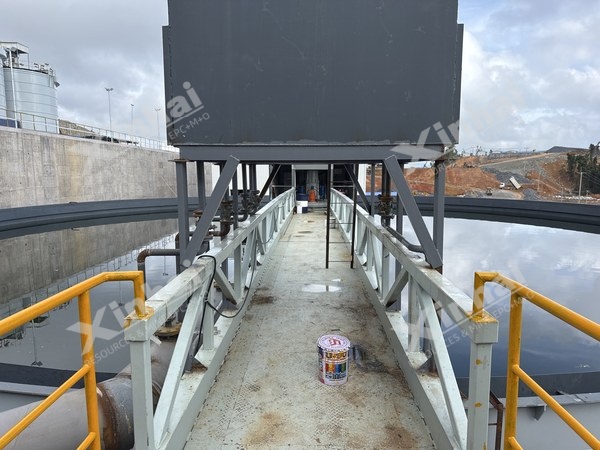
Thickener walkway, Laos plant
Here is how a 2,000 t/d gold cyanidation plant in Laos runs. Ore comes in crushed to minus 3 mm. A ball mill and spiral classifier grind it, closed with a hydrocyclone and a second mill. The pulp is thickened, then leached in double-impeller tanks. Loaded carbon goes to electrowinning.
Tailings leave the leach through a safety screen and a buffer tank. A diaphragm press dewaters them. The cake rides a belt conveyor to the stack. Thickener overflow and press filtrate both return to a water tank.
That plant is gold, not silver. The tailings end works the same way in both metals.
A pond keeps water and solids together. Tailings arrive as a slurry and the solids settle. Clear water comes off a floating barge or a pump station. Cyanide left in the pond is left to the weather. It volatilises, oxidises, and breaks down under microbes.
A gold project in Qinghai, China built one. It is a five-class hillside impoundment with a single-stage dam. Deposition is wet, and the dam is raised downstream. Total capacity is 643,200 m3, enough for 9.87 years at 1,000 t/d.
The liner runs in layers: sodium bentonite mat, geotextile, geomembrane, drainage layer, rockfill prism, cutoff wall. Monitoring wells watch for seepage.
That design covered civil works. It did not cover a closure plan. Both routes carry a closure obligation. How much lands on the operator depends on the jurisdiction.
Silver-cyanide loads onto activated carbon weakly. Weaker than the gold complex. A silver plant usually ends up at zinc precipitation instead, and at heavier washing.
The Morocco plant leaches for more than 60 hours. Pulp then passes five stages of counter-current washing before the pregnant solution goes to zinc cementation. After that wash train, the residue has given up what the wash ratio allows.
What is left sits inside unleached mineral. No filter press gets it back.
That is the boundary of the route decision. A press recovers water, a wash train recovers silver. Buying the press does not replace the wash stages, and the pond does not make them optional.
The washing stage count is set out in silver cyanidation design. Residual silver already in storage is a separate question, covered in silver in tailings.
Both routes close a water balance at different points.
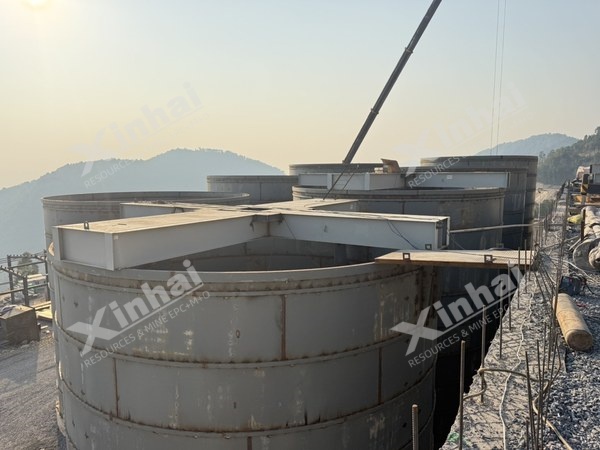
Leach tanks under erection
Dry stacking closes it at the filter. Everything the press takes out goes back into the circuit. Cyanide, thiocyanate and base metals build up in that return stream until the bleed takes them out. Run a plant with no bleed and the reagent bill climbs. Leach kinetics slide after it.
Wet storage closes it at the pond surface. The barge sends water back. The rest stays in the impoundment, where evaporation, seepage and decant take it away. Cheap while the pond has freeboard and the weather is dry. It stops being cheap once the pond fills.
Neither route removes cyanide from the stream. Both send water back with something in it. Know what that something is before you pick the route.
Dry stacking puts capital into thickeners, filters, filtrate pumps and conveyors. Add a stack area, prepared and drained. Wet storage puts capital into earthworks, liner, spillway and monitoring.
A pond draws little power. It never stops asking for inspection, though. Its closure sits on the books from opening day.
Build the comparison in a mine-life model. Use this plant's water balance and this site's closure rules. Neither route is cheaper in general. One is cheaper for a given site.
Three tests, run in this order.
A settling test on the leach residue gives the thickener area and the underflow density the filter will see. A filtration test at that density gives cake moisture, cycle time and filtrate clarity. Those three size the press. A water analysis on the combined return stream gives cyanide, thiocyanate and metal concentrations. Those set the bleed rate.
| Test | What it answers | Decision it feeds |
|---|---|---|
| Settling test | Thickener area, underflow density | Thickener sizing |
| Filtration test | Cake moisture, cycle time, filtrate clarity | Press type and plate count |
| Water analysis | Cyanide, thiocyanate, metals in return water | Bleed rate, water balance |
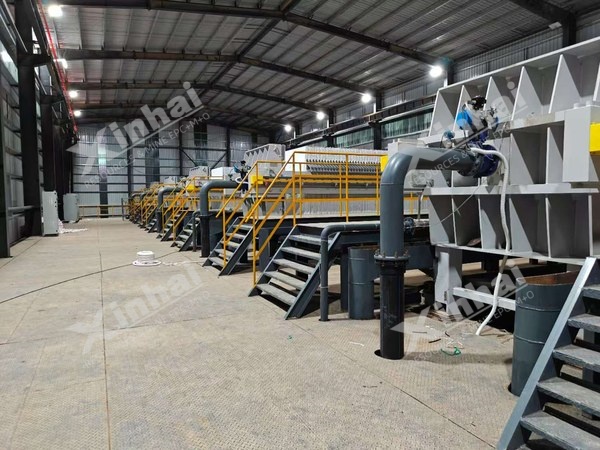
Filter press line, Laos plant
Skip that third test and the bleed gets sized by rule of thumb. The residue chemistry is what actually sets it.
Yes. A diaphragm press dewaters the residue until it can ride a conveyor to a stack. The Laos plant above runs exactly this. One caveat: that plant treats gold, and its filtrate goes back to the plant, not out.
No. A press moves water. Cyanide chemistry is untouched. Filtrate goes back still carrying cyanide and thiocyanate, and the cake keeps residual cyanide in its pore water.
Different land, not necessarily more. Dry stacking wants a stack area sized for annual tonnage, over a drainage system. Wet storage wants a valley or flat ground, a dam and a spillway. A site with neither has a siting problem, not a process problem.
The filtration test, run at the real underflow density. Cake moisture, cycle time and filtrate clarity together give the plate count. Sizing off tonnage alone overstates capacity on silver residues, which filter slowly.
The route is settled before the equipment list: how much water the plant can return, what the site allows, and what closure will demand.
Send a leach residue sample and the plant water balance. Our process team will size the dewatering circuit those two support.
Sources
Laos 2,000 t/d gold cyanidation plant: ore crushed to minus 3 mm, ball mill and spiral classifier with hydrocyclone and second mill in closed circuit, high-efficiency thickener, double-impeller leach tanks, carbon separation, electrowinning; tailings through safety screen and buffer tank to diaphragm filter press, cake by belt conveyor to stack, thickener overflow and filtrate returned to water tank — Xinhai construction drawing design report, August 2026.
Qinghai 1,000 t/d gold project: five-class hillside impoundment, single-stage dam, wet deposition, downstream dam construction, 643,200 m3 total capacity, 9.87-year service life, multi-layer liner with sodium bentonite mat, geotextile, geomembrane, drainage layer, rockfill prism and cutoff wall, seepage monitoring wells; design scope covered civil works of the impoundment — Xinhai project record.
Morocco 500 t/d silver plant: leach residence above 60 hours, five stages of counter-current washing, pregnant solution to zinc cementation — Xinhai silver ore test report and project record.
Silver-cyanide complex adsorption on activated carbon, cyanide volatilisation and oxidation in impoundments, and wash-ratio behaviour — Marsden and House, The Chemistry of Gold Extraction, 2nd edition, Society for Mining, Metallurgy and Exploration, 2006.
Both projects are Xinhai projects; the figures describe circuit and site, not a guaranteed plant performance.
 +86 13811510145
