If you want to know more information (such as product/process price, etc.), please contact us 24-hour telephone
Silver in a lead-zinc ore with no silver minerals of its own reports to the lead concentrate. Galena carries it, the lead circuit recovers it, and the zinc concentrate takes a smaller share at a lower payable rate. Reagent dose and the lead circuit's cut point decide the split.
Galena takes silver into its crystal structure and holds it through grinding and flotation. The lead rougher recovers galena, so silver follows. Sphalerite carries a smaller fraction, partly in solid solution, partly as galena and sulphosalt inclusions that never liberate.
The Guizhou sample below showed no discrete silver mineral, so silver could only be traced by assaying every product of the locked cycle.
| Product | Mass pull, % | Ag, g/t | Ag recovery, % | Carrier |
|---|---|---|---|---|
| Lead concentrate | 14.41 | 482.37 | 61.78 | Galena |
| Zinc concentrate | 35.80 | 109.93 | 34.98 | Sphalerite, locked galena |
| Tailings | 49.79 | 7.32 | 3.24 | Gangue |
| Calculated feed | 100.00 | 112.50 | 100.00 | — |
Lead concentrate took 61.78% at 482.37 g/t, zinc concentrate 34.98% at 109.93 g/t, tailings 3.24%. Payment is a separate question. Staging of the lead roughers is covered in lead-first flotation.
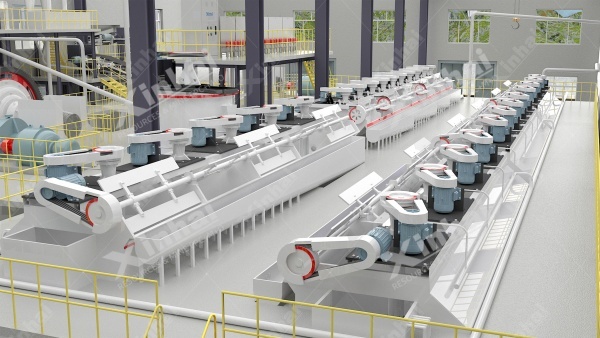
Lead-zinc flotation workshop.
Lattice substitution is the first route. Silver ions occupy zinc sites in sphalerite, usually charge-balanced by copper or iron. No grind releases that silver and no reagent moves it; it reports with zinc at whatever recovery the zinc circuit reaches.
Physical locking is the second. Galena filled cavities and fractures in sphalerite at 50 to 600 µm; a grind at 82% passing 74 µm leaves part of it attached, and the composite floats with the zinc.
Lattice silver is a fixed tax on zinc recovery; locked galena yields to a regrind on the zinc rougher concentrate. Regrind a split, reassay silver and lead: falling silver with rising lead means physical locking. Where silver forms its own minerals, free silver and carrier silver have to be told apart first.
Two levers separate galena from sphalerite: a depressant that makes sphalerite hydrophilic and a collector that makes galena hydrophobic. Whichever reaches the pulp first wins.
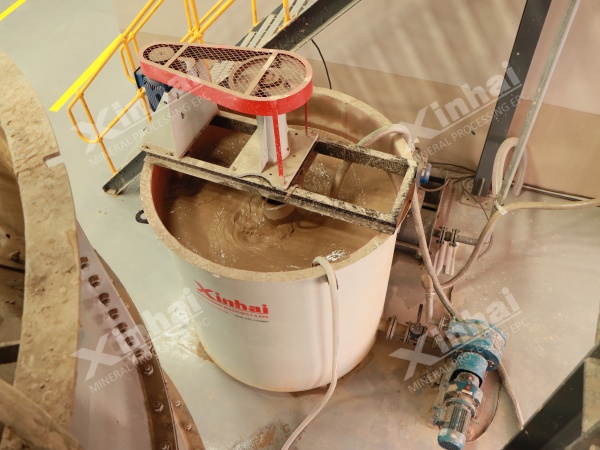
Conditioning tank ahead of the lead rougher.
Zinc sulphate and sodium sulphite enter the conditioning tank ahead of the collector, four minutes of contact. In alkaline pulp they form a hydrophilic film on sphalerite, and a later collector cannot attach through it. Reverse the order and the collector adsorbs first; the film forms over it and sphalerite floats.
The Guizhou series ran the pair from 1,000 + 1,000 to 2,500 + 2,500 g/t. Lead grade moved 74.73% to 73.80%, zinc in the lead concentrate 3.62% to 3.32%, lead recovery 85.02% to 81.16%, silver 59.62% to 55.91%. Raising the dose two and a half times bought 0.3 points of zinc rejection for 3.9 of lead and 3.7 of silver.
Every dose in a schedule should come from a series on the actual ore: one variable at a time, silver assayed in every product.
| Stage | Variable | Range tested | Selected | Result |
|---|---|---|---|---|
| Lead rougher | Lime (CaO) | 0–2,500 g/t | 0 g/t | At 2,000 g/t: 10.93% Zn in concentrate, Ag 411 g/t |
| Lead rougher | Zinc sulphate + sodium sulphite | 1,000+1,000 to 2,500+2,500 g/t | 1,000+1,000 g/t | Lead recovery 85.02 to 81.16%, Ag 59.62 to 55.91% |
| Lead rougher | Dithiocarbamate + dithiophosphate | 30+20 to 60+35 g/t | 40+25 g/t | 60+35: Ag 69.24%, 19.74% Zn in concentrate |
| Zinc rougher | Copper sulphate | 200–450 g/t | 200 g/t | Above: tailings zinc 3.08% |
| Zinc rougher | Lime (CaO) | 0–3,000 g/t | 2,000 g/t | Zinc recovery 89.63%, tailings zinc 0.66% |
The collector series is the one to read twice. At 60 + 35 g/t silver recovery reached 69.24% and lead recovery 92.11%, while zinc in the lead concentrate hit 19.74% and lead grade fell to 42.79%. That concentrate carries penalties. The staging behind such a schedule is set out in flotation circuit design for silver.
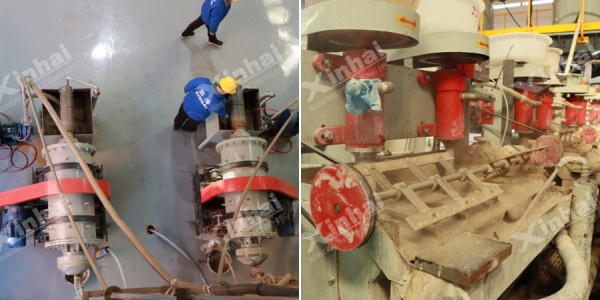
Batch grinding and flotation tests.
Xinhai's laboratory received about 160 kg in six lots from a carbonate-type silver-bearing lead-zinc deposit in Guizhou. Head grades: 12.64% Pb, 21.03% Zn, 118.51 g/t Ag, 0.42% arsenic; galena 13.98%, sphalerite 30.85%, carbonate gangue 30.60%.
The locked cycle ran at 82% passing 74 µm, lead rougher and two scavengers ahead of the same sequence on zinc. It returned lead concentrate at 76.25% Pb, 5.06% Zn and 94.41% recovery; zinc concentrate at 56.24% Zn and 95.75% recovery.
Lead recovery sat 32 points above silver recovery at 61.78%; the gap is the zinc circuit's silver. Arsenic rose from 0.42% in feed to 2.59% in the lead concentrate, a penalty to price before selling. Tailings at 0.40% Pb and 0.33% Zn leave little for a scavenger.
The output is the operating schedule: reagent, dosing point, setpoint, conditioning time. Copy a neighbour's and you get the 2,000 g/t lime case, at 10.93% zinc in the lead concentrate. These figures apply to that sample.
Concentrate contracts usually pay silver in lead above about 50 g/t at 95% of contained metal, and silver in zinc above about 3 oz per dry tonne, roughly 93 g/t, at 70%. Terms vary, so the offtake governs.
On those terms the 35% share shrinks. A zinc concentrate at 109.93 g/t clears the threshold by 17 g/t; 70% of that is 12 g/t payable. Per 100 tonnes of feed the zinc concentrate yields about 420 g of payable silver, the lead concentrate about 6,600 g: 35% of the silver bringing 6% of the revenue. That is an offtake conversation and, at best, a case for regrinding the zinc concentrate, which rarely justifies redesigning the circuit.
Five items belong on the test request.
Fire assay for silver on every product, tailings included.
Head assays for arsenic, antimony and bismuth, which report to lead concentrate as penalties.
A mineralogical scan for discrete silver minerals, which can change the route.
Separate dose series for the depressant pair and the collector.
Grind stated as percentage passing 74 µm, not mesh.
The flowsheet that follows is set out in silver recovery by ore type; residual silver in tailings, in silver in tailings.
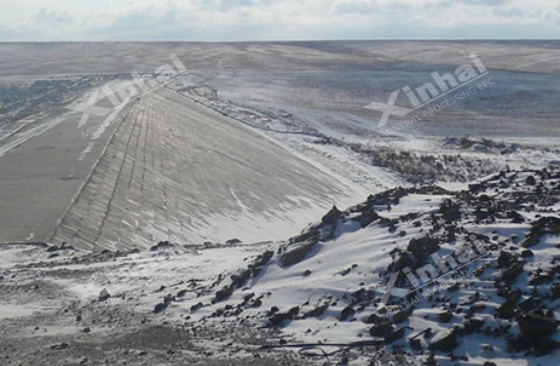
Tailings storage facility.
Mostly. In sulphide ores with no discrete silver minerals, silver rides galena into the lead concentrate. Where cerargyrite, argentite or pyrargyrite appear, or silver is oxidized, part of it floats with neither sulphide and a gravity or leach step enters the flowsheet.
Rarely in a sulphide ore. Galena and silver minerals share surface chemistry, so the lead rougher collects both. Separation becomes practical only when silver forms a distinct, liberatable mineral, and even then lead concentrate is the better carrier for payment.
A contract threshold, typically 3 oz per dry tonne, with payment near 70% of contained metal above it. Below the threshold the silver earns nothing, so check the offtake before counting it as revenue.
About 100 to 200 kg, split across several lots; the Guizhou programme used 160 kg in six lots. A dose series needs less, while the locked cycle returns intermediates and needs enough for eight to ten cycles.
Silver in lead-zinc ore is settled at two points: the depressant dose that keeps sphalerite out of lead concentrate, and the cut point where the lead circuit hands over to zinc.
Sources
Guizhou carbonate-type silver-bearing lead-zinc sample (head 12.64% Pb, 21.03% Zn, 118.51 g/t Ag, 0.42% As; galena 13.98%, sphalerite 30.85%, carbonate gangue 30.60%; locked-cycle balances; lime, depressant, collector and copper sulphate series; lead concentrate arsenic 2.59%) — Xinhai laboratory test report, 26 April 2024, on about 160 kg received in six lots.
Depression of sphalerite by zinc sulphate and sodium sulphite in alkaline pulp, and the requirement that the depressant contact the mineral before the collector — Wills' Mineral Processing Technology, 8th edition, Butterworth-Heinemann, 2015.
Silver payment thresholds and payable factors in lead and zinc concentrates are customary ranges; the offtake contract governs, and the revenue figures here are arithmetic on those ranges, not a quoted settlement.
The sample data describe that ore and circuit; they are not a guaranteed plant performance.
 +86 13811510145
