If you want to know more information (such as product/process price, etc.), please contact us 24-hour telephone
Whether low-grade silver ore goes to a heap or tanks is decided by four site facts: grade and tonnage, the mineral form of the silver, the clay and fines content, and how fast the silver dissolves in cyanide. Geology sets the first two; weeks of laboratory work settle the rest. The routes differ in what they spend money on and in what can go wrong later. The wider route menu is set out in how silver ores are processed.
Each fact points one way, and they rarely agree. A large, low-grade resource favours a heap; a tighter, higher-grade deposit favours tanks. Clean, coarse feed percolates; clay stops it. Fast-dissolving mineralogy keeps a heap's cycle short enough to pay. When the facts conflict, the strongest constraint wins — usually permeability. The same two routes on gold are compared in CIL/CIP versus heap leaching.
| Decision factor | Favors heap leaching | Favors agitation leaching |
|---|---|---|
| Grade and tonnage | Large resource, low grade | Smaller, higher grade |
| Silver mineral form | Halides, argentite | Refractory or locked silver |
| Clay and fines | Clean, coarse feed | Clay-rich feed |
| Dissolution kinetics | Fast cyanide dissolution | Slow kinetics, high recovery target |
Cyanide reaches silver in three ways. Halide minerals such as cerargyrite (silver chloride, the common oxide-zone silver mineral) dissolve in cyanide but slowly. Argentite (silver sulphide) dissolves at a workable rate. Silver locked in silicates or as fine inclusions in pyrite barely dissolves, and neither route touches it without flotation or pre-oxidation ahead.
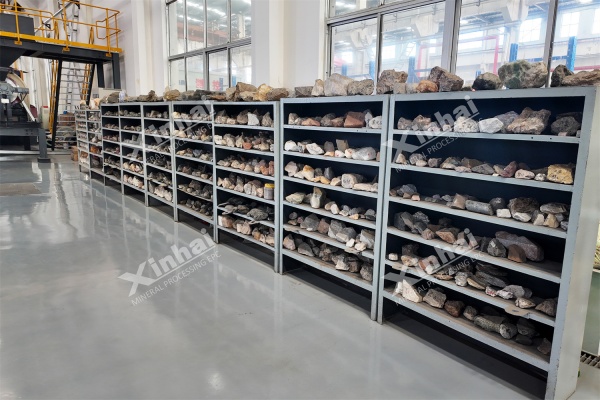
Ore samples awaiting mineralogical scan.
Manganese is the harder case. Where silver binds to manganese oxides, as in manganese-silver deposits, cyanide alone recovers little — the manganese holds the silver and eats reagent doing it, and both routes stall. One Xinhai test on a manganese-silver ore ran magnetic preconcentration first: manganese reported to the magnetic fraction, and cyanidation on the cleaned fraction returned 85.00% silver. That decision comes from a mineralogical scan, before the heap-versus-tank debate.
So the scan comes first: where silver hosts sit in sulphides — the free silver versus carrier silver case — flotation takes over and the leach question dissolves.
A heap leach is a percolation process: solution must drip through metres of stacked ore for weeks. Fines and clay clog the pore space, solution finds a few channels, and the rest of the heap sits dry — recovery dies quietly, with no alarm. Heap designs copied from cleaner ores learn this the hard way. Pad, liner and spray layout are set out in heap leaching process design.
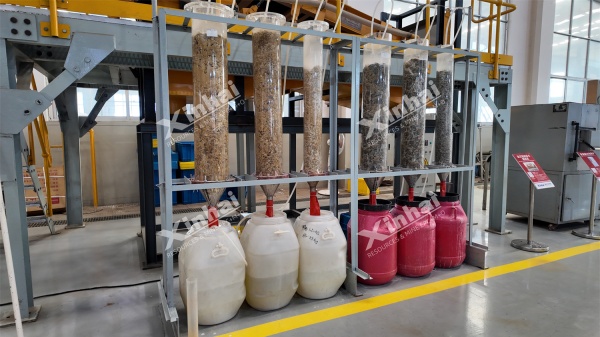
Column leach tests on ore.
Agglomeration buys back some ground. Rolling crushed ore with cement or lime binds fines into permeable pellets, and moderately clayey ores become heapable. When clay dominates, no amount of curing helps, and the ore belongs in tanks where agitation does the contacting. Crush size is the other lever: coarser feed percolates better and leaches slower — the column test settles it.
An agitation leach runs fully controlled — reagent, aeration and grind adjustable — and completes in hours to two days. A heap only lets you adjust spray rate and cycle length. Silver dissolves more slowly than gold in the same chemistry, halide silver slowest, so a silver heap cycle runs tens of days to months, and there is a ceiling: in one Xinhai tailings retreatment test, cyanide on tailings assaying 39 g/t Ag leached 48% and stopped.
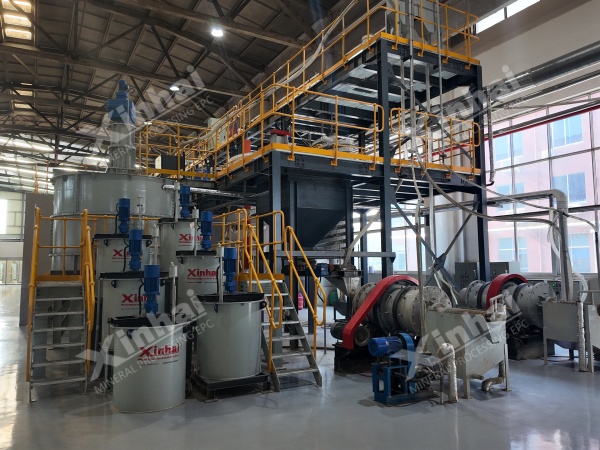
Pilot-scale agitation leach train.
That 48% was one tailings sample, not a law. It shows the direction: assay the ore and treat the flat end of the leach curve as the recovery you will get. The long cycle also spends money before it earns any — pad, ponds and working capital sit through every extra month. The leach-stage design behind that ceiling is set out in silver cyanidation design.
Silver-cyanide complex, Ag(CN)2-, loads onto activated carbon far more weakly than the gold complex. Carbon works for lean solutions; as silver tenor rises, loading drops and the metal walks past into the barren stream. The answer for silver-rich solutions is Merrill-Crowe: clarify, deaerate, dose zinc dust, filter the cement.
Heap liquor is dilute but high-volume, suiting Merrill-Crowe's zinc cost per tonne of solution; agitation leach liquor is stronger and the carbon trade-off tightens. This is where Xinhai equipment scope sits — the Morocco silver plant runs flotation, regrind, cyanidation, CCD washing and zinc precipitation as one package. Pick the recovery route before the leach route and the redesign disappears.
A heap spends its capital on the ground: pad, liner, ponds, stacking equipment, a pump-and-spray network. Running cost is low without a grinding circuit — but recovery is lower too, and at high metal prices the recovery gap outweighs the power saved. An agitation leach spends on tanks, grinding and air, and earns it back through higher extraction. The honest comparison is a mine-life cash model on tested recoveries; both routes fit one EPC+M+O contract.
Four tests, in order. Bottle-roll first: days of work, fixing the chemical ceiling — rate and ultimate extraction at lab grind. Column test second: feed crushed to plant size, loaded metre-scale, sprinkled for weeks; it returns percolation behaviour, cycle length and extraction at real crush — the heap's actual viability. Solution assays third: copper and zinc eat cyanide and move the reagent budget. Water balance last, for pad and ponds.
| Test | What it answers | Decision it feeds |
|---|---|---|
| Mineralogical scan | Which minerals host the silver | Pretreatment needed, or direct leach |
| Bottle-roll | Rate and ceiling at lab grind | Route shortlist |
| Column test | Percolation and cycle at plant crush | Heap viability |
| Solution assays | Cyanide consumers (Cu, Zn) | Reagent budget, recovery route |
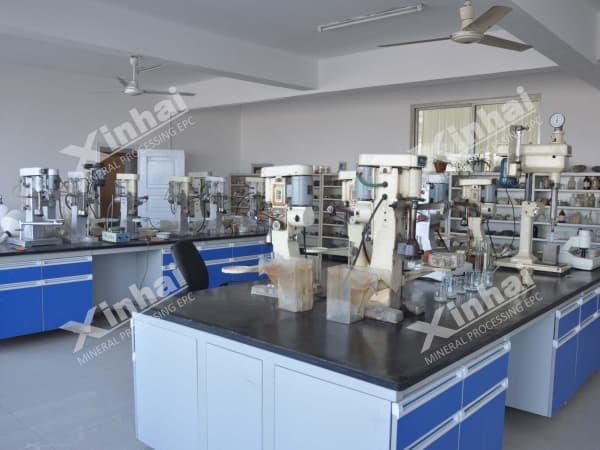
Xinhai mineral processing laboratory.
A request that skips the column has not tested the heap at all — only a finer, better-mixed imitation of it. Xinhai's laboratory runs all four as standard deliverables before a flowsheet is drawn.
There is no single cut-off. Heap economics turn on tonnage, leached recovery and pad cost together; ores at a few tens of grams per tonne have been heap leached profitably, and cleaner ores at similar grades have gone to tanks. Column test plus cash model decides.
The silver-cyanide complex adsorbs onto carbon less strongly than the gold complex, so loading falls as silver tenor rises. Lean solutions keep carbon; silver-rich ones move to zinc dust precipitation.
Moderate clay is handled by agglomeration — rolling crushed ore with cement or lime into permeable pellets. When clay dominates, percolation fails and the ore belongs in tanks.
Tens of days to months. Silver dissolves more slowly than gold, halide silver slowest, and the cycle is what the column curve says. Budget pad and working capital for the full curve.
Heap or tank, the decision is settled by the same evidence: what hosts the silver, whether solution can percolate, and where the leach curve flattens.
Send a head assay and a mineralogical report, and our process team will outline which route your ore supports, with the test programme that confirms it.
Sources
Manganese-silver ore at 85.00% silver by cyanidation after magnetic preconcentration removed the manganese — Xinhai test record.
Tailings retreatment test on tailings assaying 39 g/t Ag, cyanide leach stopped at 48% — Xinhai tailings retreatment test record; the figure describes one sample, not a guaranteed recovery.
Morocco 500 t/d silver plant flowsheet: flotation, regrind, cyanidation, CCD washing and zinc precipitation — Xinhai project record.
Silver halide and argentite dissolution behaviour in cyanide, the weaker adsorption of the silver-cyanide complex on activated carbon, and Merrill-Crowe practice — Marsden and House, The Chemistry of Gold Extraction, 2nd edition, Society for Mining, Metallurgy and Exploration, 2006.
Heap permeability, agglomeration practice, leach cycle lengths and column test procedure — US EPA, Gold and Silver Heap Leaching and Management Practices That May Minimize Environmental Impacts, and standard industry testwork practice.
 +86 13811510145
