If you want to know more information (such as product/process price, etc.), please contact us 24-hour telephone
Kazakhstan's ministry of industry has put two copper concentrators on the national drawing board. Besshoky, in Karaganda region, is planned at 7.5 million tonnes per annum (Mtpa) of ore, targeting roughly 142,000 tonnes of 25% copper concentrate a year; Kyzyltu, in Akmola region, at 3 Mtpa producing around 48,000 tonnes of 21% concentrate. Together: 10.5 Mtpa of new processing capacity and close to 190,000 tonnes of concentrate (CMRP, citing the ministry and VNIITsvetmet, October 2026).
The flowsheets are already drawn — Kazakhstan's state research institute VNIITsvetmet wrote a flotation scheme for each deposit, and both have entered plant design. That is the useful detail buried in the announcement: these are not one project with two names. They are two different metallurgical problems wearing the same metal.
Besshoky is a porphyry copper deposit — low grade, huge tonnage, the ore type that built the modern flotation industry. At this scale the engineering logic is familiar: grind to liberation (typically P80 in the 150–200 µm band for porphyry copper), float rough quickly to pull most copper forward, scavenge hard, clean slowly. Recovery is won across the whole circuit, so no single stage gets to be mediocre.
Volume concentrates the pain points: grinding owns the power bill, so staged crushing ahead of the mill train earns its capital back in kWh; water balance decides whether the tailings facility is an asset or a permit risk; and at millions of tonnes a year, a one-point recovery drift is tens of tonnes of contained copper walking into the dam.
Kyzyltu is a copper-molybdenum ore, which adds a second product and a second chemistry. Bulk flotation comes first — one concentrate carrying both metals. Then separation: suppressing copper while floating molybdenum, traditionally with lime-heavy high-pH conditioning and a depressant for copper sulfides, followed by repeated cleaning because Mo/Cu selectivity is earned stage by stage, not in one tank.
| Besshoky (porphyry Cu) | Kyzyltu (Cu-Mo) | |
|---|---|---|
| Ore per year | 7.5 Mtpa | 3 Mtpa |
| Concentrate target | ~142 kt at 25% Cu | ~48 kt at 21% Cu |
| Circuit centre of gravity | Liberation grind + rougher-recoverable volume | Selective depression + cleaner-chain length |
| Main failure mode | Over-grinding power cost; recovery drift at scale | Copper slip into Mo concentrate; reagent regime instability |
Where the flowsheets converge is unglamorous and decisive: thickening and filtration. Both sites sit in a water-limited country, and concentrate moisture plus returned process water decide how much fresh water either plant may claim. Dry-stack layouts return the large majority of water through thickeners and presses, and retire the dam-risk conversation with it.
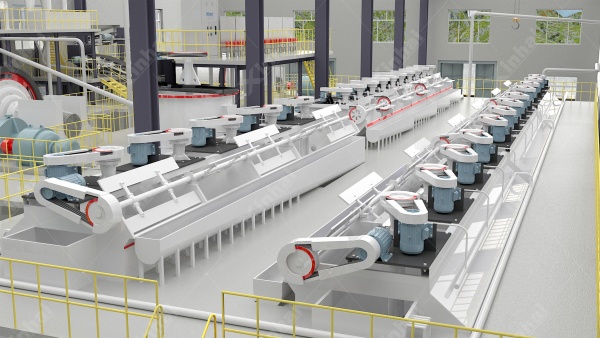
A flotation workshop — where both circuits spend most of their design effort.
These are planning-stage projects; execution will test something other than flowsheets. The country's construction calendar is short — winters freeze civil works, so foundations, steel and equipment setting are scheduled backwards from the cold months. Cross-border logistics sets procurement rhythm, and local-content expectations shape staffing long before first ore.
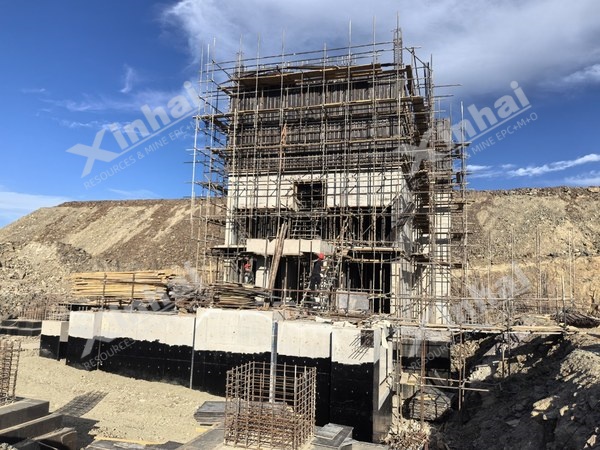
Xinhai knows this calendar from inside it: a 1.5 Mtpa copper flotation plant under EPC construction in Kazakhstan, where the first fifty days on site placed roughly 15,000 m³ of earthwork, 260 t of rebar and 2,700 m³ of concrete with a team of about 100 (project progress report, August 2026). <a href="/epc/test.
 +86 13811510145