If you want to know more information (such as product/process price, etc.), please contact us 24-hour telephone
Zimbabwe's government has confirmed the lithium concentrate export ban will take effect on 1 January 2027 with no extension (Chinese Embassy commercial office in Zimbabwe; mining.com, October 2026). The fourth-largest lithium producer worldwide — roughly 9.7% of global supply — is closing the era of shipping spodumene out of the country. Lithium must leave processed.
The scale of what is at stake: lithium exports reached $2.16 billion in the first three quarters of 2026 — about four times last year's full-year figure. Every tonne of that flow now needs a conversion route through a plant that either exists, is under construction, or must be built from scratch — and a greenfield processing plant takes years, not months.
For owners and their engineering teams, the deadline converts a policy into a construction schedule. What that schedule contains is the subject here.
A ban date is only the start of the question. Between announcement and enforcement sit practical layers: whether existing capacity can absorb the transition, whether new lines can be permitted, financed, built and commissioned in time, and what happens to concentrate that misses the deadline.
The pattern is not unique to Zimbabwe. Laos is drafting rules requiring processing for new projects with staged raw-export bans; Indonesia launched eleven Chinese-invested downstream projects worth about $10.2 billion. Concentrate exporters everywhere should read the same lesson: build the conversion step at home, on someone else's clock.
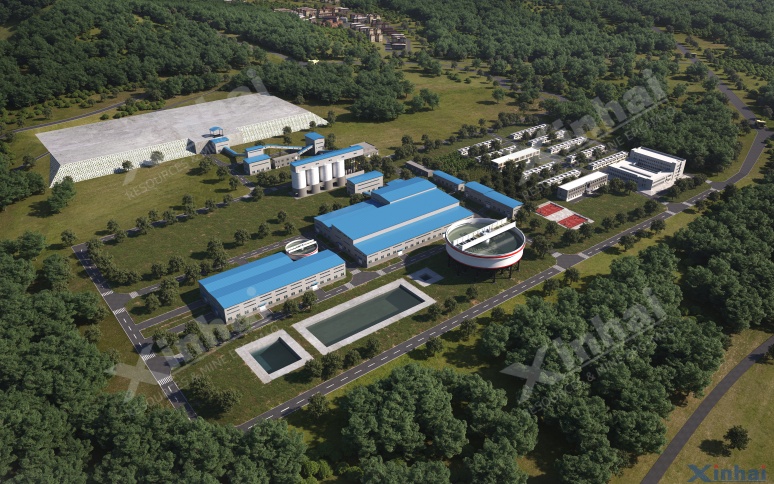
The 2 Mtpa spodumene plant Xinhai delivered in Zimbabwe.
The conversion route fits in one line: rotary-kiln roasting makes spodumene reactive, sulfuric acid leaches the lithium, purification strips iron and aluminium, and evaporation-crystallisation delivers lithium sulfate. Each stage carries known engineering risk — but none of it starts at the kiln.
It starts upstream, with what the concentrator hands over. A concentrate that drifts in iron content drags purification costs and taxes every tonne roasted after it. The sensible first move for an owner facing the ban is on the plant's supply side.
Conversion plants inherit whatever the concentrator delivers. In Zimbabwe, the controllable levers before the kiln are familiar ones: dense media pre-concentration to reject waste early, desliming followed by roughing-cleaning flotation for grade, magnetic separation for iron, and dewatering that stabilises moisture into shipment and storage.
Xinhai has operated at this end of the chain in the country: a 2 million tpa spodumene processing plant for Sinomine Resources' operation, delivered under EPC+M+O (engineering, procurement and construction plus mine management and operation), alongside further gold and cesium plants elsewhere in Zimbabwe. The record does not speak for the ban's deadlines — but it says the flowsheet knowledge exists close to the affected assets.
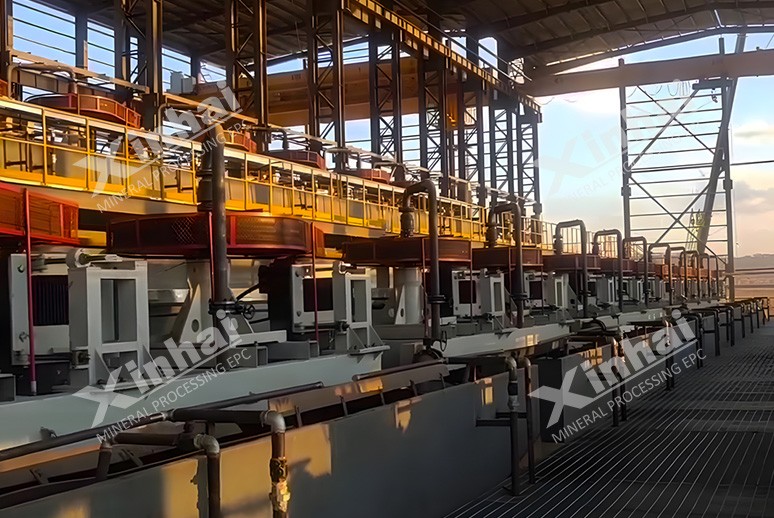
Flotation section, same site — grade control starts upstream.
A greenfield conversion plant cannot be built before January 2027 — owners starting from zero will miss the first gate and need transition relief or interim arrangements. For those attaching new lines to an existing concentrator, the schedule is tight but workable, and the difference between making and missing it usually sits in three decisions taken early:
Modular and skid packages where the process allows — fabrication parallel to civil works instead of after it
Long-lead items locked first — kilns, MVR compressors and transformers ordered before detailed design closes
Commissioning scope written backwards from the export date — water-power-reagent readiness tested against the January gate, not against mechanical completion
Owners who already run a concentrator hold one structural advantage: sampling, testwork and mass-balance discipline exist on site. Extending that base downstream is cheaper than building both ends from scratch — and the permit file gains from showing integration rather than two disconnected projects. Where the conversion step itself needs new kit, thickening and dewatering are usually the first civil commitments on the schedule.
It targets unprocessed concentrate — spodumene leaving as mined-and-floated product. Processed output such as lithium sulfate is the intended replacement trade, which is why the government ties the ban to local processing rather than shutting exports down.
Not from scratch. Greenfield programmes take years to permit, finance and build — they cannot close a gap of less than three months. What does fit the window is brownfield extension: adding conversion lines to an existing concentrator site, where sampling, testwork and mass-balance discipline already exist.
Roasting chemistry assumes consistent feed. Iron and mica carry-through raises acid consumption, burdens purification and lands in the final spec. Desliming, magnetic iron removal and stable flotation control at the concentrator are the cheapest insurance a conversion plant can buy.
No. Laos is drafting rules requiring processing for new mining projects, and Indonesia has launched large Chinese-backed downstream programmes. Resource-state industrialisation runs across southern Africa and Southeast Asia; concentrate-only business models carry rising policy risk everywhere.
Deadlines like these get met by owners who treat the ban as a construction brief, not a headline: flowsheet first, long-lead second, commissioning backwards from the gate.
 +86 13811510145