If you want to know more information (such as product/process price, etc.), please contact us 24-hour telephone
A copper concentrate is paid for its copper. A tungsten concentrate is paid for its WO3. In the same ore, each becomes a penalty element in the other's product.
Copper tungsten ores are usually low grade. Published Chinese testwork on skarn-type ores reports copper between 0.11% and 0.78% with WO3 between 0.11% and 1.71%. At those numbers the mine does not fail because the metals cannot be separated. It fails when one concentrate misses its specification and the other is written off as tailings.
At Xinhai's tungsten project at Jiuquan Iron and Steel, a 900,000 t/y photometric pre-concentration circuit held a reject rate above 25%, lifting fine crushing capacity by 37% and raising the grade to the mill. Removing waste before grinding is now routine. What happens after it, when copper and tungsten both remain in the feed, is where the real decisions sit.
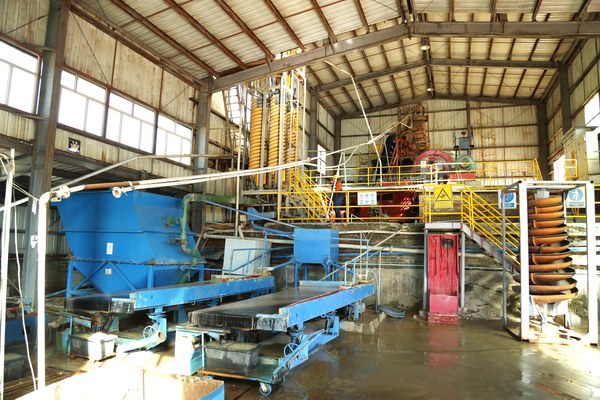
Gravity and table circuits inside a tungsten plant
Chalcopyrite and scheelite belong to two different flotation chemistries, and neither responds to the other's reagents.
Chalcopyrite is a sulfide. It floats readily with xanthate collectors in an alkaline pulp, which is why lime is the usual depressant when copper is separated from pyrite. Scheelite is an oxide mineral. It needs fatty-acid or chelating collectors, sodium silicate to suppress silicate gangue, and often lead nitrate as an activator.
Flotation (a separation process that exploits differences in the surface chemistry of minerals) works because one mineral is made hydrophobic and the other is not. Here both valuable minerals want different conditions, and the circuit must run both.
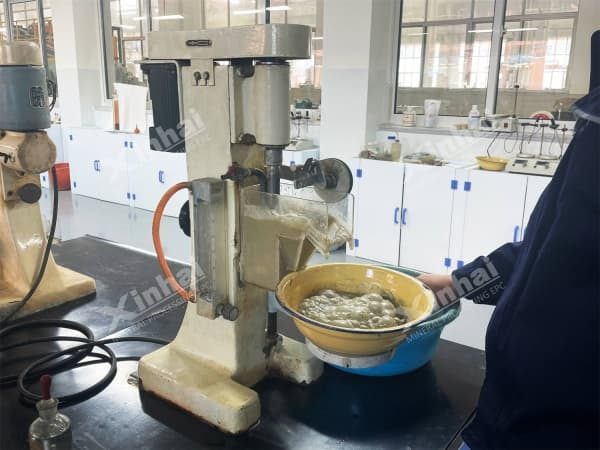
Laboratory flotation test
Industry practice has settled on one sequence: sulfides first, then tungsten.
| Stage | What happens | Why the order matters |
|---|---|---|
| Copper-sulfur bulk flotation | Xanthate collects chalcopyrite and pyrite together | Removes sulfides before tungsten flotation sees the pulp |
| Cu-S separation | Lime raises pH and depresses pyrite; copper floats | A regrind on the bulk concentrate is what makes this split clean |
| Scheelite flotation | Sodium carbonate adjusts, silicate depresses, fatty acid collects | Tailings from the first two stages become the feed |
The logic is that copper-sulfur bulk flotation also desulfurizes the pulp for the tungsten stage. Tailings then go to scheelite recovery with sodium carbonate as pH modifier, sodium silicate as depressant and lead nitrate as activator. Where pyrrhotite is abundant, magnetic separation ahead of flotation removes it before it consumes reagent.
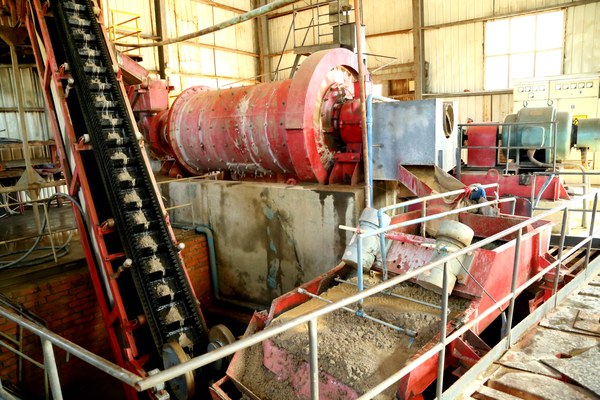
Ball mill and spiral classifier
Three decisions set the final balance, and each trades one product against the other.
Regrind size on the bulk concentrate. Jiangxi testwork reground the copper-sulfur rough concentrate to 85% passing 0.045 mm. Coarser and locked particles carry tungsten into the copper concentrate; finer and slimes cost recovery in both circuits.
Reagent carryover. Xanthate and lime left from the copper stage adsorb on scheelite surfaces and compete with the tungsten collector. Washing or dilution between stages is cheaper than adding collector downstream.
Cleaning stage count. Scheelite cleaning usually runs four to five stages, and circulating load grows with each one. Too few stages and the concentrate misses its WO3 specification; too many and fine scheelite reports to tailings.
None of these has a universal answer. They are set by testwork on the ore, then trimmed at commissioning.
Xinhai's scheelite work includes a high-sulfur copper-bearing ore grading 1.71% WO3 and 0.78% Cu. The flowsheet combined weak magnetic separation to remove pyrrhotite, copper-sulfur bulk flotation and separation, and ambient-temperature scheelite flotation. Both products met specification.
| Product | Grade | Recovery |
| Scheelite concentrate | 63.93% WO3 | 89.60% |
| Copper concentrate | 20.06% Cu | 73.12% |
| Sulfur concentrate | 38.33% S | 51.14% |
These results apply only to the submitted sample and should not be presented as guaranteed plant performance.
Gravity still earns its place where the tungsten is coarse. For a 1 Mtpa tungsten tailings project in Uzbekistan, Xinhai designed classified gravity separation followed by reverse flotation for desulfurization. The tailings were split into three narrow size fractions, each on its own gravity circuit, then ground to 90% passing 200 mesh before flotation. The design targets a 40% concentrate at 30% recovery from a 0.06% feed.
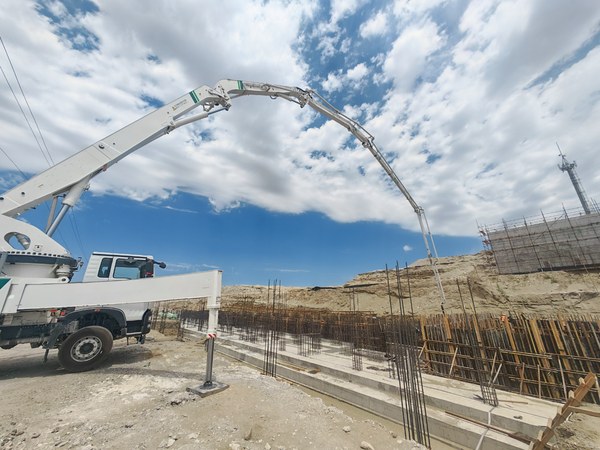
Shaking table foundations under construction
Yes. The route is copper-sulfur bulk flotation, then Cu-S separation, then scheelite flotation on the tailings. The first stage also desulfurizes the pulp.
Tungsten concentrate is bought on WO3 content, and smelters cap copper and other impurities that affect downstream processing. Above those limits the load is rejected or discounted.
There is no fixed number. Jiangxi testwork reground the copper-sulfur rough concentrate to 85% passing 0.045 mm. The right size depends on how finely the two minerals are intergrown.
No. Coarse scheelite can go to gravity or be pre-concentrated by ore sorting. Flotation handles the fine, intergrown fraction, usually the larger share of the tungsten.
Two concentrates on specification turn a copper tungsten deposit into a mine.
At Xinhai, we believe the flowsheet should be written for the ore, not adapted from a template.
Share your copper tungsten project with us. Let's work out where the two grades can both hold.
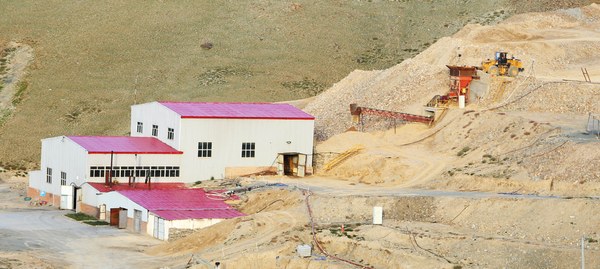
150 t/d tungsten processing plant in Mongolia
 +86 13811510145
