If you want to know more information (such as product/process price, etc.), please contact us 24-hour telephone
Every spodumene plant budgets for collectors, frothers and flotation cells. Almost none budgets for the mud that quietly eats the return on all three.
Two policy moves this week point the same way. Ghana's president announced on October 19 that the country will phase out raw exports of lithium, manganese, iron ore and bauxite by 2030. In the same week, Zimbabwe again refused to extend its spodumene concentrate export ban, effective January 1, 2027. Both put hard-rock lithium concentrators on African soil.
That means more plants built quickly, often on weathered pegmatite where fine material is already abundant. Desliming — removing the ultra-fine fraction before flotation — becomes a line item that decides the recovery number.
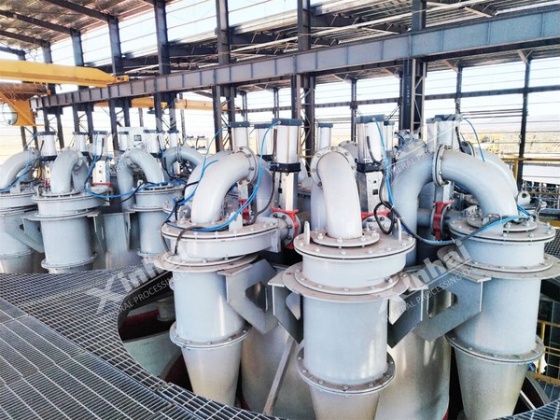
Hydrocyclone cluster at a spodumene plant in Zimbabwe
Slimes are the fine fraction of a ground pulp, usually defined by a size cut rather than a mineral. In spodumene circuits the cut is commonly set between 10 and 20 μm. Below that size, particles stop behaving like individuals in a flotation cell.
Four problems follow, and every one shows up in the recovery report:
Reagent consumption. Slimes have enormous surface area per unit of mass, and collectors adsorb onto them non-selectively. You pay for reagent that never touches a spodumene grain.
Surface coating. Fine gangue coats the coarser spodumene particles, masking the surface chemistry the collector needs.
Bubble interference. Slimes enter the froth mechanically and destabilize it, dragging gangue into the concentrate and lowering grade.
Dewatering trouble. A slime-heavy concentrate thickens slowly and filters poorly, pushing moisture and shipping penalties up.
Flotation (a separation process that exploits differences in the surface chemistry of minerals) depends on clean surfaces and a stable froth. Slimes attack both.
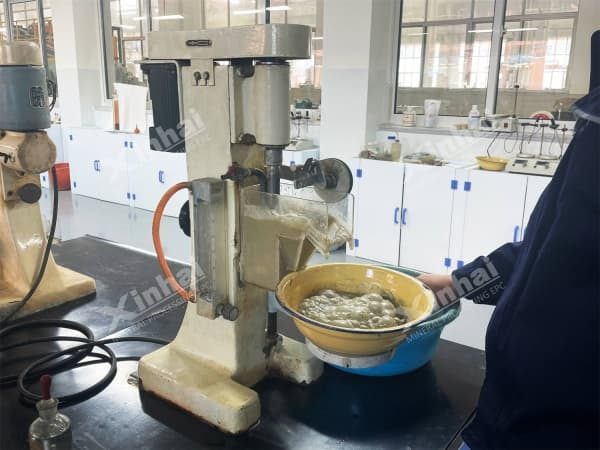
Laboratory flotation test
Not all fine material is created by the mill. Over-grinding is the source operators control most directly: grinding past liberation adds slimes without freeing more spodumene, and costs power. Weathered pegmatite is the second — surface alteration softens feldspar and mica, so they break down faster than the spodumene they host. The third is mineralogy: micas and clays are softer and report to the fine fraction first.
The first two respond to circuit design. The third does not. That is why desliming is a process step, not a grinding adjustment.
Desliming sits between grinding and conditioning. The size cut is made, the fine overflow goes to tailings or a separate recovery stream, and the coarse underflow goes to flotation at full reagent strength.
| Equipment | How it removes slimes | Suited to |
|---|---|---|
| Hydrocyclone | Centrifugal classification; fines report to the overflow | High throughput, sharp 10–20 μm cut |
| Spiral classifier | Gravity settling; slimes overflow the weir | Coarse circuits, low maintenance |
| Fine screen | Physical size separation on a mesh | Narrow cuts, with anti-blinding measures |
Hydrocyclones do most of the work in modern spodumene plants. A cluster is compact, has no moving parts, and holds its cut point as long as pressure and feed density stay steady. The trade-off is sensitivity to both: drop the pressure and the cut coarsens, sending coarse spodumene to the overflow with the slimes.
Three parameters decide whether the step helps or hurts:
Cut point. Set by the vortex finder and apex diameter. Too coarse and you lose fine spodumene; too fine and the slimes stay in the circuit.
Cyclone pressure. Drives centrifugal force and the separation size. Low pressure means a coarser, sloppier cut.
Feed density. High solids loading thickens the slurry and degrades classification, so the feed is diluted first.
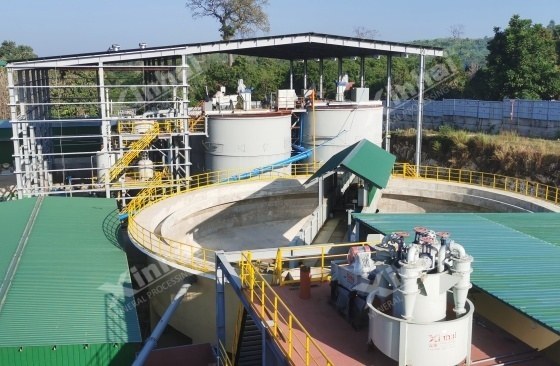
Cyclone cluster in a mineral processing plant
Xinhai Mining delivered a 2 Mtpa spodumene plant in Zimbabwe for a hard-rock lithium project, covering research and design, equipment manufacturing and procurement, and commissioning. The flowsheet did not treat the ore as one stream.
Lithium was recovered by three routes because the minerals behave differently. Petalite, whose properties are close to potash and soda feldspar, went to dense medium separation ahead of grinding. Tantalum and niobium were pulled out by spiral roughing, then magnetic and shaking table cleaning. Only then did the remaining stream enter the lithium flotation system, in the order desliming, magnetic separation, mica flotation and spodumene flotation. Spodumene ran one roughing, three scavenging and three cleaning stages in closed circuit.
Desliming was not a standalone treatment — it was the gate the pulp passed through before any flotation reagent was added. The plant was fed for trial operation in July 2023, about a year after construction started.
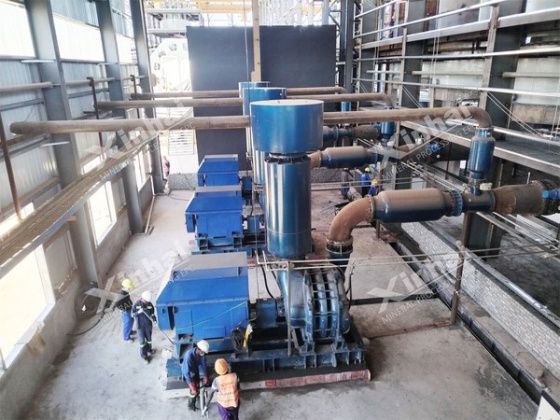
Flotation cells under maintenance at the lithium plant
It removes the ultra-fine fraction of a ground pulp before flotation, usually at a cut between 10 and 20 μm. The fine overflow leaves the circuit; the underflow goes to conditioning and flotation.
They consume collector non-selectively, coat the surfaces of coarser spodumene and destabilize the froth. Reagent goes to material that never reports to concentrate, and spodumene is lost because its surface was masked.
Hydrocyclones are standard: compact, no moving parts, holding a 10–20 μm cut at high throughput. Spiral classifiers suit coarser circuits; fine screens make a narrow cut where blinding is managed.
There is no universal number. It depends on liberation size, clay content and how much fine spodumene you can afford to lose. Testwork on a representative sample sets it.
If your circuit spends more on reagent than the concentrate justifies, check the desliming stage before touching the reagent scheme.
At Xinhai, we believe the cheapest recovery gain in a lithium plant is often the step nobody wanted to build.
Share your lithium project with us. Let's look at where your fines are going.
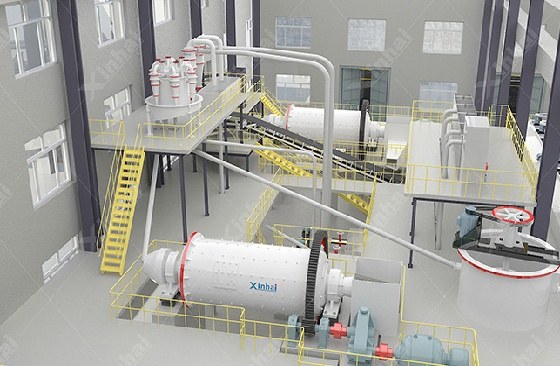
Grinding and classification workshop
 +86 13811510145
