If you want to know more information (such as product/process price, etc.), please contact us 24-hour telephone
A mining rights transfer moves the title. It does not deliver a flowsheet, a plant or a team that can run one — and that gap decides the schedule. The 28th China International Mining Conference opens in Tianjin on 10 September and runs to 12 September at the Meijiang Convention and Exhibition Center. For the first time it adds a trading section to the forum and exhibition: a mining rights transfer market covering titles, equity, equipment and engineering services. The exhibition covers 65,000 m², with 658 companies from 25 countries and 28 forums.
CHINA MINING 2026, Xinhai EPC+M+O.
Xinhai Mining will be at Booth N1-1200.
A market that moves titles faster does not move mines faster.
The two instruments are usually separate. An exploration right — an exploration licence or permit, depending on the country — lets you look for minerals. A mining right, variously a licence, lease or title, lets you produce them. A transfer moves whichever the seller holds.
| In the transfer | Not in the transfer |
|---|---|
| The exploration or mining title | A flowsheet matched to the ore |
| The resource report as filed | Testwork on representative samples |
| Permits granted to date | Equipment, civil works and installation |
| Surface access | Commissioning and an operating team |
A resource report is a statement about a deposit, not a specification for a plant. Mineral resources are not ore reserves and do not have demonstrated economic viability. Two things need checking: whether the reported resource still matches the ground, and whether the ore behaves as the report implies. Grade, hardness and mineralogy all move between zones.
Metallurgical testwork (laboratory and pilot testing that determines the flowsheet and design parameters for a specific ore) is where a project stops being a document and becomes an engineering problem. It settles the questions that fix everything downstream:
the grind size needed to liberate the valuable minerals
the recovery and concentrate grade realistically achievable
reagent demand and water balance
how the tailings behave, and how much water can be recovered
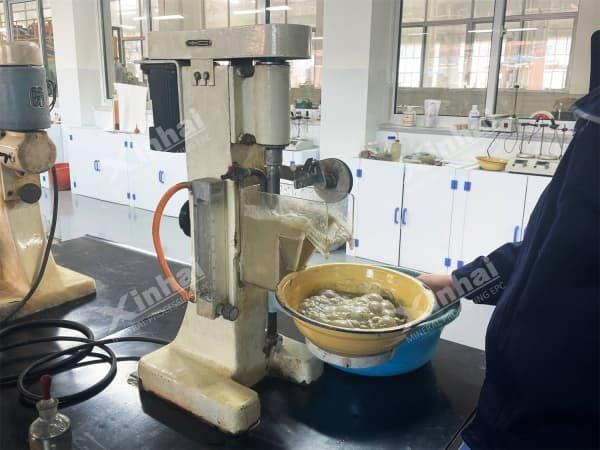
Flotation testwork
Copying a flowsheet from a neighbouring deposit is a common shortcut and an expensive one. Ore that looks identical on paper rarely behaves the same in a mill.
Once the flowsheet is fixed, the constraint becomes delivery. Equipment has to be manufactured, shipped, cleared and installed , often across more than one border and thousands of kilometres inland. Xinhai supplies more than 1,000 types of mining, mineral processing and metallurgical equipment for projects up to 50,000 t/d.
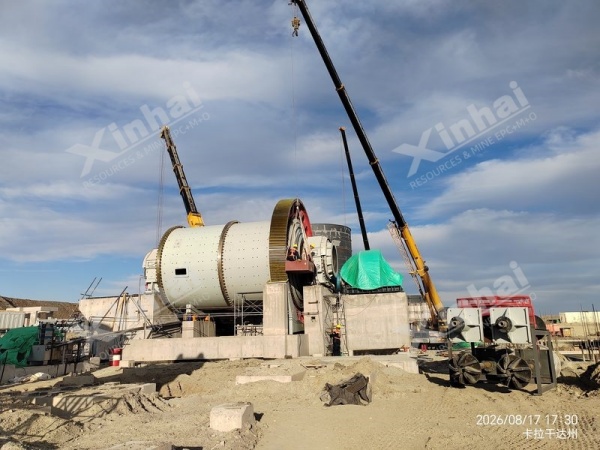
Ball mill installation, Kazakhstan
Construction then has to fit the weather. On a 1.5 Mtpa copper flotation plant in Kazakhstan, the team completed roughly 15,000m³; of earthwork, 260 t of reinforcement and 2,700m³; of concrete in the first 50, because the effective window for major civil works there is shorter than a year.
Commissioning without an operating team is a false finish. Production, equipment, safety, environmental, human resources and financial management all have to be in place before a plant changes hands, and operators need training before first ore. This is the stage most often squeezed when a schedule slips, and the one that decides whether nameplate capacity is ever reached.
Two projects illustrate where the time goes.
Kazakhstan 1.5 Mt/a copper flotation plant. Winters are severe, so the civil works window is under a year. Earthworks started in autumn 2025 and the project moved into major equipment installation in August 2026, with a site team of around 100. Sequencing outdoor work ahead of winter is what kept the schedule intact.
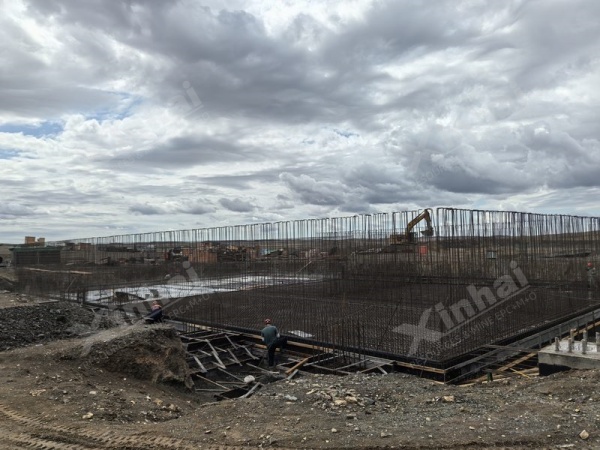
Earthworks at the 1.5 Mtpa copper site
Mongolia 1,000 t/d zinc flotation plant. The site sees -30℃ and has little water. The plant uses filtered dry-stack tailings with a closed-circuit water system, so process water is recovered and reused rather than drawn fresh. Equipment installation is complete and the plant has entered commissioning.
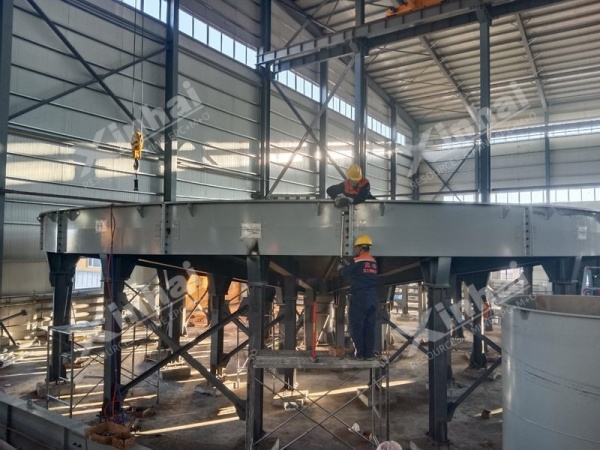
Zinc concentrator under construction, Mongolia.
Both cases point the same way: the calendar, not the deposit, sets the pace.
Has the resource been verified against current drilling?
Is there testwork on samples that represent the ore you will mine first?
Does the equipment lead time fit the construction window?
Are permits and closure requirements settled before design freezes?
Is there an operating team and a training plan before commissioning?
A transfer moves the title — the right to explore or to mine — with the permits and resource report held at that date. It does not include a plant, testwork, equipment or an operating team. Those are separate scopes.
An exploration right allows you to search for minerals and define a resource. A mining right allows you to produce and sell them. Names vary by jurisdiction, but the distinction holds: one permits investigation, the other production.
For a concentrator of 1,000 to 5,000 t/d, expect 12 to 24 months from testwork to commissioning once permits are in hand. Climate is the biggest variable where winter closes the construction window.
Often partly. Civil works may be reusable, but the flowsheet still has to match the ore you will process, and the equipment needs a condition assessment. Reuse is usually faster, though rarely as simple as it first looks.
If you are assessing a mining right, we'd be glad to discuss the technical questions — resource verification, testwork, flowsheet and schedule.
At Xinhai, we believe the right mine design is built around your ore and your calendar, not a standard template.
Share your project with us. Let's work through the constraints together.
 +86 13811510145