If you want to know more information (such as product/process price, etc.), please contact us 24-hour telephone
An equipment list is the result of mine design, not the cause of it. By the time quotations arrive, the decisions that will govern the next decade of costs and recoveries — throughput, flowsheet, layout, utilities — have already been made on paper. Owners who shop hard for mills and float cells while treating design as a formality usually pay for it twice: once in drawings, then again in rework.
This guide covers what professional mine design services actually deliver, why their quality caps your production indicators, and which five questions separate a design partner from a drawing office.
Mine design turns geological data into a buildable, financeable plan. A complete scope runs through six layers, each locking decisions that are expensive to change later:
| Layer | What it decides | Locked in for |
|---|---|---|
| Production scale and mine life | Tonnes per year against reserve base; sets every downstream size | The project's lifetime |
| Deposit development plan | Open-pit limits or underground access, extraction sequence, grade scheduling | Decades of ore order |
| Mining method and processing flowsheet | How ore is broken and how it is concentrated — gravity, flotation, leach route | Recovery ceiling |
| Major equipment configuration | Crusher, mill and cell sizing derived from the flowsheet, not the catalogue | Capital cost baseline |
| General layout and utilities | Plant arrangement, power supply, water balance, tailings placement, roads | Operating cost curve |
| Investment accounting and working drawings | Budget by work package plus construction-ready CAD detail | Bankability of the number |
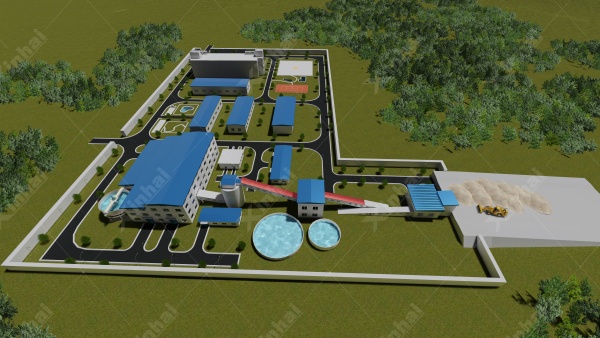
A plant layout is one of the six layers design locks in.
Read the middle column carefully. The first three layers decide what the plant can achieve; the last three decide what it costs to get there. That division explains why an undersized scrubbing stage or a missing maintenance bay — invisible on a quotation — shows up as lost metal within the first quarter.
Mine design reports a ceiling — the recovery its testwork basis proved achievable if every unit operation performs as designed. Plant performance then drifts toward whatever the design allowed, not beyond it. Three failure paths recur across projects.
First, grind-size mismatch. If the mill train cannot reliably reach the liberation size the testwork assumed — because one grinding stage was deleted to save capital — fine locked mineral never becomes floatable, and no reagent programme fixes that. Second, climate left out of the equations. A thickener sized on temperate-water behaviour underperforms at −30 °C; a water balance drawn without a dry season collapses when ponds drop. Third, space nobody budgeted. Crushers need lifting beams, screens need walkways, pumps need spares storage; omit them and every repair becomes a shutdown.
A mine sits where geology, mining, mineral processing, civil, structural, electrical, water and logistics engineering meet — plus environmental compliance and economics. Each discipline produces correct answers on its own terms; the design's job is making them consistent with each other.
Interface failures are quiet and expensive. A substation planned for installed rather than coincident load strands capital. Drainage designed before the final plant pad levels floods a switchroom. Tailings lines routed without the haul road schedule get built twice. This is why experienced owners buy design as a coordinated package with clash checks and single-point accountability, not as separate consultancy line items stitched together after the fact.
Design capability is easy to claim and hard to verify. Five questions separate a delivery partner from a drawing office:
Have you designed this ore type in this climate band? Flotation experience transfers poorly to heap leach; warm-climate layouts fail cold-climate physics.
Is your flowsheet based on my testwork or a borrowed template? Ask which laboratory ran it and which sample it used. A copied scheme fails quietly on mineralogy.
What exactly arrives at handover? Working drawings, bill of quantities and a constructible budget — or only concept-level layouts priced separately later.
Who supports commissioning? A design team that leaves site after handover transfers its learning curve onto your operators.
Do you carry the design through EPC? When one party owns design, manufacture and installation, interface errors land on them instead of between contracts.
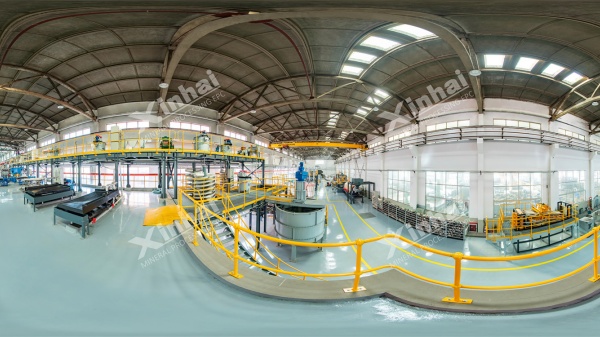
Testwork first: the data every honest flowsheet traces back to.
Xinhai Mining has worked this boundary since 1997: nearly 2,500 mines served and more than 600 EPC+M+O projects delivered across over 70 ore types, under an integrated model that keeps design, equipment manufacture, construction and operation inside one accountable chain. On a 1,000 t/d zinc project in Mongolia, the −30 °C winter drove the design itself — seasonal construction sequencing, filtered dry-stack tailings and a closed-circuit water system chosen because the site could afford neither a frozen dam nor open water loss.
Mine design spans the whole value chain — resource utilisation, development plan, mining method, processing route, infrastructure and economics. Plant design is the concentrator subset inside it. Buyers who contract only plant design often discover the pit feed, water supply and tailings corridor were never engineered to match it.
After drilling gives a dependable resource estimate and metallurgical testwork defines the ore's behaviour — typically at pre-feasibility. Earlier, designers guess; later, procurement has already locked choices the design would have made differently. The window between testwork completion and equipment enquiry is where design earns most of its money back.
Yes — a competent designer should survive that test. The deliverables to require: process calculations tied to your testwork, general arrangement drawings, equipment specification sheets, a constructible quantity take-off and a phased implementation plan. Where design and build stay separate, insist the designer remains engaged through installation and commissioning so accountability does not evaporate at handover.
Trace it to evidence. Ask for the laboratory report behind the number — sample origin, grind size, mass balance closure — plus operating data from a flowsheet the designer actually built on comparable ore. A recovery figure that cannot name its testwork is marketing, not engineering.
Drawings are cheap relative to the decades they price. Before comparing equipment quotations, compare the answers to those five questions — the ceiling on your recovery is already being set.
Sources
Xinhai Mining company profile and project records — service history, EPC+M+O delivery figures, Mongolia zinc project
Drytailingmachine.com engineering pages — EPC design scope, metallurgical testwork services
 +86 13811510145