If you want to know more information (such as product/process price, etc.), please contact us 24-hour telephone
Kazakhstan is sitting on about 55 billion tonnes of mine waste. It processes roughly 11% of it. In several developed economies that figure runs 70% to 80%.
The country has 1,747 registered sites holding tailings and waste rock, and the pile grows by 300 to 700 million tonnes a year. Those dumps were never designed as resources. They were built to get waste out of the way, which is why turning them back into feed is a different problem from building a concentrator on virgin ore.
The tax argument is settled. From January 2026, metals recovered from man-made mineral formations carry a mineral extraction tax at a coefficient of 0.1, a tenfold cut. What the tax has not settled is the plant.
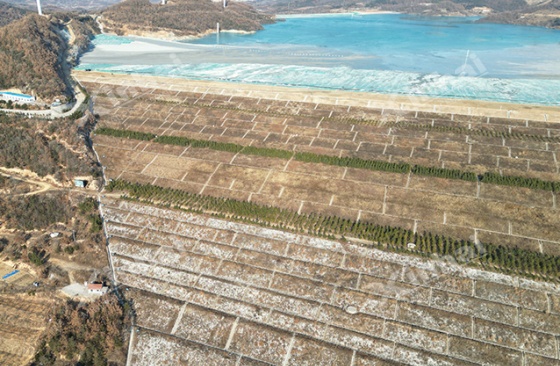
Tailings storage facility with a raised, revegetated dam
A tenfold cut moves a marginal project across the line. It does not change what sits in the impoundment: material deposited in layers over decades, already picked over once by a circuit that took what it could recover at the time.
Two things follow. The remaining metal is harder to get, because the easy fraction left on the first pass. And the legal status of the material is unsettled: tailings are classified as waste under one set of rules and as subsoil resources under another, which is why the industry has asked for a clear extraction framework rather than only a lower rate.
Industry is moving regardless. Metlen Energy & Metals is evaluating recovery of copper, zinc, nickel and cobalt from metallurgical waste, with phasing and logistics under discussion and no investment figure disclosed. Qarmet has ten projects worth $137 million queued behind the tax approval. ERG Recycling already processes more than a million tonnes a year.
A legacy impoundment is not a blended ore stockpile. Coarse sand settles near the discharge point and fine slimes travel to the far corner, so a dredge or a hydraulic monitor pulling from different locations delivers a different grade and a different size distribution every shift.
That variability breaks any flowsheet tuned to one condition. Two pieces of equipment do most of the stabilizing: a deep cone thickener to hold the feed density steady before separation, and a cyclone cluster to split the stream by size so coarse and fine fractions are treated on their own terms rather than in one pass.
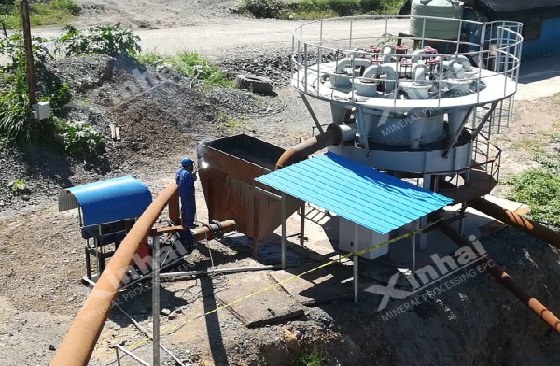
Cyclone cluster separating coarse and fine fractions
The first concentrator already recovered the well-liberated grains. What remains is disproportionately locked in composite particles, often fine-grained and intergrown with gangue that the original grind never needed to break.
Regrinding is the usual answer, and the cost is where projects fail. Grind too little and the locked metal reports to the new tailings; grind too fine and you generate slimes that consume reagent and dewater badly. Tower mills and stirred mills are common choices here because they grind finer with better energy control than a ball mill running the same duty.
Reprocessing produces its own tailings. It is usually a smaller volume than the original, but it arrives at a site whose impoundment may already be full, closed, or under a closure order. The re-processing line has to account for that from the start.
| Route | What it needs | When it fits |
|---|---|---|
| Dry stacking | Thickener plus filter press, conveyor, stacked pad | Site has space, water recovery matters |
| Paste backfill | Deep cone thickener, mixer, positive displacement pump | An underground mine nearby needs void filling |
| Beneficial use | Classification, washing, product specification | Market exists for sand or construction aggregate |
The choice is decided by site constraints more than by preference, and it should be scoped at the same time as the recovery circuit, not after it.
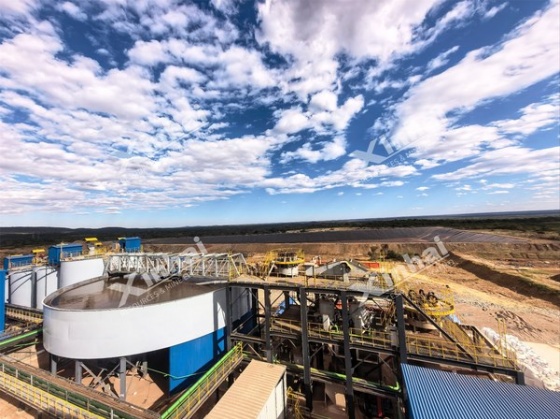
Thickener, cyclones and stacked tailings at a gold plant
The sequence is diagnostic before it is capital. Assay the impoundment at depth and across the footprint, because one composite sample hides exactly the variability that ruins a flowsheet. Then run bench and pilot testwork on the actual material, and design around the results rather than around a standard line. On a Kazakh asset this sits alongside the country's existing tax treatment of ore and concentrate, which already rewards processing in-country.
A Henan gold plant shows how much a retrofit can recover. Its tailings ran 500 t/d at about 43% solids, heavily slimed and slow to settle. Xinhai replaced the dewatering step with two-stage cyclones for concentration and classification, feeding the underflow to a multi-frequency dewatering screen and the overflow to the existing thickener. The screen produced about 60% of the feed at under 15% moisture, with overall water recovery at 75%. Treatment cost fell to 1.7 yuan per tonne, and the plant stopped buying bleaching powder.
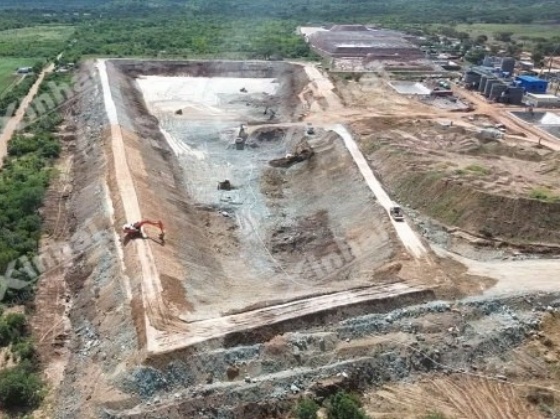
Lining works under way at a tailings storage facility
The tenfold tax cut improves the economics substantially, but profitability still depends on the grade left in the impoundment and on the cost of liberating it. A high-grade legacy dump can work; a low-grade one may not, at any tax rate.
Two reasons, and the tax was only one of them. The legal status of tailings as both waste and subsoil resource has made extraction rights unclear, and the material itself is harder to process than fresh ore.
Usually the metals the original circuit did not fully recover: copper, zinc, nickel, cobalt, and in some deposits rare metals. What is available depends on the orebody, the era of operation, and the recovery the plant achieved at the time.
Usually yes, but a much smaller one. The new tailings are the residue after a second recovery pass, and dry stacking or paste backfill often handles the volume without a new impoundment.
The tax cut answers whether Kazakhstan wants its waste processed. The plant answers whether it can be.
At Xinhai, we believe a legacy tailings project starts with sampling, not with equipment.
Share your tailings project with us. Let's find out what is actually still in the ground.
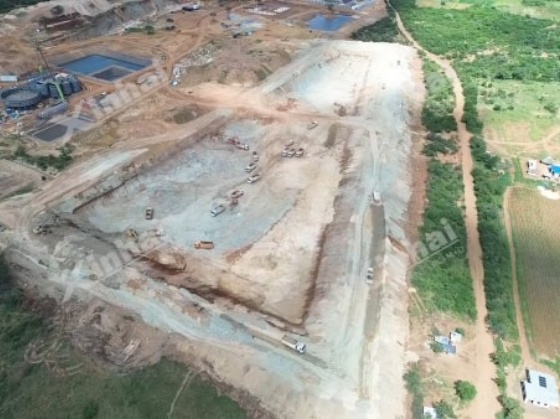
Gold tailings storage facility under construction
Sources
1,747 registered mine and industrial waste sites holding about 55 billion tonnes, with roughly 11% processed against 70%–80% in developed economies, plus the Metlen Energy & Metals evaluation — Mining.com.au, "Kazakhstan steps up mining waste recovery push", 22 October 2026, citing the Ministry of Industry and Construction.
Mineral extraction tax coefficient of 0.1 for metals recovered from man-made mineral formations from January 2026; Qarmet's ten projects valued at $137 million; the legal ambiguity of tailings as both waste and subsoil resource — Times of Central Asia and MINEX Forum, October 2026.
Annual growth of 300–700 million tonnes and ERG Recycling's annual throughput above one million tonnes — MINEX Forum, "Kazakhstan Eyes Industrial Revolution Through Waste Mineral Reprocessing".
Henan gold plant tailings dewatering retrofit (500 t/d, about 43% solids, two-stage cyclone concentration and classification, multi-frequency dewatering screen, roughly 60% screen yield at under 15% moisture, 75% water recovery, 1.7 yuan per tonne treatment cost) — Xinhai project records.
Equipment roles for feed stabilization, regrinding and tailings routing — Xinhai tailings re-processing line documentation and product specifications.
 +86 13811510145
