If you want to know more information (such as product/process price, etc.), please contact us 24-hour telephone
Tungsten is not mined where it is richest. It is mined where the orebody's shape allows it to be reached at a cost the grade can carry.
Skarn, quartz vein and porphyry deposits account for most tungsten production, and each points to a different combination of mining method and concentrator flowsheet. Get the pairing wrong and the mistake is expensive to undo, because a shaft and a plant cannot be relocated.
The pairing also decides how much rock reaches the mill. Tungsten grades run from a few tenths of a percent to a few percent, so most of what a mine hoists or hauls is waste. Whether that waste stays underground, or is rejected at surface before grinding, is settled long before anyone selects a flotation cell.
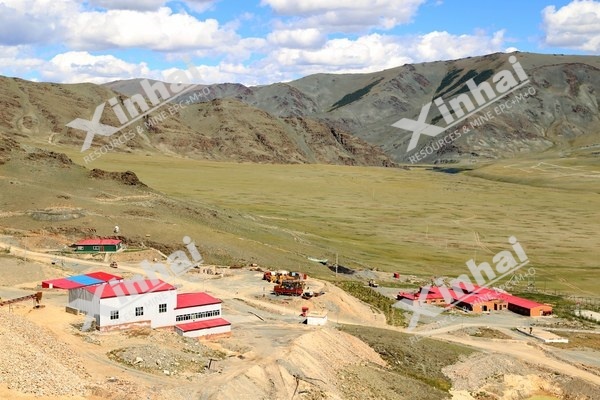
150 t/d tungsten plant in Mongolia
Tungsten deposits are narrow, deep and structurally complex often enough that underground work is the default. Open pit becomes viable only when the orebody is shallow and wide enough to justify moving the overburden.
Skarn deposits, the main source of scheelite, can go either way. They form where hot fluids from an intrusion react with carbonate rock, so mineralisation follows a contact rather than a vein. Where that contact reaches surface the pit can follow it; where it dips steeply the operation goes underground.
Vein and stockwork deposits sit in granite intrusions emplaced one to four kilometres down, so the ore is usually deep, though outcrops do get mined by open pit. These are the classic wolframite hosts, with the mineral spread across narrow quartz veins rather than one continuous body. That geometry rewards selective mining: take the vein, leave the wall rock.
Porphyry deposits run the other way: low grade, spread across a large rock volume, which rules out anything except bulk open-pit removal. The cost per tonne moved is low; the grade leaves no other option.
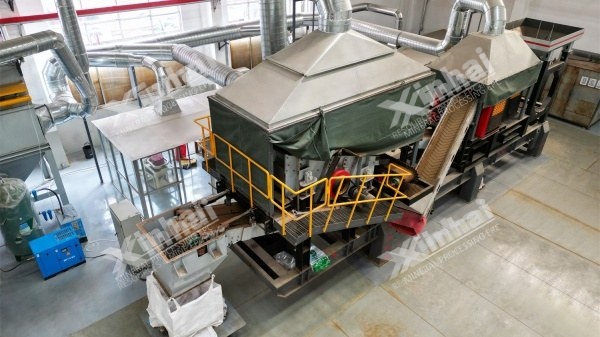
Pilot-scale crushing equipment
| Deposit type | Mining method | WO3 grade | Beneficiation |
| Skarn | Underground or open pit | 0.3–1.4% | Magnetic, gravity, flotation |
| Vein and stockwork | Underground or open pit | Variable | Gravity, flotation, DMS, leaching |
| Porphyry | Open pit | 0.1–0.4% | Gravity, flotation |
| Disseminated | Underground | 0.1–0.5% | Magnetic, gravity, flotation |
The skarn row is where most tungsten sits. Its grade range is also the widest, which is why the same deposit type can support a small underground operation and a large open pit on different parts of the same system.
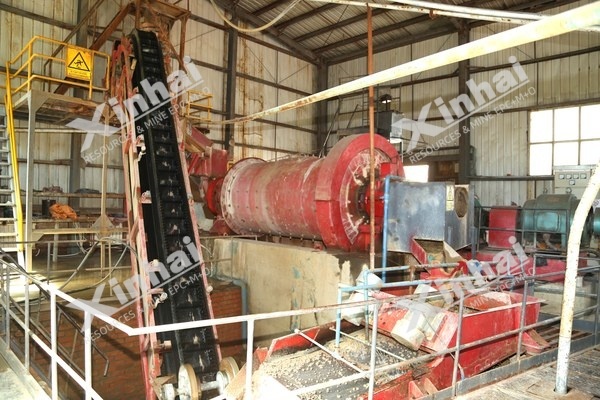
Ball mill and feeder inside the mill building
The mining method fixes three things the concentrator has to live with.
Top size. Coarse run-of-mine from an open pit needs crushing stages before grinding; underground ore broken to a finer fragmentation can skip some of them.
Grade going in. Selective underground mining sends higher-grade ore to the mill; bulk open-pit mining sends dilution with it, which shifts the cut-off decision.
Reject before grinding. When ore arrives as coarse lumps, photometric or dense-medium sorting can discard waste before it ever reaches a mill.
The mineralogy then sets the separation route. Wolframite runs roughly 7.1–7.5 g/cm3 and responds to gravity: jigs and shaking tables for the coarse fractions, spirals for the fine, and flotation for the slimes that density alone cannot recover. Scheelite is lighter, so gravity loses its grip and flotation carries the circuit, with fatty acid or hydroxamate collectors and sodium silicate suppressing calcite and silicate gangue.
The Mongolia 150 t/d tungsten plant, built by Xinhai, shows how much the ore's condition matters. Run-of-mine arrived at 200 mm and below with a WO3 grade around 7%, medium hardness, and moisture and slimes both under 6%. Tungsten was not liberated above 1 mm, so the circuit ground to minus 1 mm before any separation, then ran jigs and shaking tables on the coarse fractions and sent the slimes to a separate step.
Low-grade material tells the other side. For a 1 Mtpa tungsten tailings project in Uzbekistan, Xinhai designed classified gravity separation followed by reverse flotation for desulfurization, splitting the feed into three narrow size fractions so each could run at its own gravity parameters. From 0.06% WO3 the design targets a 40% concentrate at 30% recovery. That grade sits two orders of magnitude below the Mongolia case, and the flowsheet is built around it rather than around a standard template.
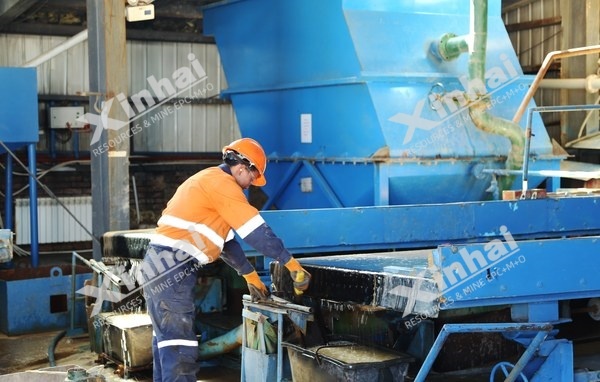
Adjusting a shaking table
Both. Underground dominates because most orebodies are narrow and deep, but shallow, wide, low-grade deposits such as porphyry are mined by open pit where bulk removal is cheaper.
Published figures put skarn at 0.3–1.4% WO3 and porphyry at 0.1–0.4%. Those are geological ranges, not economic thresholds; each cut-off grade comes from that project's own mining, processing and metal price assumptions.
Wolframite is dense, around 7.1–7.5 g/cm3, so gravity separates it from lighter gangue cheaply. Scheelite's density difference is too small, and flotation works on its surface chemistry instead.
In practice yes. Grades sit near or below 1% WO3, so hauling raw ore any distance carries mostly waste rock. Concentration happens next to the mine, and the tailings stay there.
Mining method and flowsheet are one decision, made from the orebody rather than from a preference for shafts or trucks.
At Xinhai, we believe the plant should be designed for the ore the mine will deliver.
Share your tungsten project with us. Let's work out the method and the flowsheet together.
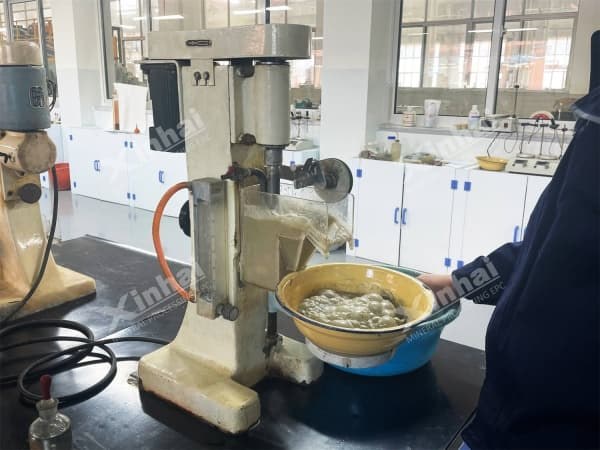
Laboratory flotation test
Sources
Deposit types, mining methods, WO3 grade ranges and beneficiation routes — A Review of Tungsten Resources and Potential Extraction from Mine Waste, Table 3.
Wolframite gravity circuit and Mongolia 150 t/d plant parameters (WO3 around 7%, feed to 200 mm, slimes and moisture under 6%, grind to minus 1 mm) — Xinhai project records.
Scheelite flotation practice (fatty acid and hydroxamate collectors, sodium silicate depression of calcite and silicate gangue) — Xinhai scheelite production line documentation.
Uzbekistan 1 Mtpa tungsten tailings project (classified gravity separation plus reverse flotation; three size fractions; 40% concentrate at 30% recovery from 0.06% WO3) — Xinhai engineering design records.
Grade ranges are published geological figures, not economic thresholds. Cut-off grades depend on each project's mining, processing and metal price assumptions.
 +86 13811510145
