If you want to know more information (such as product/process price, etc.), please contact us 24-hour telephone
Oxidized silver ore floats poorly. Its minerals carry a hydrated surface. Xanthate collectors cannot anchor on that surface. Sulfidization flotation (adding sodium sulfide to rebuild a floatable film on oxidized mineral surfaces) fixes this. The treated surface accepts the same collectors a sulfide flotation plant already uses. The sections below cover the chemistry, the four control points, and the tests that size the circuit. This route sits inside the wider set of silver ore processing methods, and the silver flotation process page shows the standard line it plugs into.
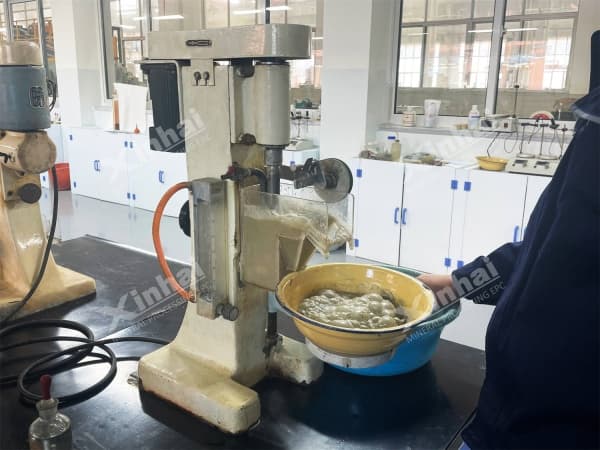
Laboratory flotation test on silver ore feed.
Chlorargyrite (silver chloride) is the main oxidized silver mineral. Iodargyrite and embolite sit beside it in many deposits. Acanthite, the natural silver sulfide, often carries an oxidized skin after weathering. All these families share one problem. The surface hydrates, and the salt dissolves in part. Silver ions move into the pore water. A collector needs a stable surface to adsorb on. A hydrated, dissolving one gives it nothing to hold.
The losses concentrate in the fine fraction. A tailings study at the Goltsovoe deposit found 123 g/t of silver in the minus 40 micron class. That class held about half the mass yield. Recovery stalls, and the value leaves with the slimes.
Sodium sulfide is the standard sulfidizing reagent. In water it releases S2- and HS- ions. The S2- ion meets the silver salt surface and converts it to silver sulfide. The new layer is far less soluble and far less hydrated. Xanthate now adsorbs on it the way it adsorbs on any sulfide mineral.
Two facts decide whether the film helps. First, the film is fresh. Dissolved oxygen and residual sulfide slowly degrade it. The pulp should reach the cells soon after conditioning ends. Second, the dose has a ceiling. Excess S2- and HS- coat the particles themselves and work as a depressant. More sodium sulfide can mean less recovery. Plants that learned this the hard way add Na2S close to the cell feed, in stages.
Four control points separate a working circuit from a wasted reagent shed.
| Control point | What goes wrong without it | Typical range |
|---|---|---|
| Na2S dosage | Too much depresses the pulp; too little leaves salt surfaces unfilmed | Set by a dosage curve; often 100 to 300 g/t |
| pH | Film formation slows, or excess HS- builds up | About pH 8 to 10 |
| Collector match | Poor selectivity sends silver into gangue slimes | Xanthate blends; specialty collectors on hard ore |
| Conditioning time | Too short leaves the film unformed; too long lets it age | Set by a timed float test |
Dosage and collector interact. The Goltsovoe test work settled on 150 g/t of sodium sulfide with 300 g/t of butyl xanthate, at 85 to 95 percent minus 74 micron grinding. Silver recovery moved from 70.7 to 84.8 percent. On a complex lead-silver ore, a separate study compared collector families. Aerophine 3418A showed the best selectivity for silver, and a closed laboratory circuit reached 87.8 percent silver recovery. Both numbers are starting points. The ore's deportment, test work, and plant pH decide the final figures. Cells matter here too. The XJB bar flotation cell is the unit Xinhai assigns to fine oxide silver duty.
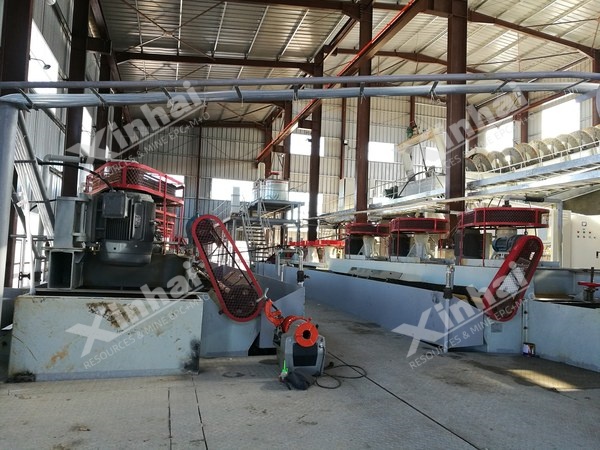
Flotation cell row, 500 t/d silver plant, Morocco.
Coarse silver skips chemistry. Native silver and cerargyrite are dense. Density still works when the surface rejects collectors, and that is the point. A jig or a shaking table catches them before the pulp reaches flotation. This preconcentration does two things. It removes particles a collector would miss anyway. It also trims the reagent bill for the rest of the circuit. The fines still carry silver, so the flotation stage stays. Spiral chutes cover the intermediate sizes between the two routes.
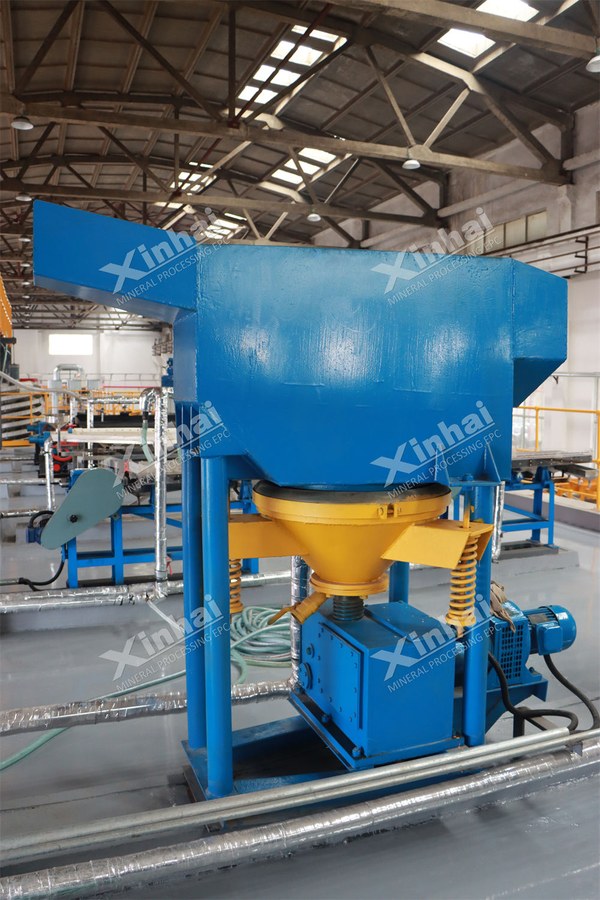
Pilot jig unit for coarse silver preconcentration.
Scale is the other half of the decision. A 500 t/d silver flotation project in Morocco shows what Xinhai builds at this size. The ore carried native silver and pyrite in a quartz-feldspar gangue with clay and limonite. The flowsheet runs two-stage semi-closed crushing, two-stage grinding, then flotation with one roughing pass, three scavenging passes, and two cleaning passes. Concentrate and tailings each pass through two dewatering stages. The plant reached stable production. The project record lists a final production cost 15 percent below the customer's expectation.
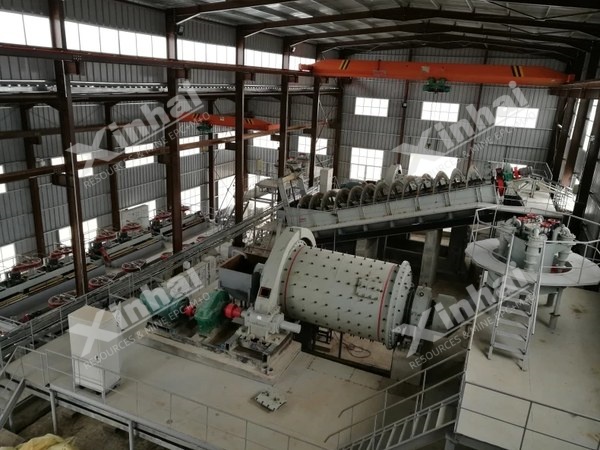
Two-stage grinding section, 500 t/d silver plant, Morocco.
The route starts in the laboratory. A deportment analysis shows which minerals carry the silver and at what liberation size. Four tests follow:
A silver deportment analysis, to confirm how much silver is oxidized and how much stays locked;
A sodium sulfide dosage curve at the plant pH, to find the peak before depression begins;
A timed conditioning test, because the film ages and its working window is measurable;
A locked-cycle run, with and without gravity preconcentration, on the same feed.
One boundary case deserves a sentence. Ore dominated by silver chloride can also respond to leaching, and the cyanidation design points differ from flotation ones. The test comparison should make that call, not habit.
Oxidized silver rarely travels alone. In lead-zinc districts it sits with cerussite and anglesite, the oxide and sulfate lead salts. Those minerals need the same treatment. Sodium sulfide films their surfaces, and the lead floats with the silver riding on it. The control points stay identical: dose, pH, collector, timing. Industrial closed-circuit tests on a low-grade oxidized lead-silver ore reached 67.7 percent lead recovery and 87.6 percent silver recovery with flotation alone.
A dosage curve answers this for each ore. Published work gives one reference point. The Goltsovoe tests settled on 150 g/t of sodium sulfide with 300 g/t of butyl xanthate. Excess sulfide depresses flotation, so the curve must show both the peak and the drop after it.
No. The film forms on surface-oxidized species such as chlorargyrite. Native silver and silver sulfides already float with ordinary collectors. Silver locked inside silicate grains stays lost unless grinding frees it first.
It can be. Chloride-rich ores sometimes leach better than they float. The choice depends on the deportment analysis and comparative tests. Large tonnage plants usually favor flotation for reagent cost and water balance.
Send the silver grade, a deportment or phase analysis, liberation size data, the main gangue minerals, and any prior flotation or leach tests. Capacity and site water conditions help size the circuit. With those inputs, a preliminary route can be drafted before locked-cycle work.
Oxidized silver punishes guessing. Send a sample with a deportment analysis, and our process team will run the sulfidization curve your ore supports, then size the circuit around it.
Sources
Sulfidization of silver-polymetallic ores of the Goltsovoe deposit for decreasing loss of silver in mill tailings, DOAJ, doaj.org/article/7581b2c275c941ebaab84777ed95cd98
Sulfidizing Behavior of Complex Lead-Silver Ore: A Flotation Study, Minerals 2021, 11(4), 434, MDPI, doi.org/10.3390/min11040434
Xinhai Mining, Morocco 500 t/d silver mine flotation project record and silver ore processing route, miningepc.com
 +86 13811510145
