If you want to know more information (such as product/process price, etc.), please contact us 24-hour telephone
Africa, with its vast landmass, hosts some of the world’s richest gold deposits, making it a key player in global gold production. Efficient gold ore processing is the critical step that converts mined ore into profit and supports the continent’s rapidly growing mining industry. This guide covers Africa’s geological framework and major gold-producing countries, while providing practical insights for setting up a profitable gold processing plant with minimal hassle.
We delve into core processing methods, equipment selection, investment planning, and the significant advantages of integrated EPC solutions for ensuring project success.
Africa pretty much owns the global gold scene these days, churning out massive tonnage thanks to a handful of heavyweight countries and all kinds of different deposits. If you’re planning to put up a gold processing plant in Africa, you’d better wrap your head around this picture first.
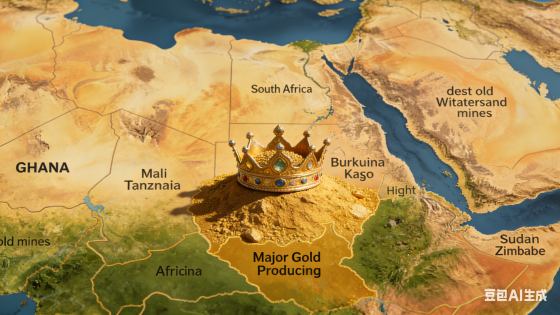
Ghana’s been wearing the crown lately—now officially Africa’s biggest gold pumper. South Africa still hangs in there with those crazy-deep old Witwatersrand mines, while Mali, Tanzania, and Burkina Faso are right up there too. Throw in Sudan and Zimbabwe and you’ve got the real muscle behind most African gold mines.
The following table highlights some of the top contributors to Africa gold mines output:
| Country | Estimated Annual Production (2023) | Major Gold Regions |
|---|---|---|
| Ghana | ~ 100 tonnes | Ashanti Belt, Sefwi Belt |
| South Africa | ~ 90 tonnes | Witwatersrand Basin (Gauteng, Free State) |
| Mali | ~ 70 tonnes | Syama, Loulo-Gounkoto |
| Tanzania | ~ 60 tonnes | Lake Victoria Goldfields, Geita |
| Burkina Faso | ~ 55 tonnes | Houndé, Mana, Essakane |
| Sudan | ~ 50 tonnes | Block 15, Block 14 (Nubian Desert) |
| Zimbabwe | ~ 40 tonnes | Midlands Greenstone Belt |
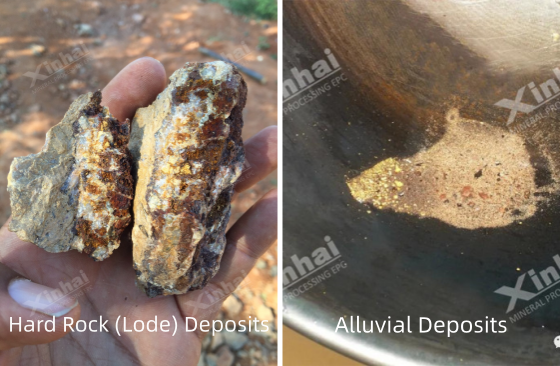
How you set up your gold ore processing totally hinges on what kind of ground you’re dealing with:
Hard Rock (Lode) Deposits: Gold stuck inside quartz veins deep in solid rock. This is the bread-and-butter feed for proper big plants, but man, it takes a serious beating—lots of crushing and grinding.
Alluvial Deposits: Loose gold flakes just sitting in river gravel. Way cheaper and simpler—mostly gravity stuff—but the patches are usually small and run out fast.
Refractory Ores: Gold locked up tight inside sulfide minerals. Nasty stuff. You’ve got to roast it or do some other fancy pre-treatment first, and yeah, that jacks the price up big time.
The ore's mineralogy dictates the choice of processing method for African gold processing. From simple, low-cost setups for alluvial gold to complex plants for refractory ores, the continent employs a range of technologies to maximize recovery efficiently and economically.
Uses gold’s high density to separate it from lighter minerals, effective for coarse, free gold, especially in alluvial deposits. Common equipment includes shaking tables, spiral concentrators, and centrifugal concentrators.
Industry standard for free-milling oxide ores: gold is leached with cyanide and adsorbed onto activated carbon, then eluted and recovered as doré. Essential for both oxide and pre-oxidized refractory ores.
Recovers gold from sulfide ores by making gold-bearing particles attach to air bubbles and float, while waste sinks. Flotation concentrate is often further processed via CIL or smelting.

To optimize recovery and economics, plants often combine methods in mixed circuits.
Gravity + CIL: A highly efficient circuit where gravity first recovers coarse free gold, and the remaining finer gold in the tails is leached by CIL. This lowers cyanide consumption and increases overall recovery.
Flotation + CIL: Used for complex ores where gold is both free-milling and locked in sulfides. Flotation produces a sulfide concentrate, which may be reground and fed to the CIL circuit, or sold/smelted directly.
When to Choose a Hybrid Process: Mixed circuits are selected when the ore contains multiple gold types (e.g., both free and refractory), when pre-concentration can significantly reduce downstream costs, or when maximizing overall recovery from a complex deposit is critical.

The efficiency of an African gold processing plant hinges on selecting the correct equipment for each stage, balancing performance, durability, and capital cost.
Primary crushers for gold ore, like jaw and cone crushers, reduce run-of-mine rock. For grinding, a ball mill for Africa is standard, chosen based on ore hardness and target throughput. Rod mills may suit softer ores. This stage accounts for a major share of both power consumption and initial investment.
The core of a CIL/CIP circuit is the CIL tank Africa setup—a series of large, agitated tanks. Robust gold adsorption equipment, including submerged screen pumps and inter-tank screens, is critical. Tanks and agitators must use corrosion-resistant materials (e.g., stainless steel, specialized linings) to withstand the cyanide slurry.
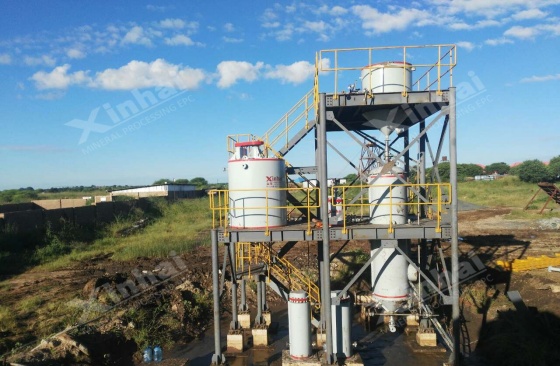
The gold recovery equipment system strips gold from loaded carbon and recovers it via electrowinning. The resulting sludge is smelted in a furnace. Modern gold refining setups in Africa must incorporate scrubbers and filters to meet stringent environmental regulations on emissions.
Support systems are vital: thickeners for water recovery, filters for tailings management, and conveyors for material transfer. Their specifications directly impact plant stability and water/energy efficiency.
Gold Processing Plant Equipment Table (500 TPD Example)
| Equipment Category | Key Function | Typical Capacity/Spec for 500 TPD Plant | Example Model/Type |
|---|---|---|---|
| Crushing | Primary size reduction of ROM ore | 40-60 t/h, Feed size<500mm | Jaw Crusher (e.g., PE600×900) |
| Secondary Crushing | Further crushing to ~25mm | 30-50 t/h | Cone Crusher (Single Cylinder) |
| Grinding | Fine grinding to liberate gold (~75µm) | 20-25 t/h, with cyclones | Ball Mill (Φ3.2×4.5m) |
| Leaching & Adsorption | Gold dissolution and recovery onto carbon | 6-8 tanks, ~250 m³ each | CIL/CIP Tanks with Agitators |
| Solid-Liquid Separation | Clarification and washing of leached slurry | Dia. 12-15m | High-Efficiency Thickener |
| Carbon Handling | Adsorption, transfer, and screening | Flow rate: 15-20 m³/h | Interstage Screen & Pump |
| Gold Recovery | Stripping gold from loaded carbon & electrowinning | Batch system for 1-2t carbon | Stripping Column & Electrowinning Cell |
| Smelting | Melting gold sludge into doré bars | 50-100 kg/batch | Induction Furnace |
| Material Handling | Transport of ore & slurry between stages | Belt width: 650-800mm | Belt Conveyors & Slurry Pumps |
| Power & Control | Plant power supply and process automation | 500-800 kVA | Transformer & PLC Control System |
Establishing a 300–1000 TPD gold plant cost Africa involves significant capital expenditure (CAPEX), typically ranging from $10 million to $50+ million, influenced by location, process complexity, and infrastructure. Key CAPEX components include processing equipment, construction, and infrastructure. Operational expenditure (OPEX) is dominated by grinding media, reagents, labor, and energy, with the latter often being the single largest variable cost. Partnering with an experienced firm can optimize the total EPC cost Africa through integrated design and procurement.
| Cost Category | Typical Distribution | Notes |
|---|---|---|
| Equipment & Installation | 40-50% | Major mills, tanks, and material handling. |
| Site Construction & Civils | 20-30% | Foundations, buildings, and plant layout. |
| Infrastructure & Utilities | 15-25% | Power, water, and tailings storage. |
| Engineering & Contingency | 10-15% | Design, project management, and buffer. |
Operators face common African gold processing challenges, requiring practical solutions.
For low-grade ore, increasing flotation or CIL concentration efficiency is key.
Unreliable power and water supplies necessitate investments in on-site generators and water-recycling systems.
Addressing the skills gap often relies on comprehensive training programs provided by experienced EPC contractors during commissioning.
When you’re tackling a gold plant EPC Africa job, teaming up with a battle-tested EPC contractor Africa gives you a massive edge: one throat to choke, full turnkey package. That all-in-one setup keeps everything in sync—from the first sketches and hunting down gear worldwide to throwing steel on the ground and flipping the switch at handover. No more finger-pointing between twenty different suppliers, no endless delays, no budget suddenly blowing out. You get firm deadlines, everything actually fits together, and someone who can’t duck the responsibility.
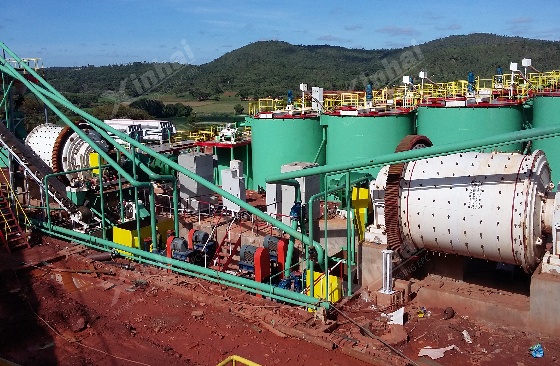
Take the 700 t/d gold processing plant we built in Zimbabwe. The ore was running a solid 6 g/t—pretty rich stuff. We ran the whole show under our EPCM+O umbrella, looking after the project from cradle to grave. Threw in a closed-circuit grinding setup married to gravity recovery so the fat gold dropped out early, then a properly tuned cyanidation-leaching line and smelting circuit. Every workshop layout, every dust collector, every safety guardrail—we handled the lot. Result? Finished bang on time, hit the recovery numbers we promised, and the client’s bank account looked a lot happier.
Ready to build your gold plant in Africa? Consult our expert team for a personalized flow sheet and a detailed quote to launch your project.
 +86 13811510145