If you want to know more information (such as product/process price, etc.), please contact us 24-hour telephone
In the entire process of molybdenum ore development, experimental research on beneficiation technology plays a crucial role. It is not merely preliminary work but rather a key process that transforms geological reserves into profitable industrial indicators. For "refractory" molybdenum ores characterized by complex composition, unique dissemination properties, or numerous interfering minerals, a scientific, systematic, and forward-looking beneficiation test is the decisive link for avoiding investment risks and optimizing project economics. This article systematically elaborates on the complete logic and practical value of professional beneficiation testing.
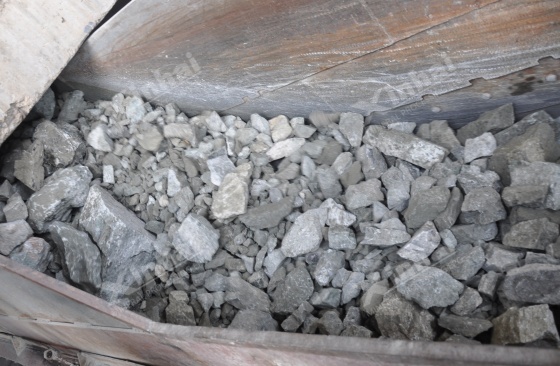
Facing complex and refractory molybdenum ores, successful beneficiation testing is a critical step in the design and construction of a molybdenum processing plant. It should follow a rigorous procedure from principles to simulation, with the core steps as follows:
The starting point for any effective process stems from a profound understanding of the ore's intrinsic nature. Work at this stage goes far beyond chemical analysis. Utilizing professional methods such as microscopy (ML) and scanning electron microscopy (SEM), it aims to clarify several fundamental issues:
Occurrence State of the Target Mineral: Does molybdenum exist as molybdenite, or as other molybdates? What are its crystal grain size and dissemination characteristics? Is it uniformly distributed, or is it closely associated with minerals such as pyrite, calcite, and fluorite?
Key Process Mineralogy Parameters: Determine the theoretical liberation size that needs to be achieved, predict potential slime generation tendencies during grinding, and identify the main sources of impurity minerals affecting concentrate quality.
This foundational research provides an irreplaceable theoretical basis for all subsequent process selections.
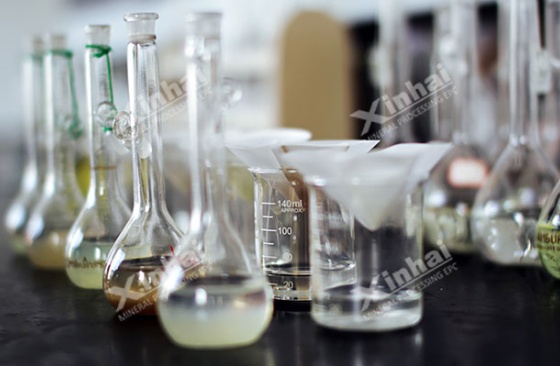
After clarifying the ore properties, testing moves into the core stage of process exploration.
Confirmation of Beneficiation Method: Typically, molybdenite is recovered using the flotation method. However, for certain special ores, it may be necessary to compare the advantages and disadvantages of different methods, such as flotation, gravity separation, or even leaching.
Exploration of Crushing & Grinding Process: Through systematic grind size tests, find the balance point between "degree of monomer liberation" and "risk of over-grinding." For ores with special hardness or toughness, grindability tests are also required to provide key data for future mill selection at the plant.
Flotation Reagent Scheme: This is key to processing complex ores. Testing needs to be done one by one:
Depressants and Their Dosage: How to selectively depress easily floatable gangue minerals (e.g., calcium-containing fluorite, calcite)? Should sodium silicate, carboxymethyl cellulose, or combined reagents be used?
Collectors and Frothers: Considering molybdenite's natural hydrophobicity, should kerosene, diesel, or new high-efficiency collectors be chosen? How should the type and dosage of frother be matched?
Pulp Chemistry Adjustment: What is the impact of pulp pH on separation efficiency? Is it necessary to add lime, soda ash, etc., for adjustment?
This process builds a response model between reagents and performance indicators through extensive comparative testing.
After determining the test conditions, open-circuit flowsheet testing is required to establish a rational flowsheet structure (e.g., number of roughing, cleaning, and scavenging stages, and middlings treatment method). Finally, closed-circuit cycle testing simulates the real state of continuous material separation and middlings recirculation in future industrial production. The stable indicators obtained (concentrate grade, recovery, yield) serve as a reliable basis for project technical and economic evaluation, directly determining the project's feasibility and profit margin.
The following two cases from Xinhai Mining's historical projects demonstrate from different perspectives the value of systematic testing in solving practical challenges.
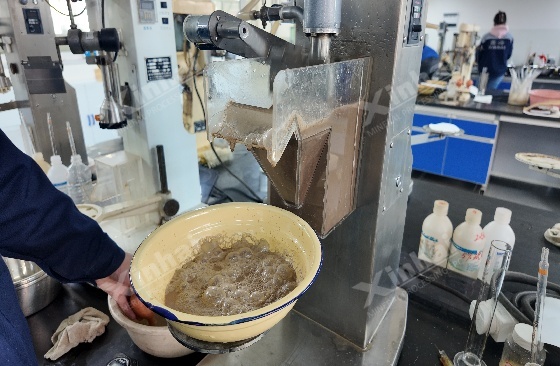
In a molybdenum ore project for a mining enterprise in Fujian Province, the comprehensive sample provided by the client assayed about 0.50% Mo. Through systematic condition and closed-circuit tests, the process flowsheet we determined ultimately achieved excellent indicators: a molybdenum concentrate grade of 52.36% and a recovery of 96.34%.
However, considering potential fluctuations in run-of-mine (ROM) ore grade during future mining operations, the project further required test verification for low-grade ore (approx. 0.26% Mo). Based on adjustments and verification of the established process principles, results showed that even at this lower grade, qualified molybdenum concentrate with a grade of 50.36% and recovery of 95.11% could still be obtained.
This case demonstrates that a comprehensive test study not only addresses the current sample but also provides technical reserve and confidence for resource variations that may be encountered throughout the mine's lifecycle.
Another case involves a tungsten-molybdenum associated ore located in Kazakhstan. Tungsten (scheelite) was the primary element for recovery in this ore, but it contained a large amount of fluorite with floatability similar to scheelite, causing serious interference, while the molybdenum content was relatively low.
Confronted with this challenge, our test research started with in-depth mineralogical identification, clarifying the distribution and dissemination characteristics of fluorite. Process-wise, a complex flowsheet was adopted: "Sulfur Pre-flotation — Scheelite Roughing at Ambient Temperature — Heating, Stirring, and De-reagent Cleaning of Rougher Concentrate."
In the cleaning stage, through numerous condition tests, the combination and dosage of modifiers and depressants such as sodium silicate, sodium hydroxide, and sodium sulfide were optimized, successfully achieving efficient depression of fluorite. The final closed-circuit test effectively controlled impurities while comprehensively recovering tungsten. This case highlights our capability in fine reagent control and complex flowsheet design when dealing with complex associated ores where mineral properties are similar, and separation is extremely difficult.
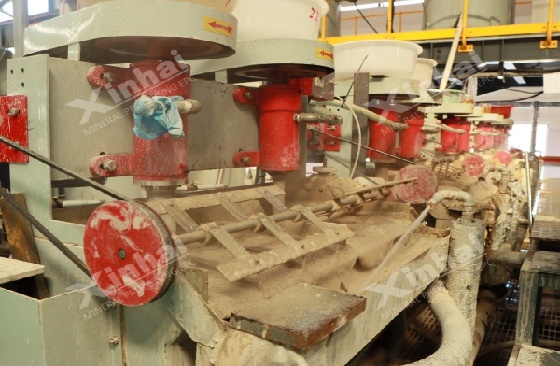
Choosing a professional partner for beneficiation testing offers value far beyond obtaining a report. Relying on the "Mining Full Industry Chain Service (EPC+M+O)" model, Xinhai endows beneficiation testing with unique advantages.
We not only possess a CNAS nationally accredited laboratory, ensuring data accuracy and authority, but also can conduct continuous pilot-scale testing. Pilot testing serves as a bridge between laboratory and industrial production, effectively verifying process stability and equipment adaptability, significantly reducing scale-up risks.
More importantly, our global EPC project construction and production operation practices have accumulated valuable on-site data and experience. This allows our test research to proceed from the perspective of industrial production, fully considering process reliability, equipment operability, and cost economics during the design phase, avoiding the generation of "paper-optimized" solutions.
As a potential EPC contractor who may undertake subsequent design, construction, and even operation, our depth of understanding and sense of responsibility towards test results are fundamentally different. We are acutely aware that an overly idealized test plan or one that ignores engineering constraints will incur enormous costs in later stages. Therefore, our testing objective consistently pursues industrializable indicators that are low in full lifecycle comprehensive cost and achievable stably, not merely theoretical peaks in the laboratory. This integrated "pre-testing, post-plant" responsible perspective ensures the coherence of the technical solution from source to endpoint.
Beneficiation testing is a science reliant on experience and innovation. We have a stable team composed of senior engineers and researchers, long dedicated to tackling beneficiation technological challenges for various complex ores. Continuous project experience transforms into profound technical expertise, enabling us to identify ore characteristics more rapidly, judge technical routes more accurately, and solve new problems encountered during testing more efficiently.
For complex and refractory molybdenum ores, beneficiation process testing is by no means a routine procedure to be treated hastily. It is a systematic technical diagnosis and solution rehearsal, the "first cornerstone" determining whether investments of hundreds of millions or even billions can achieve expected returns. A rigorous, reliable test report with an industrial vision is the source of investor confidence and a solid starting point for project success.
If you have complex and refractory molybdenum ore requiring beneficiation testing, or are selecting an EPC contractor.
Please get in touch with Xinhai! WhatsApp: +8613811510145.
 +86 13811510145