If you want to know more information (such as product/process price, etc.), please contact us 24-hour telephone
The zinc market delivered a rare signal in August 2026: LME zinc climbed to a four-year high while zinc concentrate treatment charges (TCs) — the fees mines pay smelters to process their ore — turned negative for the first time on record.
A negative TC means a smelter not only forfeits its processing fee on every tonne of concentrate it treats; it effectively pays for the privilege. Profit along the zinc value chain has flipped — from the smelter to the mine.
First, LME zinc spot closed near US$4,100/t on 27 August — the highest level since June 2022 and roughly 55% above the mid-2025 low of about US$2,650/t. Three-month futures rose for a seventh consecutive session, holding above US$3,850/t.
Second, spot TCs for imported concentrate slid from positive territory at the start of the year to around − US$110/dry tonne — profit has shifted almost entirely upstream, to the mines.
Third, LME-registered warehouse stocks fell from roughly 260,000 t at end-2024 to just over 90,000 t, a drawdown of more than 60%.
Three numbers, one conclusion: this is a supply story, not a demand story. The ore is running short.
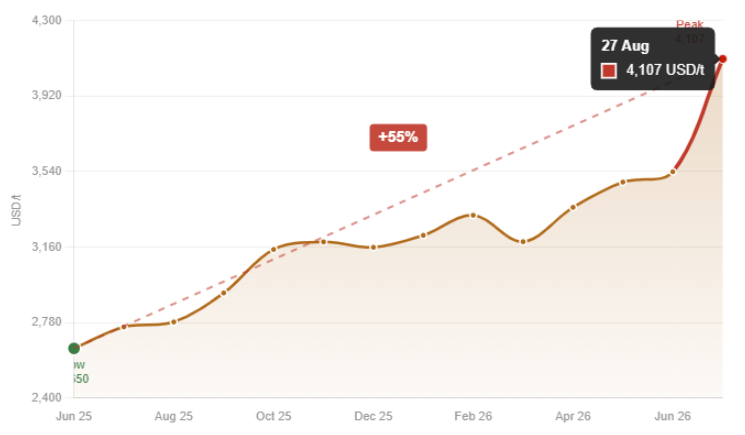
Figure: LME zinc price, June 2025 – August 2026.From a low of ~US$2,650/t in mid-2025 to a peak of US$4,107/t on 27 August 2026 — a gain of approximately 55%. Sources: INSEE monthly average spot prices; Mining.com / Fastmarkets spot peak. For informational purposes only; not investment advice.
Output is falling in volume, but the deeper problem is quality. Declining head grades are the harder trend to reverse.
First-quarter results from leading producers confirm it. Glencore's mined zinc output fell 17% year-on-year. Teck's Red Dog mine in Alaska saw production slip from 117 kt to 106 kt on lower grades. An earthquake at the Garpenberg mine in Sweden removed an estimated 70 kt from annual output, and Antamina in Peru expects production down more than 200 kt year-on-year.
A new mine takes eight to ten years from discovery to first production — too slow to close a near-term deficit. Grade decline at mature operations, meanwhile, is a geological fact that no management practice can undo.
The arithmetic is stark. When head grade falls from 4% to 3%, every tonne of refined zinc requires roughly one-third more ore to be mined, hauled, ground, floated and dewatered — lifting cost at every stage of the operation.
Grade decline is irreversible. The metal lost in the concentrator is not.
Negative TCs mean profit now sits almost entirely with the mine. Every additional kilogram of zinc recovered from a tonne of ore is sold at historically high prices; every kilogram lost is cash off the table. On the same orebody, the difference between a well-run and a poorly-run concentrator can swing annual revenue by millions of dollars.
The levers are well established, but each takes discipline:
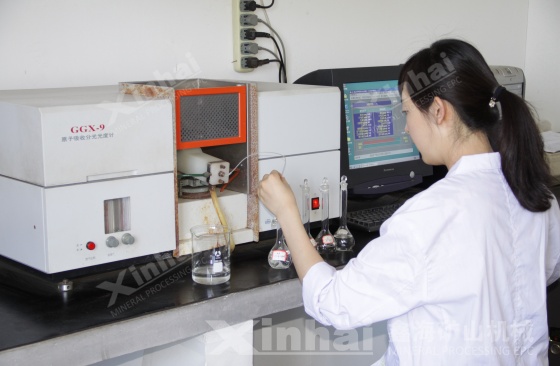
Testwork first. Ore characteristics vary widely; copying a neighbor's flowsheet is a common and costly mistake.
Fit-for-purpose flowsheets. High-sulfide zinc ores, zinc-oxide ores, and marmatite each demand their own approach — and the hardest ores often hold the largest upside.
Grinding and reagent optimization. Coarse grinding under-liberates valuable minerals; overgrinding depresses flotation performance and wastes energy. Stage-wise reagent addition and precise control are fundamentals, not refinements.
Automation and tailings re-processing. Real-time control of the grinding and flotation circuit — plus a second look at what remains in the tailings stream — recovers value that would otherwise be lost.
What does this look like in an actual plant?
In autumn 2025, Shandong Xinhai Mining was awarded the EPC contract for a 1,000 t/d zinc flotation plant in Mongolia — a project that combined nearly every challenge of building a concentrator in an era of declining grades: winters of −-30℃, an arid highland site with severe water scarcity, and a mature orebody.
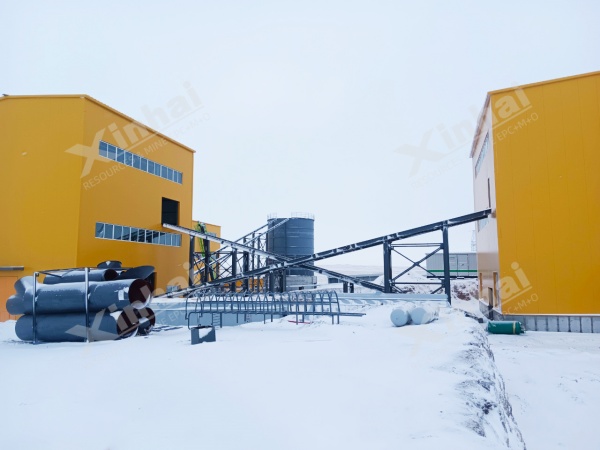
Cold. Erection was planned around the seasons. Outdoor installation was completed before the depth of winter; crews returned for indoor installation and hook-up once heating was live. The schedule pushed forward where possible — and never fought the climate head-on.
Water. The plant integrates filtered dry-stack tailings with a closed-circuit water system: process water is recovered in thickeners and from filter cake, then reused. On a water-scarce site, this is not an environmental gesture — it is what keeps the plant running.
Efficiency. Plant-wide automation and an on-site assay laboratory keep grinding, flotation and thickening under real-time monitoring and control.
Scale. Bolted thickeners of 15 m and 20 m diameter deliver a compact footprint with high throughput — the first application of large-diameter bolted thickeners in a Xinhai EPC project.
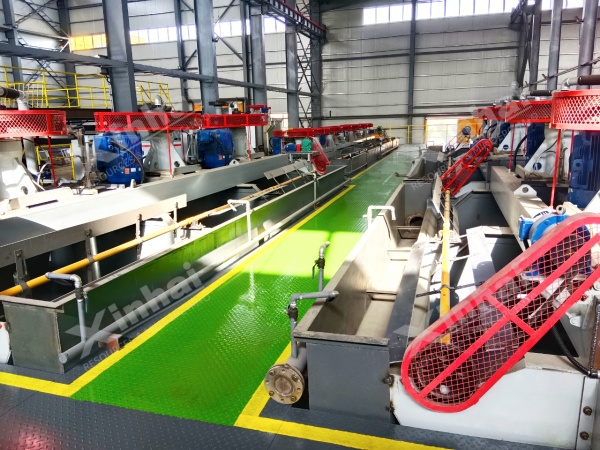
The strongest endorsement: the client came back. Xinhai delivered a 3,500 t/d iron ore processing project for the same owner in 2018; seven years later, that owner returned to Xinhai for its zinc plant. In this industry, repeat business says more than any brochure. Equipment installation is now complete, and the plant has entered commissioning.
Re-examine your ore. Many concentrators still run flowsheets designed for an orebody the mine no longer delivers — the ore has changed, but the flowsheet has not.
Audit your recovery. Grind size, reagent regime and residual zinc in tailings — each can hide recoverable value.
Treat tailings as a resource. At current prices, material that was once uneconomic to re-process may now pay its way.
Shandong Xinhai Mining delivers end-to-end EPC services — from testwork and flowsheet design to equipment manufacturing, installation, commissioning, and operations management.
 +86 13811510145