If you want to know more information (such as product/process price, etc.), please contact us 24-hour telephone
Heated flotation or room temperature? For scheelite, the gangue answers. Not the head grade, not the plant size. Quartz and silicate gangue leaves both routes open. Fluorite gangue makes heating mandatory. Calcite gangue strains either one.
The symptom that sends people looking is always the same. Roughing looks fine. The cleaners stall. Concentrate sits near 30% WO3 no matter how the crew trims the reagents. That ceiling was set by the gangue, at the design stage, before the first ton of ore was crushed.
Scheelite is calcium tungstate, CaWO4. Calcite and fluorite are calcium minerals too. Same surface sites, same appetite from a fatty-acid collector, so the collector grabs all three hard and sorts none of them well. What lands in the rougher concentrate, then, is a calcium mix.
Every cleaning stage has one job after that. Strip calcite and fluorite off. Leave scheelite on. Extra cleaning cannot buy back a grade the gangue is holding down. The flowsheet has to block the gangue first, at the front, or every stage downstream repeats the same losing fight.
Our scheelite flotation process page breaks that separation down by mineral pair. This article covers the route call above it.
The heated route is the Petrov process. Roughing runs loose on purpose, so calcite floats up with the scheelite and nobody fights it there. The fight happens later, on the rougher concentrate alone, where the equipment can win it.
That is where the numbers sit. Concentrate the rough concentrate to 50-70% solids, 60% in practice. Sodium silicate to 2.5-3% of pulp mass, NaOH to hold pH near 11. Heat above 85°C, stir hard for 30 to 60 minutes. Then dilute with water and clean at room temperature.
| Parameter | Value | What the step does |
|---|---|---|
| Rougher concentrate solids | 50–70%, commonly 60% | Enough solid mass that the heat is not wasted |
| Sodium silicate | Up to 2.5–3% of pulp mass | Supplies silicate ions to film the calcium sites |
| Regulator | NaOH, pH about 11 | Puts the solubility gap on the scheelite side |
| Temperature and time | 85–95°C, strong agitation 30–60 min | Speeds up and secures desorption |
Sodium silicate does the stripping in that hot, thick pulp. It releases HSiO3− and SiO32− ions, and at a mineral surface these meet Ca2+ and form hydrophilic calcium silicate. Near pH 11, the solubility products rank fluorite above calcite, and calcite above scheelite. Fluorite takes the film first. Calcite follows. Scheelite keeps its coat and floats. A small dose of sodium sulfide finishes the desorption. The conditioning runs in an agitated reagent tank built for that duty.
One cost note, the kind plants learn the hard way. The heat lands on concentrate, not on the whole pulp. Keep the rougher mass low. Heating 10 tonnes of concentrate per shift is one steam bill, and heating 30 tonnes is another. Somewhere between the two, the route stops paying for itself.

Principle flowsheet for a copper-sulfur scheelite ore. The tungsten section runs eight cleaning passes.
The 731 method skips the heat, and sodium carbonate does the pH work, holding HSiO3− where it depresses. The collector is 731 oxidized paraffin soap or GYR. Rougher concentrate first. Then a heavy sodium silicate addition, strong agitation past 30 minutes, dilution, and cleaning. Steam drops out of the cost sheet, and so does most of the heating power. The premise is quartz-dominated gangue, and many skarn ores satisfy it.
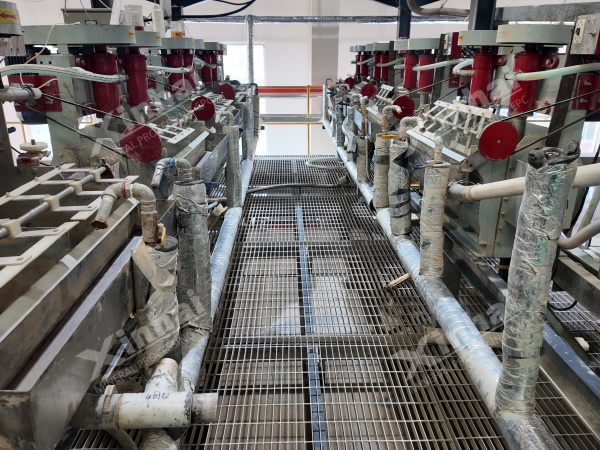
Pilot flotation circuit used to prove out the room-temperature route.
Fluorite gangue leaves no choice, because the two minerals float too close together for room-temperature chemistry to part them. Heating is mandatory. Our tungsten-containing fluorite ore article covers that pairing in detail.
Quartz and silicate gangue is the easy case, and either route runs. Heated gives the better indices most of the time, so the call comes down to power price and steam supply. Steam already on site? Heat. No steam? Price the steam plant into the project first.
Calcite gangue is the hard case. Conventional depressants fall short, so new depressants or new collectors carry the separation, and the recipe comes from test work only. The lime method helps on calcite-fluorite ore alone. On one ore it lifted concentrate grade from 2.22% to 4.67–5.76% WO3. That is what reagent hunting pays when it works. Our calcite-associated fluorite separation article shows the hunting itself.
| Gangue type | Route | Deciding fact |
|---|---|---|
| Quartz and silicate | Either; heated gives better indices | Quartz depresses easily, so room temperature holds |
| Fluorite | Heated, mandatory | The pair floats too close to split cold |
| Calcite | Both strain | Needs new reagents; test work decides |
Three premises sit under all of these calls. Ore typing must be exact, from mineralogy and chemical analysis. The gangue share has to be counted, because past a certain point, the fluorite fraction drops and the heat cost never pays back. And the return-water calcium has to be mapped, since plants with high water recycle accumulate Ca2+ and the whole parameter set drifts conservative.
A 2025 study in Minerals (vol. 15, no. 11) measured how calcium ions adsorb on calcite and drag the scheelite-calcite separation with them. Plants meet the same physics from the other end. A high recycle rate loads the circuit with Ca2+, and adhesion between scheelite and calcite climbs. Part of the selectivity the sodium silicate built is gone, and the cleaners work harder for less.
The symptom shows up in the cleaners first: feed grade holds, yet cleaner tailings start carrying tungsten. That gap points at calcium loading, not at bad operation.
The fixes are plain, and they work in order. Bleed return water, replace it with fresh make-up. Trim sodium silicate upward in steps. Confirm every move on circuit water, in a timed laboratory float, because the calcium level drifts through the year. Water balance and reagent scheme get set together at design stage, and revisited together when the recycle rate climbs.
Two fluorite-type ores still differ in gangue share and dissemination size, and dosage and agitation time follow those differences. The beneficiation test is where the numbers come from, and parameters copied from another plant mostly end in rework.
Four deliverables should be in the report. A sodium silicate dosage curve on plant water chemistry. A temperature-time window for the heated route. A collector response check across the expected pH range. A locked-cycle run proving the index holds.
A curve drawn on distilled water misreads a circuit running on recycled water.
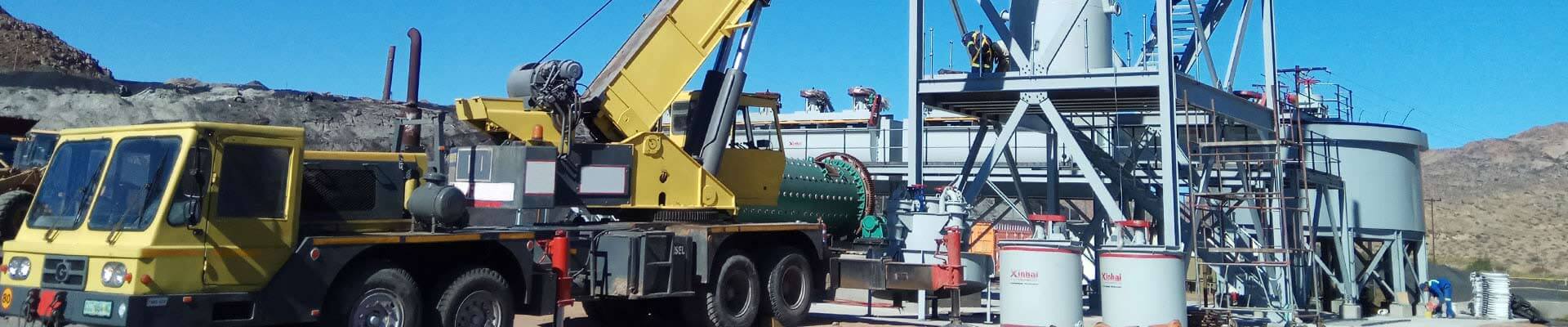
Xinhai runs the sequence in one system, test work through design and manufacturing, inside a design institute of more than 700 technical specialists. The 1 Mt/a tungsten tailings project in Uzbekistan entered installation in July 2026. Tailings retreatment, gravity-led, so no heated stage applies there. Same discipline though. Test work first, route second, parameters last.
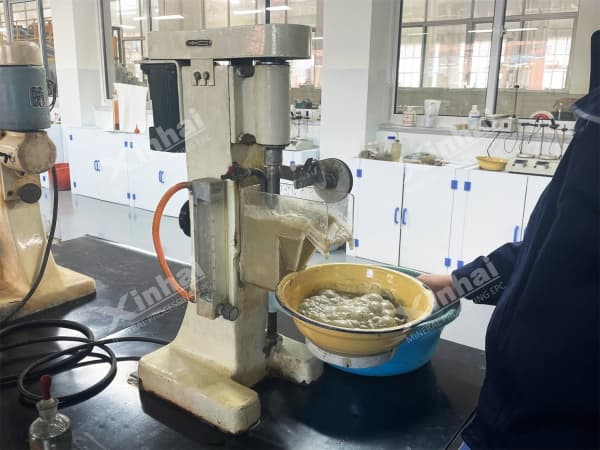
Test work fixes the reagent scheme and the agitation time.
Pick the wrong route and no parameter rescues it. The gangue decides the route. The test report decides the numbers.
It depends on the ore. Quartz and silicate gangue runs fine at room temperature. Only a high fluorite share makes heating mandatory.
85 degrees C is the common floor. Below it, desorption slows, and the loss is bought back with longer agitation or more sodium silicate. Either way, time cost climbs.
The heated route runs at 2.5-3% of the pulp mass. The room-temperature route is controlled by the HSiO3- concentration band. Either way, the dose follows gangue content and return-water calcium.
Sources
Flotation progress and practice of tungsten ores, Metal Mine, 2021(6)
Status of tungsten slime processing, Nonferrous Metals Science and Engineering, 2012
Research progress in tungsten ore processing, Nonferrous Metals Science and Engineering
Upgrading tests on a barite-type scheelite rough concentrate, Conservation and Utilization of Mineral Resources
Zhang Z., Zhang X., Deng X., et al. Adsorption of Calcium Ions on Calcite Surface and Its Influence on Flotation Separation of Scheelite. Minerals, 2025, 15(11): 1225.
Xinhai Mining project records and company materials
 +86 13811510145
