If you want to know more information (such as product/process price, etc.), please contact us 24-hour telephone
Scheelite does not need fine grinding to float. A 2025 study on a Tasmanian skarn ore returned 91.76% WO3 recovery and 61.03% grade from the +425 µm fraction. The reagent scheme was pH 9, 5 g/t sodium oleate, and a sodium silicate–quebracho blend. The coarsest fraction beat the finest on both counts. Where grinding should stop is a question for a liberation test.
The logic behind fine grinding is sound. A mineral locked inside gangue has no surface to float on. The deviation comes later. Designs adopt "grind fine" as a default target, without first measuring the size at which scheelite reports as free particles.
The default often arrives by copy. A flowsheet from a similar plant is used as the template, and its grind size travels with it. That plant may have run a finely disseminated ore. The new ore may not.
When grade sags in a plant that copied its grind, the first move is usually reagent adjustment. Size distribution rarely gets checked. A sieve analysis of the classification overflow takes one shift to run. It settles in a page what several rounds of reagent trials cannot.
Scheelite disseminates across a wide range. In skarn ore with coarse dissemination, most scheelite in the +425 µm fraction is already liberated. Grinding further produces slimes. Slimes float poorly and settle slowly. The cleaning circuit then has to lift grade from a pulp that carries more of them.
Grinding is the largest power consumer in a concentrator. Power spent below the liberation size buys a lower grade, which is the opposite of the intent. Liberation testing, and the flowsheet options that follow from it, are covered in our scheelite processing routes note.
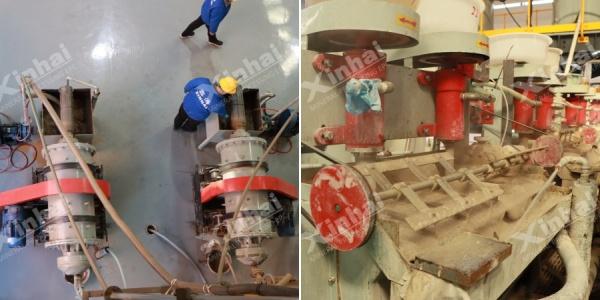
Grinding and flotation test work sets the target size.
Musa and co-workers published the work in Minerals, 2025, volume 15, issue 11, article 1183. The feed came from the Kara mine, a magnetite–scheelite skarn in Tasmania. These were plant samples, not hand-picked mineral. Reagent response therefore reflects what the mill actually feeds.
Tests ran at 900 rpm and pH 9. Sodium oleate went in at 5 g/t as collector. The depressant was a blend of 4 g/t sodium silicate and 4 g/t quebracho.
Three coarse fractions went through the same scheme. Each sample was prepared to contain material above its stated size.
| Feed fraction | WO3 recovery | WO3 grade | Mass recovery |
|---|---|---|---|
| +425 µm | 91.76% | 61.03% | 70.95% |
| +300 µm | 84.14% | 58.73% | 84.15% |
| +150 µm | 79.44% | 45.76% | 88.81% |
The trend runs one way. The coarsest fraction returned 12.3 points more recovery and 15.3 points more grade than the finest. Mass recovery moved the other way. Less material reported to concentrate at the coarse end, which is what selective flotation of liberated scheelite looks like.
The authors frame the result as a starting point for other scheelite skarn deposits and for high-density mineral systems. Test work on the ore at hand remains the first step.
Read the mass column with the grade column. A high mass pull at low grade means gangue came along. A low mass pull at high grade means the froth carried scheelite and left the rest behind.
Three reagents do the work, and each has a job.
Sodium oleate collects. It films over calcium sites on the scheelite surface. Coarse scheelite liberates early, so a collector film is enough to lift the particle out of the pulp.
Sodium silicate with quebracho depresses. Silicate disperses slimes and acts on silicate gangue. Quebracho, a tannin extract, adds depression on the same minerals. In a coarse fraction there is less liberated gangue to hold down, so the depressant load is lighter.
pH 9 sits inside the range where fatty-acid collectors work. Sodium carbonate normally holds that value in the pulp.
Earlier coarse flotation trials mostly failed on reagent design. Schemes were carried over from fine-particle practice. Gangue depression fell short. The froth turned sticky, and coarse particles dropped back into the cell.
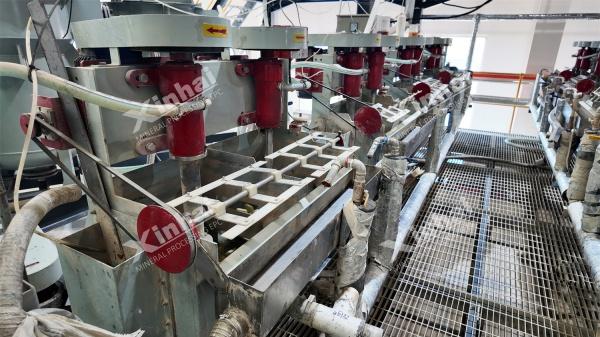
Pilot flotation cells prove the reagent scheme before scale-up.
Coarse flotation sits at the front of the circuit. Grinding-classification overflow is split by size. The coarse stream goes to coarse flotation, and its concentrate joins the main circuit. The fine stream follows the existing route.
Hydrocyclones hold the cut point, using centrifugal force to classify by size. Feed density and pressure have to stay steady. Let either drift and the cut size moves with it. A change in circulating load shows up at the cut point before it shows up in the assay.
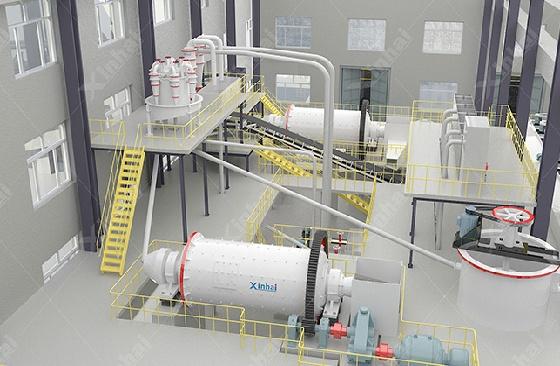
Hydrocyclones hold the size split in the grinding circuit.
Machines follow the size split. The coarse section needs high air input and strong agitation, which points to air-inflation flotation cells. The fine section runs on pulp-suction cells.
Reagent addition needs its own point. Collector is dosed into the conditioner ahead of the coarse cells, at a density the conditioner can hold. Dosing into the coarse cell itself leaves the pulp short of collector where the particle load is heaviest.
Slimes get their own route, and they never return to coarse roughing. Fine particles carry a large specific surface. Add reagent and the slimes take it first. The coarse froth then breaks down, and the circuit swings wider with every pass.
Four checks settle the cut size before the circuit is fixed:
Sieve analysis of the classification overflow, to see what the mill produces
Liberation analysis by size class, to find the coarsest class that is free
Slime fraction and its reagent uptake, taken from measurement on site samples
Reagent consumption per tonne at the proposed cut, from locked-cycle test work
Where the ore is coarser still and the density difference is wide, gravity can run ahead of flotation. A jig handles that duty.
Coarse flotation saves grinding power. The cleaning circuit stays as it is. Raising scheelite grade in cleaning still comes down to gangue type, and heating or room temperature follows from that. The route map for the main ore types sits on our scheelite flotation line page.
One effect carries into cleaning. A coarse rougher concentrate sends less slime forward. Thickener duty in the heating route drops, and the pulp reaches the conditioner at a steadier density. That is a side benefit, not the reason to adopt coarse flotation.
No. Coarse flotation assumes the coarse fraction is already liberated. Scheelite locked in gangue at 50 µm offers no surface chemistry to separate on. The grind cannot be skipped for such ore. The saving comes from staging the grind, and that also needs test data.
The coarse section takes cells with high air input and strong agitation. The fine section takes pulp-suction cells. A classifier sets the size boundary between them. Cell selection follows the size distribution measured in test work, not a list copied from another plant.
There is no general figure. The saving depends on ore grindability, the margin built into the existing grind, and the size the liberation test supports. A grinding test with power measurement gives the number for a specific ore.
Grinding size is set early in design, and it is expensive to change later. Civil works and equipment follow it. Run the liberation test first. Whether the ore floats coarse, and where the grind should stop, are both answered in that report. A report with a liberation curve by size class helps. So does a locked-cycle result at each candidate cut, plus a power figure per tonne. With those three in hand, design can fix the grind once.
Sources
Musa E.D., Hunt J., Fathi M., Missen O.P., Doherty G., Mollison M. Coarse Froth Flotation to Optimise Scheelite Recovery. Minerals, 2025, 15(11): 1183. https://www.mdpi.com/2075-163X/15/11/1183
Xinhai Mining internal study notes, No. 2, 2026-11-07. Ore-specific applicability is subject to beneficiation test work.
 +86 13811510145
