If you want to know more information (such as product/process price, etc.), please contact us 24-hour telephone
Mine tailings are usually treated as a cost — something to store, monitor and eventually close. A tungsten mine in southern China just proved that is only half the story.
At Shizhuyuan, a tungsten-polymetallic operation in Hunan province, a new reagent scheme and flowsheet lifted tungsten recovery from 26.8% to above 70%. The bigger number: the mine now recovers 350,000 tonnes of fluorite concentrate a year from its tailings, worth nearly 600 million CNY, while cutting tailings discharge by over 15% (CCTV / CQNews, 13 September 2026).
That did not come from a new discovery. It came from re-treating material the mine had already dug, ground and discarded. The question for any concentrator owner: what is still in your tailings, and what would it take to get it out?
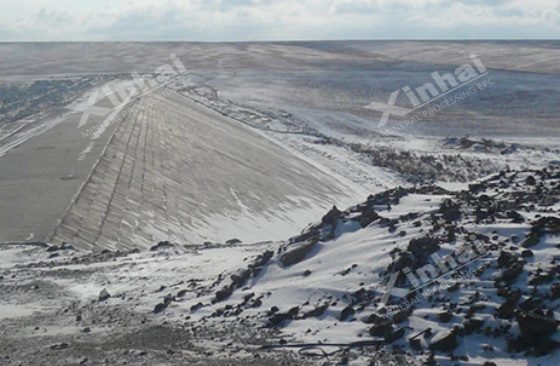
Tailings (the residual material left after valuable minerals are recovered) build up for as long as a mine runs. Every tonne carries a double cost: the money spent to grind and process it, and the ongoing cost of storing it safely. China's revised Mineral Resources Law and stricter tailings-dam compliance keep raising the second.
That is why reprocessing — re-treating stored tailings to recover values they still contain — has moved from a research topic to a business decision. Shizhuyuan's fluorite is a pattern, not an exception. Tailings at copper, tungsten, fluorite, lithium and rare-metal mines often hold grades not worth chasing a decade ago. Prices and technology have both moved since.
Reprocessing is not "running the old flowsheet again". Three steps come before any equipment is ordered.
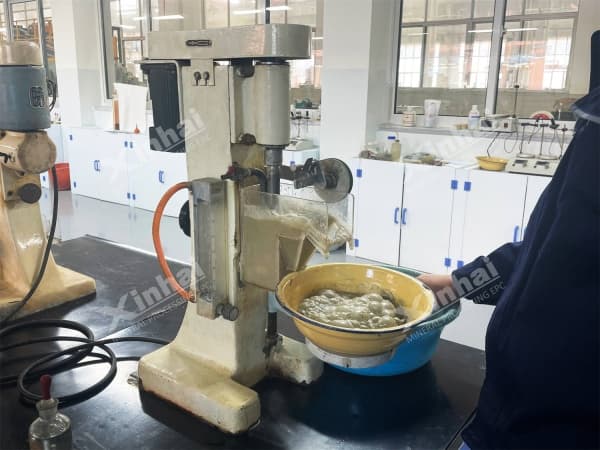
First, metallurgical testwork (laboratory and pilot testing that fixes the flowsheet and design parameters for a specific material). A sample is analysed for mineralogy and grade to find what is recoverable and how fine to grind.
Second, flowsheet selection. The tools are the same as primary processing:
gravity separation, for dense minerals such as tungsten or tin;
flotation (a separation process that uses the surface chemistry differences between minerals), for fluorite and sulfides;
magnetic separation, for iron and other magnetic minerals;
combined circuits, when more than one product is worth recovering.
Third, scale-up from locked-cycle laboratory results to a plant that keeps running as feed changes.
Fluorite is a non-metallic mineral, but its recovery challenge is specific: most fluorite ore is high-silica, with fluorite locked in quartz. Grind too coarse and fluorite stays trapped. Grind too fine and every mill pass costs more.
The FC-97 fluorite concentrate steel and chemical buyers use requires SiO₂ below 1.2%. That separates a saleable concentrate from a by-product nobody wants.
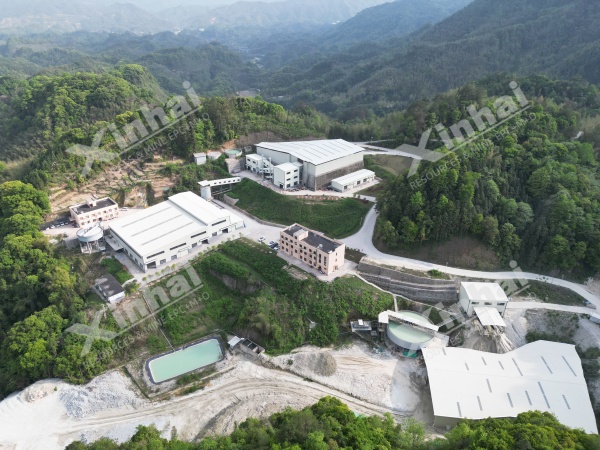
At a 300 t/d fluorite plant Xinhai delivered in Jiangxi, the feed assayed 36.40% CaF₂ with 54.10% SiO₂. Testwork compared three routes:
| Route | Regrind | CaF₂ grade | CaF₂ recovery | SiO₂ |
| Single-stage grind, 1 roughing + 8 cleaning + 1 scavenging | none | 97.49% | 93.06% | 2.13% |
| Same flowsheet, finer grind | none | 97.58% | 87.91% | 1.43% |
| Rougher-concentrate regrind + cleaning | −325 mesh 90% | 97.98% | 92.10% | 1.16% |
Regrinding the rougher concentrate — instead of grinding the whole feed finer — frees fluorite from quartz and drops SiO₂ below spec, without paying to grind every tonne twice.
These results apply only to the submitted sample and should not be presented as guaranteed plant performance.
Testwork earns its keep only when the plant that follows is delivered. That is where an EPC+M+O approach (an integrated model covering engineering, procurement, construction, plus mine management and operation) changes a retrofit's economics.
At a 1 Mtpa tungsten-tailings plant in Uzbekistan, Xinhai treats material assaying just 0.06% WO₃ — feed a primary plant would discard. A gravity-plus-flotation circuit, with tailings split into three narrow size fractions for separate gravity recovery, yields a 40% WO₃ concentrate at 30% recovery.
For fluorite, Xinhai has delivered from a 300 t/d plant in Jiangxi to a 1,200 t/d lead-fluorite operation in Sardinia, Italy — its first turnkey project in Europe — recovering fluorite at 68.3% into a 98.06% CaF₂ concentrate alongside lead at 96.4% recovery.
| Project | Feed | Product | Recovery | Delivery |
| Uzbekistan tungsten tailings, 1 Mtpa | 0.06% WO₃ | 40% WO₃ concentrate | 30% | EPCM |
| Jiangxi fluorite plant, 300 t/d | 36.40% CaF₂ | 97.74% CaF₂ concentrate | 92.56% | EPC |
| Italy lead-fluorite plant, 1,200 t/d | 30–32% CaF₂ | 98.06% CaF₂ concentrate | 68.3% | Turnkey |
The common thread: testwork fixes the flowsheet before procurement, then one team carries design, equipment, installation and commissioning through to operation. See our tailings treatment solutions and non-metal processing approach.
Reprocessing re-treats stored tailings to recover minerals left behind in the first processing pass. Because the material is already mined and ground, the main costs are testwork, a retrofit circuit and running it. Economics turn on grade, mineral association and current prices.
Yes, when the tailings carry enough fluorite and it separates cleanly. Shizhuyuan recovers 350,000 tonnes of fluorite concentrate a year from tailings, worth nearly 600 million CNY. The deciding factors are fluorite grade, liberation size and the buyer's silica spec.
Mineralogy, grind-versus-liberation testing and locked-cycle flotation tests. These fix the flowsheet and design parameters before equipment is ordered. A retrofit that skips testwork risks buying a circuit that cannot hit target grade or recovery. Testwork is cheaper than rework.
It varies with scope. A 300 t/d fluorite EPC plant Xinhai delivered in Jiangxi ran on a 240-day programme covering design, equipment, installation and commissioning. Larger or more complex retrofits take longer, and the testwork and design phase is worth not rushing.
If you are considering a tailings reprocessing or fluorite flotation project, we would be glad to talk through the technical questions — from sampling to flowsheet design and equipment selection.
At Xinhai, we believe testwork should justify a retrofit before steel is ordered.
Share your tailings project with us. Let's work out what is still in your material.
 +86 13811510145