If you want to know more information (such as product/process price, etc.), please contact us 24-hour telephone
A mining technology that has run for decades inside global plants is now arriving in China. That changes the build-or-buy math for operators.
On 10 September 2026, Glencore Technology launched its China operations at the 28th China Mining Conference in Tianjin, showcasing three flagship technologies — IsaMill (a horizontal fine grinder), Jameson Cell (a column-style flotation device with no moving parts), and refractory-ore oxidative leaching. The company reports 144 IsaMill units across 23 countries and 500+ Jameson Cells since 1988 (data: Glencore Technology, Jiemian News, 10 September 2026).
For overseas operators, localizing in China will reshape lead time, cost, and service. For mid-tier and emerging-market players weighing a fine-grinding or flotation flowsheet, it opens a real second option — a Chinese EPC with end-to-end capability.

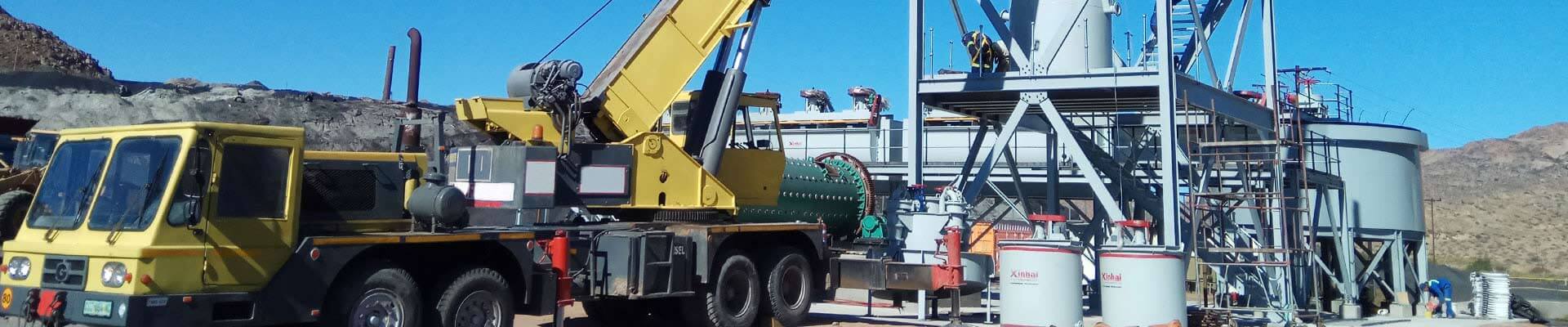
Ball mill interior at Xinhai Mongolia 1,000 t/d zinc plant.
Glencore Technology's flagships have run in commercial plants for decades — IsaMill since the early 1990s, Jameson Cell since 1988. The Tianjin launch makes the technology locally accessible to Chinese-engineered flowsheets.
Three facts from the announcement matter most:
IsaMill: 144 units across 23 countries; grinding down to about 5 µm; footprint about one-third of a comparable vertical mill.
Jameson Cell: 500+ units since 1988; no moving parts; 99% availability.
Refractory-ore oxidative leaching: process package covering copper, lead, zinc, nickel, gold, silver, PGM, iron.
Complex-ore bodies are the rule in most jurisdictions where Xinhai Mining operates — Africa, Central Asia, South America, Southeast Asia. Two unit operations move the economics:
Fine grinding — liberates valuable minerals from gangue. At P80 (the screen size at which 80% of particles pass) of 10–30 µm, IsaMill-class mills earn their keep. Conventional ball-mill-classifier circuits still deliver for less demanding targets.
Flotation (a separation process exploiting differences in mineral surface chemistry) — sets recovery and concentrate grade.
On a 1.5 Mtpa copper orebody, a one-point gain in recovery moves tens of thousands of tonnes over the mine life.

For an overseas project owner, the build-or-buy decision was once simple: license a proven technology, accept the cost and lead time, run a globally benchmarked plant. The Tianjin launch makes a Chinese EPC route a real option.
| Aspect | Licensed route | Chinese EPC route |
|---|---|---|
| License fee | High six-figure USD (IsaMill line) | None — in-house IP |
| Lead time | 12–18 months | 6–9 months |
| Capex differential | Higher baseline | 30–50% lower |
Both routes ship real plants. The trade is licensed benchmark with vendor lock-in vs in-house flowsheet with full EPC accountability.
A licensed IsaMill line carries a high-six-figure-USD license fee plus a process package, with 12–18 month lead time. A Chinese EPC offering its own fine-grinding circuit ships in 6–9 months without the license fee. Equipment cost differential is often 30–50%.
A 99% availability commitment on a Jameson Cell is real — but it is a single-unit number. Plant-wide recovery depends on the whole circuit. A vendor supplying one unit cannot guarantee the other five; an EPC supplying all six can.
Licensed technology comes with remote troubleshooting from the licensor. A Chinese EPC route puts its own commissioning team on site, backed by a home R&D and pilot centre — closing the plant faster in low-technical-depth regions.
A 1,000 t/d zinc flotation plant in Mongolia runs an in-house flowsheet under −30°C winters and high-altitude arid climate.
Flowsheet: closed-circuit grinding → flotation → thickening → filter pressing, with dry stacking and water recovery. Bolted thickeners of 15 m and 20 m diameter are in use — Xinhai's first large-diameter EPC deployment. The same client took a 3,500 t/d iron-ore plant in 2018.


A 1.5 Mtpa copper flotation project in Kazakhstan delivers end-to-end EPC+M+O at scale. Feed grade: about 0.86% Cu. Locked-cycle testwork: 22% Cu concentrate at 90% recovery on the submitted sample.
These results apply only to the submitted sample. Full scope: metallurgical testwork through commissioning. As of August 2026, the project is in major-equipment installation. The flowsheet is in-house.

IsaMill is a horizontal stirred mill grinding to about 5 µm. Conventional ball-mill circuits reach P80 of 75–150 µm for sulphide copper. IsaMill earns its premium where ball mills cannot liberate.
Jameson Cell uses a downcomer for fine bubbles, no moving parts, and 99% availability. Mechanical cells (Xinhai's XCF, KYF) cost less. Jameson wins where fine bubbles justify licensing.
A license-only route delivers a process package under vendor lock-in. A Chinese EPC delivers the full scope under one contract with in-house IP — 6–9 vs 12–18 months, 30–50% lower capex.
Xinhai Mining does not position against licensed technologies head-on. Where IsaMill or Jameson Cell fit best, those remain legitimate. Xinhai delivers EPC+M+O with in-house testwork, flowsheet, and equipment. Mongolia zinc and Kazakhstan copper are reference points.
If you are weighing a fine-grinding or flotation EPC for a complex-ore project in a cold, arid, or remote region, start with a metallurgical test on a representative sample — not a commitment to either route.
At Xinhai, we believe the right flowsheet is written in the ore, not borrowed from a licensor's catalog.
Share your fine-grinding or flotation project with us. Let's work out whether the build-or-buy math closes for your conditions.
Sources
Glencore Technology China launch, IsaMill and Jameson Cell installation data, and refractory-ore leaching scope as reported by Jiemian News on 10 September 2026 (covering the 28th China Mining Conference in Tianjin).
Mongolia 1,000 t/d zinc flotation plant and Kazakhstan 1.5 Mtpa copper flotation plant project data from Xinhai Mining internal pr
 +86 13811510145