If you want to know more information (such as product/process price, etc.), please contact us 24-hour telephone
Ask which is better for chrome ore — dense medium separation or a spiral circuit — and the question itself is built wrong. Neither beats the other across a whole feed. They own different size ranges, and most plants run both.
Chromite separates easily by density: 4.2 to 4.8 g/cm3 against roughly 2.6 for serpentine and talc. Almost any density-based device works on that gap. What decides the choice is the size fraction you feed.
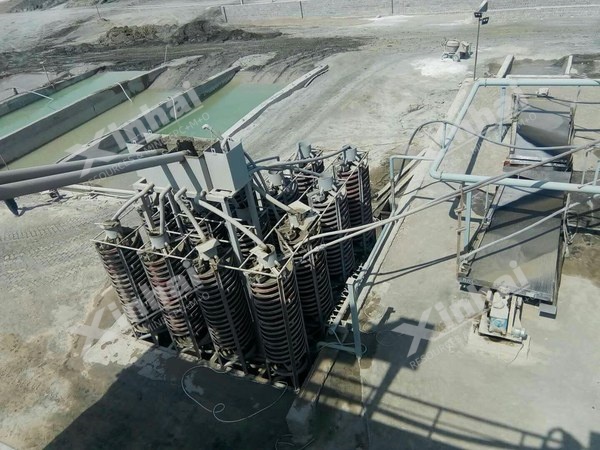
Spiral concentrator bank at a chromite plant
Dense medium separation (DMS) floats light gangue and sinks chromite in a suspension of ferrosilicon powder. It works above roughly 1 mm, through a drum for the coarsest sizes or a cyclone for middling ones. Below that, the medium recovery circuit handles more liquid per tonne of solid, and the economics turn.
A spiral concentrator is a helical trough with no moving parts. Slurry runs down it, centrifugal force pushes denser chromite to the inner edge, and a splitter at the bottom cuts concentrate from tailings. Published comparisons put spirals at roughly 24 microns to 2,000 microns, with the strongest performance in the 0.1 to 1 mm band.
The jig sits between them at 0.5 to 25 mm, often the cheaper coarse option where the ore is hard and liberation coarse.
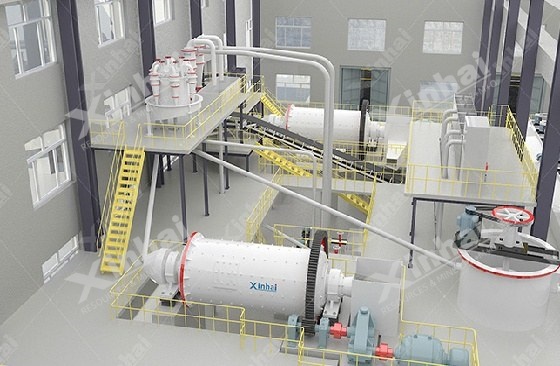
Grinding and classification ahead of separation
DMS buys a sharp cut at high density. Chrome circuits commonly run a separation density of 3.0 to 3.3 g/cm3, high enough to float silicate gangue while keeping chromite in the sink.
The cost is the medium. Ferrosilicon is recovered magnetically, washed and returned, and losses run continuously. Indian Bureau of Mines literature puts normal medium loss at 0.1 to 0.4 kg per tonne of ore, rising to 1 to 1.5 kg/t on porous ores whose cavities absorb the suspension. That is the largest single operating cost in DMS, so the process stays on coarse feed where tonnes per hour are high.
DMS also needs prepared feed: screened to a narrow band and washed free of slimes. Slimes thicken the medium and destroy the cut point.
Spirals win on cost: no power to drive the separation, no medium, no reagent, and little maintenance beyond worn troughs. That is why a spiral bank is the default for 0.1 to 1 mm in most chrome operations.
They fail at both ends. Particles above roughly 2 mm do not stratify and roll through, so coarse feed needs crushing or a different device. Below about 0.075 mm the water film is thick relative to the particle and separation degrades.
Spirals are also sensitive to feed variation. Pulp density changes the depth of the flowing film; size distribution changes where the splitter should sit. A bank set up for one feed runs at a different recovery the moment the mine moves into another ore zone, and the correction is not a new machine but a splitter adjustment and a re-check of the wash water.
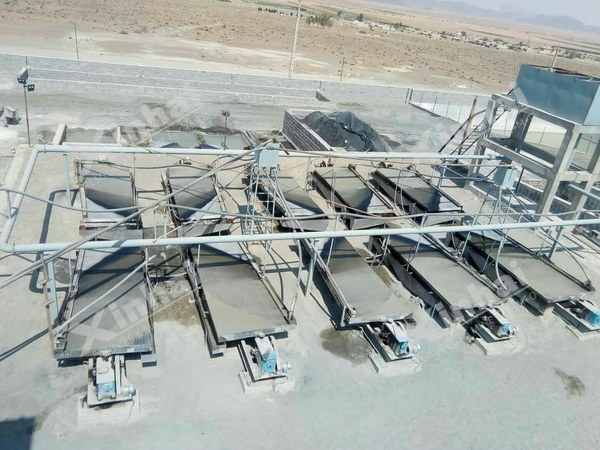
Shaking table bank for fine chromite cleaning
Three inputs decide the answer, and all three come from testwork, not from a capacity table.
Size distribution. The share above 1 mm sets the first split. A feed that is 70% minus 1 mm does not need a DMS for a fraction that barely exists.
Liberation size. Ore that liberates at 3 mm suits a DMS on 1 to 25 mm. Ore that liberates at 0.2 mm makes the coarse circuit pre-concentration only.
Cr:Fe target. A high ratio demand points to a magnetic stage whatever handles the coarse fraction, because density separation does not distinguish chromite from other heavy iron-bearing minerals.
The conventional split is 1 mm or 0.5 mm, chosen by testwork. Crushing finer than the ore needs generates slimes; crushing coarser leaves locked particles in the coarse stream.

Feed analysis ahead of circuit selection
| Feed type | First stage | Why |
|---|---|---|
| Hard, lumpy ore, coarse liberation | DMS or jig | Most value sits above 1 mm, and medium loss spreads over high tonnage |
| Friable ore, high fines | Spiral | The ore breaks into fines, so a coarse circuit would discard liberated chromite |
| Historic tailings | Spiral, after scrubbing | Already fine and often clay-bound, so the feed needs washing before coarse separation |
The third row is the one operators underestimate. Tailings that sat for years have segregated by size: the coarse sand at the discharge end behaves quite differently from the slimes at the far corner, and a blended sample hides that. The same holds across a whole chrome ore mining process.
A South African chrome concentrator shows how two feed sources force two configurations in one plant. It takes both underground ore and material dredged from its old tailings dam, and the streams are not interchangeable.
Underground ore is crushed, screened and ground before separation. The tailings stream is scrubbed and re-pulped at the dam, then pumped straight to the magnetic circuit with no crushing stage, because it is already fine. Downstream, both share one regrind and flotation circuit for platinum and palladium.
Xinhai delivered design, equipment and commissioning for the 480,000 t/y upgrade. Capacity rose from 360,000 t/y, concentrate grade improved by more than 20%, and moisture came out below 15%. It commissioned on the first attempt, with no testwork or civil work in scope.
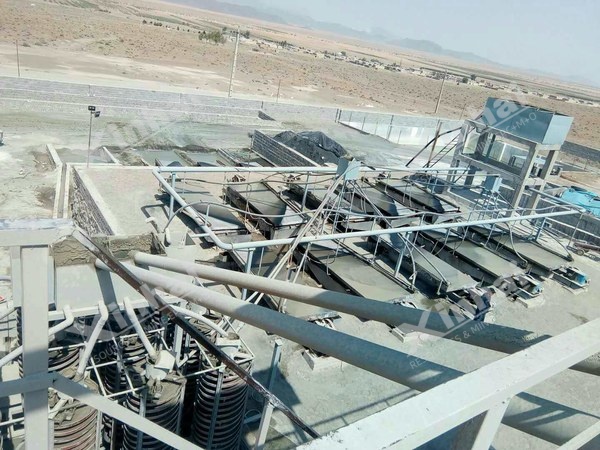
Spirals and tables in one chromite circuit
Neither is better across a whole feed. DMS is the stronger choice above about 1 mm, where medium loss spreads over high tonnage. Spirals are the practical choice from 0.1 to 1 mm.
Below roughly 1 mm. The medium recovery circuit handles more liquid per tonne of solid at finer sizes, and cost per tonne of concentrate rises faster than the benefit.
It covers about 24 microns to 2 mm. Particles above 2 mm do not stratify in the trough, and separation degrades below about 0.075 mm, so both ends of the distribution need separate treatment.
Most production plants do, because run-of-mine feed rarely sits inside one size band. Testwork decides where the split goes, usually at 1 mm or 0.5 mm.
The question is not which machine is better. It is where your ore changes character.
At Xinhai, we believe the circuit should follow the size distribution.
Send us your feed analysis. We will tell you where the split belongs.
Sources
Medium loss rates for heavy medium separation (0.1–0.4 kg/t normal, 1–1.5 kg/t on porous ores) and separation density practice — Indian Bureau of Mines, "Iron Ore Beneficiation", technical literature.
DMS separation density of 3.0–3.3 g/cm3 for chromite and the standard split at 1 mm or 0.5 mm — Drill Rig Tech, "Chromite Processing and Beneficiation of Friable Ore".
Size ranges for spirals (about 24–2,000 microns), DMS (+1 mm) and shaking tables — Discovery Alert, reporting on the Multotec spiral circuit at the Thaba JV chromite and PGM project.
Chromite specific gravity 4.2–4.8 g/cm3, silicate gangue about 2.6 g/cm3, and jig range 0.5–25 mm — Xinhai, "Key Equipment for Chrome Gravity Separation", as published on drytailingmachine.com.
South African 480,000 t/y chrome concentrator upgrade (capacity 360,000 to 480,000 t/y, concentrate grade up more than 20%, moisture below 15%, two feed sources) — Xinhai project records.
Ranges above are indicative operating practice, not fixed equipment guarantees. Each project's split point depends on its own testwork.
 +86 13811510145
