If you want to know more information (such as product/process price, etc.), please contact us 24-hour telephone
Scheelite responds to flotation. Wolframite goes to gravity first and finishes in magnetic separation. Both are tungsten ore, and both feed similar mills. They still take different routes. The difference sits in physical properties: density, magnetism, and surface chemistry. Those properties are measurable before any drawing is made. So the flowsheet decision is one of the earliest a tungsten project settles, and one of the hardest to revise.
Both routes share one enemy. Tungsten minerals are brittle. Grind them too fine and they turn to slime. Slime is hard to recover, and it carries tungsten metal into the tailings. Whichever route a plant picks, the fight against slimes comes first.
The clearest way to see the split is a property table. Scheelite is calcium tungstate, CaWO4. Wolframite is an iron-manganese tungstate, (Fe,Mn)WO4. Density, magnetic behavior, and floatability all differ, and each difference points to a different separation method.
| Property | Scheelite | Wolframite |
|---|---|---|
| Specific gravity | 5.9–6.1 | 7.1–7.5 |
| Magnetism | non-magnetic | weakly magnetic |
| Response to fatty acid collectors | good | poor |
| UV fluorescence | blue-white | none |
| Typical gangue | calcite, fluorite, quartz | quartz, feldspar |
Embedding differs as well. Wolframite typically liberates at coarser sizes, one more reason gravity works for it. Skarn scheelite is often finely disseminated, and its grind follows the liberation curve. Two rows still carry the most weight. Density decides whether gravity separation can work at all. Magnetism decides how the concentrate is finished. Fluorescence is a field tool. Scheelite glows blue-white under short-wave UV light, and exploration crews use it to tell the two minerals apart on site.
Wolframite sits at 7.1 to 7.5 specific gravity. Its quartz gangue sits near 2.65. That gap is wide enough for physical separation, and it shapes the whole route. The guiding rule in wolframite processing is early recovery and sized treatment.
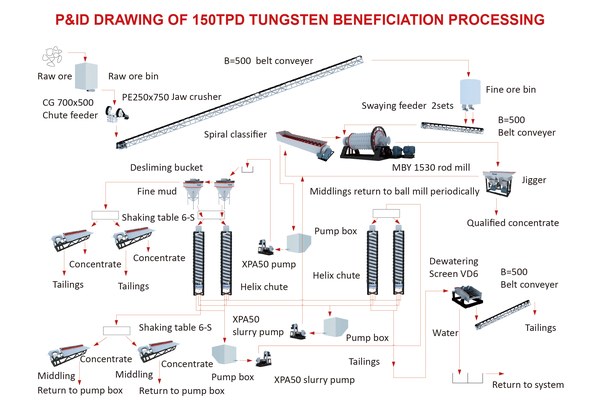
Flowsheet of a 150 tpd tungsten gravity plant: jigs, shaking tables and desliming ahead of grinding.
Coarse material goes to a jig straight after crushing. The pulsating water column pulls wolframite out of light gangue at low cost, before the ore reaches a mill. Medium and fine fractions move to shaking tables. Water flow and vibration there produce a high-grade concentrate plus a middling product for regrinding. The last step is magnetic separation. Wolframite itself is weakly magnetic, and the final concentrate is cleaned on magnetic separators to drop the remaining weakly magnetic impurities.
The route also treats size classes separately by design. Feed to the tables is deslimed first, because slimes blind the riffles and smear the separation. Middlings go back to a regrind mill, and the regrind tonnage is kept small on purpose. Every extra pass through a mill turns more wolframite into slime. So the circuit recovers as much as possible before grinding, not after it.
The full flow needs no reagents. That keeps tailings chemistry simple and operating cost low. It also sets a boundary. The density gap works only on particles coarse enough to settle at different speeds. Grind the ore into slimes, and gravity loses the handle.
Scheelite has a specific gravity of 5.9 to 6.1. On paper, the gap against quartz still looks large. In practice it is not enough. Scheelite and its gangue overlap in settling rate inside a real classifier, and gravity alone cannot make a clean cut. Flotation is the route, and a dedicated scheelite flotation production line is built around it.
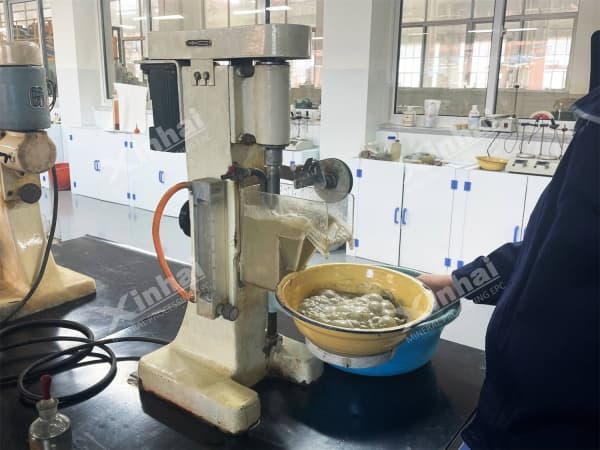
Laboratory flotation test on tungsten feed.
Scheelite floats well with fatty acid collectors, commonly sodium oleate. The collector forms a film on the calcium-active sites of the scheelite surface. The difficulty is the gangue. Calcite and fluorite share calcium chemistry with scheelite, so they float alongside it under the same collector. Sodium silicate is added to depress them. Recent work on a skarn scheelite ore measured best flotation at pH 8.5 to 9.0 (Fu et al., 2025). Cumulative recovery passed 80 percent inside 60 seconds.
Scheelite circuits also deslime the flotation feed. Slimes coat coarse particles and slow the collector down, so the fines are removed ahead of roughing. After roughing, the concentrate normally runs through several cleaning stages, and target grades for APT feed commonly sit above 65 percent WO3.
The rougher concentrate rarely meets specification on its own. Calcium gangue follows scheelite into the first froth. The standard answer is a heated cleaning stage: thicken the pulp, heat it, and clean it hot. A separate article compares the heated route against room-temperature cleaning in detail.
Many tungsten deposits carry both minerals. At the Shizhuyuan mine in Hunan, tungsten is distributed roughly 3:7 between wolframite and scheelite. A single uniform circuit struggles there, because the two minerals do not share an optimum pH. The same 2025 study measured scheelite floating fastest at pH 8.5 to 9.0, while wolframite needed 9.5 to 10.0. Kinetics differ too. Scheelite reaches its cumulative recovery well inside a minute. Wolframite takes longer. Collectors built for this situation hold the minerals apart and float them in sequence. The layout question, parallel circuits or one sequenced circuit, comes down to tonnage and the grade split between the two minerals. Testwork answers it with recovery-by-pH curves for each mineral.
Both routes reward the same habit. Recover early, and recover coarse. Every tonne captured before fine grinding skips mill power, skips reagent, and never enters the slime inventory at all. That habit pays twice in tungsten, once in energy and once in metal that stays recoverable.
Mixed ore is one meeting point. Tailings are the other. Tailings reprocessing has become a real tungsten source. It borrows from both routes. Gravity pre-concentration pulls coarse metal back, and flotation cleans what remains. Xinhai built a 1 million tonne-per-annum tungsten tailings plant in Uzbekistan, which entered installation in July 2026. In scheelite-bearing tailings, coarse particle flotation recovers value before fine grinding, cutting both grinding load and slime losses.
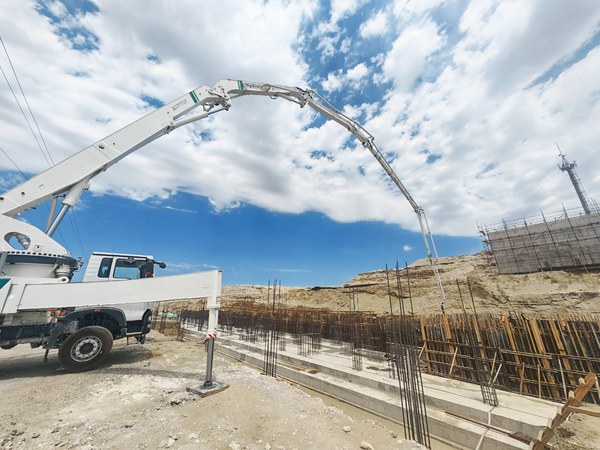
Raft and shaking-table foundations at the 1 Mtpa tungsten tailings plant in Uzbekistan.
Yes, with care. The two minerals float best at different pH. A combined circuit therefore floats them in sequence, using a collector designed for mixed tungsten ore. The lab report decides the split points. Do not assume them from a single-mineral test.
Scheelite's density of 5.9 to 6.1 leaves only a small settling-rate advantage over quartz. Jigs and shaking tables cannot hold a clean cut at that contrast. Scheelite plants therefore run on flotation from roughing through final cleaning.
A reagent mixing plant, heated conditioning tanks for the cleaning stage, and thickening ahead of heating. The cleaning side, not the roughing side, drives most of the extra equipment list on a scheelite flowsheet.
The grind is set by the liberation curve from testwork. Grind past the liberation size and tungsten turns to slime. Stop short and middlings stay locked. Test both candidate cut points in locked-cycle runs before the mill is bought.
A tungsten flowsheet is not a template. The mineral signs its own route in density, magnetism, and surface chemistry, and a lab confirms it. Grind size is decided first and revised last. Bring the ore sample to our process team before the flowsheet drawing starts.
Sources
Fu et al. (2025). Asynchronous flotation of scheelite, wolframite, and cassiterite: A new flotation collector and process. ScienceDirect. https://www.sciencedirect.com/science/article/abs/pii/S1383586625041425 (pH windows, flotation kinetics, Shizhuyuan tungsten distribution)
Xinhai Mining company news (2026-07-31). Uzbekistan 1 Mtpa tungsten tailings project enters installation. https://www.drytailingmachine.com/news/uzbekistan-tungsten-project-xinhai-excellence-2026.html
Mineral property data (specific gravity, magnetism, UV fluorescence) are standard mineralogy references; property ranges are typical values and vary by deposit.
 +86 13811510145
