If you want to know more information (such as product/process price, etc.), please contact us 24-hour telephone
Dry stacking means dewatering tailings to a solids content high enough that the material can be stacked and trafficked by machine. On chromite, three properties of the tailings decide how hard that is.
Chromite runs 4.2 to 4.8 g/cm3, against roughly 2.6 for the serpentine and talc that make up most of the gangue. That gap lets the slurry settle and thicken readily, which helps every dewatering route.
The angular grain shape works against it. Slurry carries these particles at high solids loading, and every surface it touches takes abrasion: pump impellers, pipe bends, filter cloth.
The size split sets the equipment. Published characterisation of a chromite plant tailings sample found 33.45% of the material below 25 microns, and that fine fraction carried 30.56% of the contained Cr2O3. Coarse and fine behave differently enough that a plant usually needs a separate device for each.
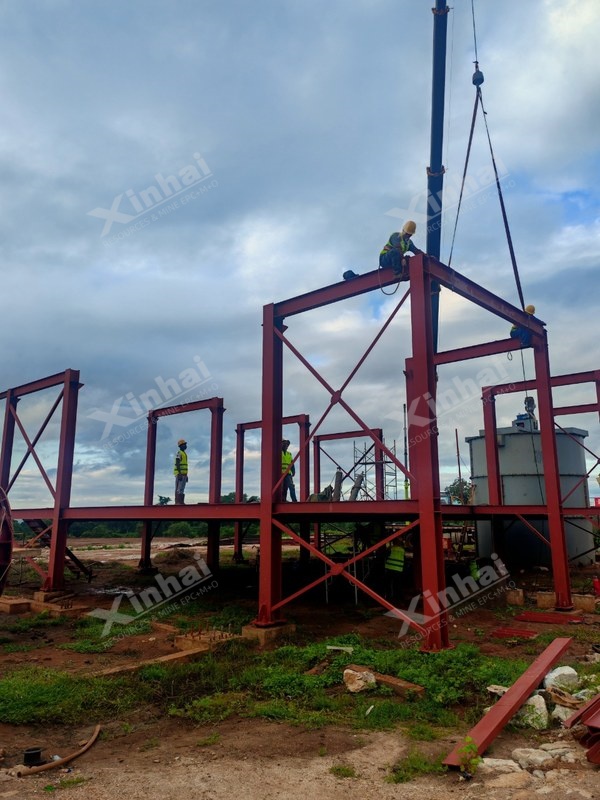
Filter press platform under construction
A filter press fed at low solids concentration delivers a fraction of the capacity it was sized for. Pre-thickening has to happen first.
Xinhai's dry stacking line runs three stages: a hydrocyclone, a high-efficiency deep-cone thickener, then a high-frequency dewatering screen. Cyclone underflow density is adjustable through a siphon device, commonly around 75%. The deep-cone thickener carries inclined plates inside the cone, raising settling area more than eight times and holding a denser underflow than a conventional thickener of the same footprint. The three stages together take the stream above 85% solids.
Feed a press at 20–30% solids and it produces at a fraction of its rated capacity. The usual response is to order another press, which adds cost without fixing the concentration. Check the thickener underflow density first: below about 45% solids, the press cycle lengthens and throughput falls away, and the cause sits upstream of the press.
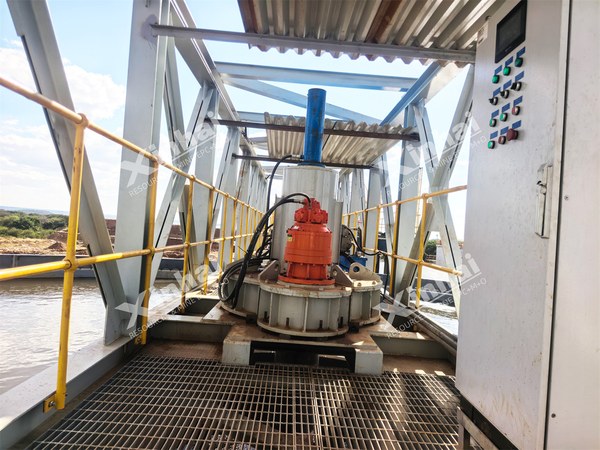
Thickener drive head on the bridge
Xinhai's dry stacking reference project was designed for 4,000 t/d at 65% passing 200 mesh, feed at 30% solids and neutral pH. Four configurations were evaluated on that duty.
| Option | Cake moisture | Running cost | Installed power | Wear part life |
|---|---|---|---|---|
| Belt filter press | 14–18% | 6–8 yuan/t | 700 kW | Cloth, 3–5 months |
| Chamber filter press | 16–20% | 5–8 yuan/t | 350 kW | Cloth, 2–3 months |
| Ceramic filter | 8–12% | 5–8 yuan/t | 600 kW | Ceramic plate, 2–6 months |
| High-frequency dewatering screen | 15–20% | 2–4 yuan/t | 220 kW | Screen cloth, 8 months |
Two rows carry most of the decision. The high-frequency dewatering screen uses about a third of the power of the belt press route and costs about a third as much per tonne to run, for a cake in the same moisture band. The ceramic filter is the only option that reaches single-digit moisture, which decides the choice when the product is concentrate.
The screen route suits a plant whose tailings carry a separable coarse fraction and whose moisture target is loose. The press routes suit plants with a high slime content or a concentrate specification. Sizing follows from the moisture target and the tonnes per hour, in that order: a press sized for the wrong moisture will run at the wrong cycle time whatever its filtration area.
These are Chinese operating costs from that project. Electricity, labour and wear-part pricing change by country, so the ranking is the reliable part and the absolute figures are a starting point for local estimation.
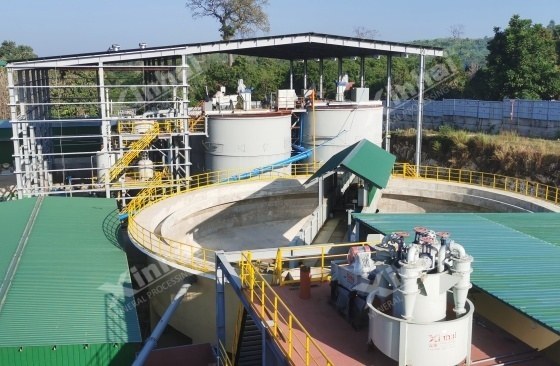
Cyclone cluster for tailings classification
A dewatering circuit designed for copper or iron tailings runs into three specific problems on chromite.
Filter cloth life. Angular solids cut cloth on every press type. The lives in the table above are already short by general tailings standards, so a plant running at the low end needs a cloth change schedule written into maintenance planning.
Pump and pipeline wear. Slurry carrying dense, angular particles attacks impellers and bends. Chromite installations have needed specialised pumping and recirculation arranged to prevent pipeline blockage as well as wear.
Coarse cake resists air drying. A coarser cake dewaters more easily up to a point. Past that point the cake is open enough that air passes straight through without picking up moisture, and the drying step stops working. Chromite tailings carry both a coarse and a fine fraction, which puts them on that boundary.
Chromite dewatering is designed around the fine fraction, which sets the achievable moisture. The coarse fraction sets the wear rate. Both need measuring before the equipment is selected, which means a size analysis across the full distribution and a settling test on the fines, run on a sample that represents the plant at steady state.
A published industry case describes a chromite producer whose slurry storage had run out, with production facing a stop. Building a new tailings facility was not an option at the time, so dry storage became the only route.
The circuit was a thickener for pre-thickening followed by two plate-and-frame filter presses totalling 1,632 m2 of filtration area. Feed arrived at relative density 1.4 to 1.5, up to 80 dry tonnes per hour. The presses produced cake consistently below 17.5% moisture, which was conveyed to a stockpile and trucked to the storage area.
Two details carry into any chromite design. The feed was described as extremely abrasive with a P50 of 450 microns, and the response was to redesign filter cloths for the high-wear areas and add specialised pumping recirculation. The cake also held a high void ratio because of the coarse, angular solids, so the presses ran a membrane squeeze to compact it before drying air could work.
On the concentrate side, Xinhai's 480,000 t/y chrome concentrator upgrade in South Africa reached concentrate moisture below 15%, the range a smelter will accept.
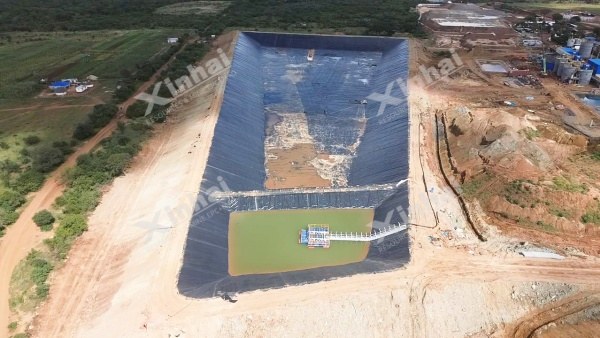
Lined dry stacking area with decant pond
Yes. Chromite's high density makes the slurry settle and thicken readily, which works in favour of dewatering. The constraints are abrasion and the split between coarse and fine fractions, and both need testwork before equipment selection.
Under 20% is generally enough for handling and stacking. Concentrate carries a tighter spec: smelters commonly want under 15%, and membrane presses reach 10–14%.
It depends on the size split. A high-frequency dewatering screen gives the lowest cost where the coarse fraction is separated first. Where fines dominate and the moisture target is tight, a filter press or ceramic filter reaches it.
Per tonne dewatered, yes. A wet facility also carries impoundment maintenance, environmental charges and closure liability, and those costs sit outside the dewatering line. Where regulation is tightening, they are what make dry stacking competitive.
Dewatering chromite tailings is a wear problem first and a moisture problem second.
At Xinhai, we believe chromite tailings design starts with a particle size analysis, before an equipment list.
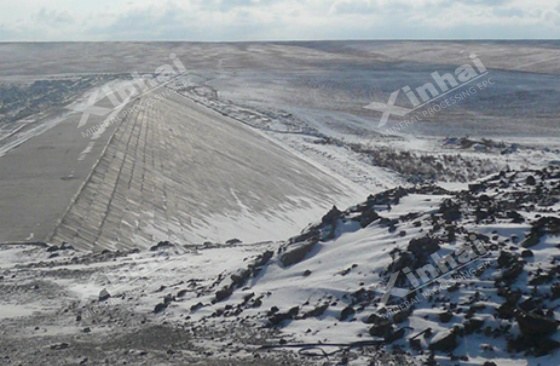
Tailings storage facility with a raised dam
Sources
Dewatering options, cake moisture, running cost, installed power and wear-part life (4,000 t/d design duty at 65% passing 200 mesh, 30% feed solids) — Xinhai, "Tailings Dry Stacking Production Line", as published on drytailingmachine.com.
Chromite tailings size distribution (33.45% below 25 microns carrying 30.56% of the contained Cr2O3) — Tripathy, Ramamurthy and Singh, "Recovery of Chromite Values from Plant Tailings by Gravity Concentration", Journal of Minerals and Materials Characterization and Engineering, Vol. 10, No. 1.
Chromite and gangue densities (4.2–4.8 g/cm3 chromite, about 2.6 g/cm3 serpentine and talc) — Xinhai, "Key Equipment for Chrome Gravity Separation", and published chromite tailings characterisation.
Chromite dry storage case (thickener plus two plate-and-frame presses, 1,632 m2 total filtration area, relative density 1.4–1.5, 80 dry tonnes per hour, cake below 17.5% moisture, P50 450 microns, membrane squeeze) — "Innovation in tailings dewatering: case studies of the successful application of filter presses", Australian Centre for Geomechanics.
South African 480,000 t/y chrome concentrator upgrade, concentrate moisture below 15% — Xinhai project records.
Cost figures are operating costs from a project in China and move with local electricity, labour and wear-part pricing. They indicate relative performance and are not a quotation.
 +86 13811510145
