If you want to know more information (such as product/process price, etc.), please contact us 24-hour telephone
The copper grade in run-of-mine ore is usually pretty low, only 0.2% to 2%. Mineral processing is basically the job of taking that raw ore and, using physical and some chemical tricks, upgrading it into a copper concentrate that contains 20%–30% copper.
Because every copper deposit is a bit different, there’s really no one-size-fits-all flowsheet. You have to tailor the process depending on things like how oxidized the ore is, how finely (or coarsely) the copper minerals are scattered through the rock, and what other annoying elements or minerals are hanging around.
The main methods people use are gravity separation, magnetic separation, and — most importantly — flotation. Flotation is hands-down the go-to technology for copper ores. It works well for both sulfide and oxide types, which is why almost every copper concentrator relies on it. Magnetic separation mostly just cleans out iron junk or grabs some pyrrhotite if you’re lucky. Gravity is usually only a helper step, not the star of the show.
A typical copper flotation flowsheet looks roughly like this:
ore crushing & screening → staged grinding + staged flotation → thickening & dewatering → final copper concentrate.
Why we crush and grind
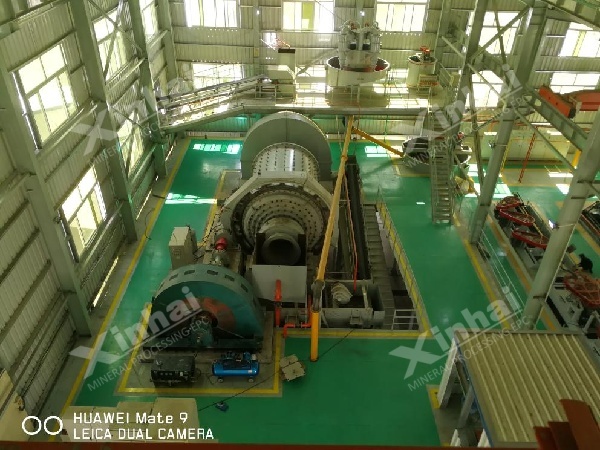
Basically, the goal is to break those big ugly rocks down and grind them fine enough so that the valuable copper minerals get liberated from the worthless gangue. Only then can you actually separate them in the next steps.
Common setups
Three-stage closed-circuit crushing
The old-school classic: primary crusher → secondary → tertiary → screens closing the loop. Still used in a lot of medium-sized plants.
SABC circuit (SAG mill + ball mill + pebble crushing)
This is what almost every big modern mine goes for. The pebbles that come out of the SAG mill get crushed separately and sent back — no need for separate secondary and tertiary crushing plants anymore. Simpler layout, way less dust, big win.
Staged grinding
Really useful when the copper minerals are patchily distributed (think lumpy, coarsely intergrown ores). You do a rough grind first, float off what you can, then take the rough concentrate and regrind it finer for a cleaner separation. Avoids over-grinding both the valuables and the gangue — a great way to save power and get better concentrate grades.
Key number to watch
Grinding fineness (how much passes -200 mesh) has a huge effect on how well flotation works later. For nicely disseminated ores, getting 50%–70% minus 200 mesh in a single stage is often good enough. But for those massive, locked-together ores, you usually need two grinding stages to get them fine enough.
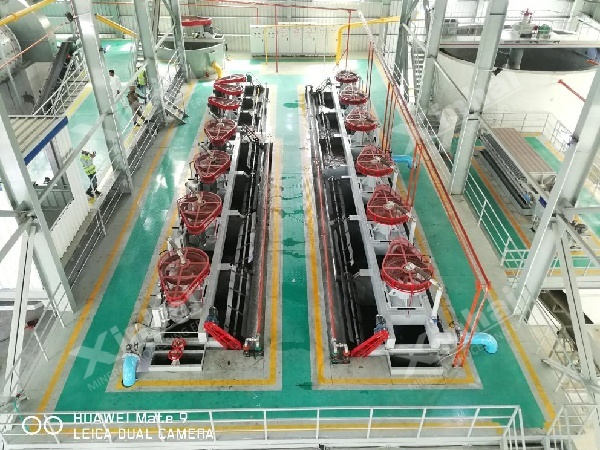
Applicability: Suitable for ores where copper minerals are coarsely and uniformly disseminated, with relatively loose contact between copper minerals and gangue, and smooth, flat contact edges.
Main Process Conditions:
·Grinding Fineness: Typically ground to 50%–60% passing -200 mesh, at which point copper minerals are essentially liberated.
·Flotation Process: Through roughing, scavenging, and one to three cleaning stages, good flotation indices can be achieved.
·Advantages: This process is simple and has low processing costs, making it widely used in small to medium-sized copper concentrators.
Applicability: Suitable for simple sulfide ores or copper-molybdenum ores from porphyry copper deposits.
Main Process Conditions:
·Grinding Fineness: Run-of-mine ore is ground in one stage to 40%–70% passing -200 mesh before flotation. The rougher concentrate is then reground, with the regrind fineness determined based on mineral liberation.
·Flotation Process: A large amount of tailings is discarded through roughing and scavenging. The rougher concentrate is sent for regrinding. After regrinding, two to three cleaning stages produce the final copper concentrate.
·Process Characteristics: When the run-of-mine ore grade is low and throughput is high, the concentrator can achieve good economic benefits. Due to the regrinding of the rougher concentrate, the particle size is finer, resulting in better liberation of copper minerals from gangue and pyrite, leading to higher flotation concentrate quality.
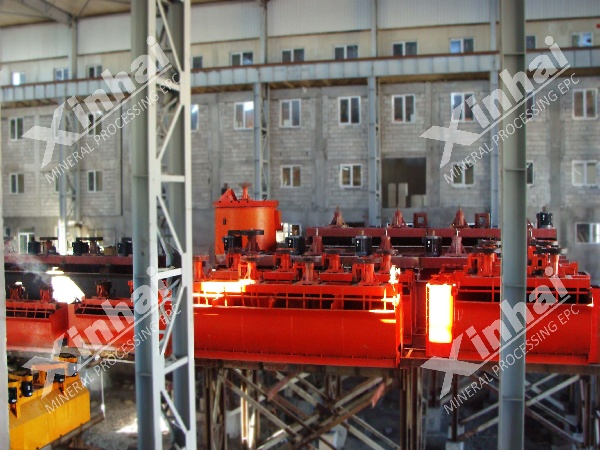
Applicability: Suitable for copper ores with non-uniform dissemination sizes. To achieve liberation of most copper minerals, the ore needs to be ground finer, often requiring two-stage grinding.
Main Process Conditions:
·Grinding Fineness: Approximately 80% passing -200 mesh, or even finer, to liberate most copper minerals.
·Flotation Process: After coarse grinding in the first stage, some coarse copper minerals can be floated. This portion of copper concentrate has a relatively high grade and can be directly used as concentrate, sent to the final cleaning stage, or combined with the concentrate from flotation after two-stage grinding to form the final concentrate.
Advantages: Two-stage grinding is more effective than single-stage direct fine grinding, both in terms of grinding efficiency and preventing over-grinding of copper minerals. Therefore, this process is often adopted by large and medium-sized copper concentrators.
The copper concentrate produced by flotation contains approximately 60%–80% moisture and must be dewatered to below 12% moisture before it can be transported for smelting.
Standard Three-Stage Configuration:
·Thickening: Gravity sedimentation in thickeners, accelerated by flocculants, producing underflow with a solids concentration of 50%–65%.
·Filtration: Ceramic filters or pressure filters use vacuum or pressure to reduce moisture to 12%–15%.
·Drying (only required in alpine regions or for special requirements): Further drying to reduce moisture to <8%.
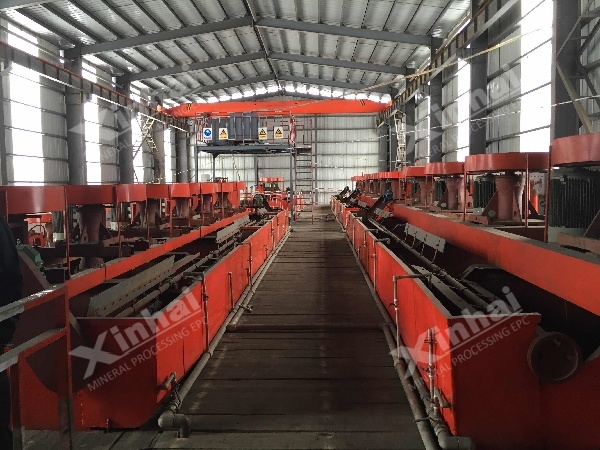
Zero Wastewater Discharge: Benchmark projects such as the Pulang Copper Mine have achieved 100% recycling of process water, with no discharge from the plant site.
Tailings Disposal:
·Dry Stacking: Filter-pressed dry tailings (15% moisture) are used for dam construction, reducing the risk of dam failure.
·Underground Backfilling: Tailings mixed with cementing agents are backfilled into mined-out stopes, serving multiple purposes.
·Resource Utilization: Recovery of sulfur and iron from tailings, or use as building material raw materials.
Intelligent Monitoring: X-ray fluorescence online analyzers, ultrasonic particle size analyzers, and automatic pH control systems are now standard equipment in large concentrators, enabling automatic reagent addition and closed-loop control of grinding particle size, significantly improving the stability of process indicators.
Xinhai Mining has been engaged in the mineral processing industry for many years and has undertaken numerous copper ore processing projects both domestically and internationally. Three typical project cases are presented here:
The mineral composition of this project's ore is relatively simple. The metallic minerals are mainly chalcopyrite and pyrite, while the non-metallic minerals are primarily quartz and chlorite. Multi-element analysis results indicate that the only recoverable element in the ore is copper. The run-of-mine ore grade is 0.80% Cu.
The flotation process designed by Xinhai for this project used lime as a modifier and Z-200 as a collector. The raw ore was ground to 68.4% passing -200 mesh. Through a process consisting of one roughing, two scavenging, and two cleaning stages, a concentrate with a yield of 3.45%, a copper grade of 20.78%, and a copper recovery of 90.05% was obtained.
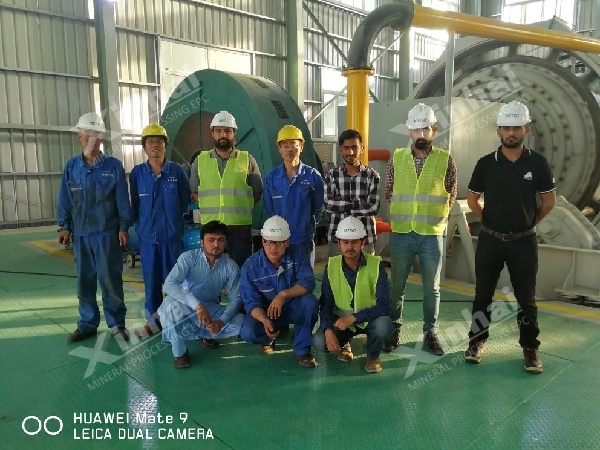
The Myanmar 500tpd copper ore flotation project was a full industrial chain service project provided by Xinhai Mining. The services mainly included mineral processing tests, process design, equipment manufacturing, packaging and shipping, installation and commissioning, and staff training. In terms of design, based on the test results, Xinhai adopted a process flow comprising single-stage closed-circuit crushing, grinding, and classification, and a flotation circuit of one roughing, two cleaning, and three scavenging stages.
This ore is a high-sulfur copper-sulfur ore, massive in structure, with copper, sulfur, and iron minerals closely intergrown. The copper minerals are finely disseminated, making it a refractory copper-sulfur ore.
After fine grinding, the ore undergoes a process of preferential copper flotation, magnetic separation for impurity removal, activated flotation of sulfur from the tailings, and magnetic separation of iron from the sulfur tailings. This yields a copper concentrate with a yield of 5.25%, a copper grade of 21%, and a recovery of 84.76%; a sulfur concentrate with a sulfur grade of 58.5% and a recovery of 82.26%; and an iron concentrate with an iron grade of 70.18%.
Conclusion
Copper ore processing is a technology that "varies with the ore." For low-grade porphyry copper ores, the SABC process combined with bulk flotation is a key tool for cost reduction. For high-sulfur massive ores, stage grinding and separation combined with powerful depression is the key to quality improvement. Facing strict environmental regulations, wastewater recycling and dry tailings stacking are the bottom line for survival.
If you have a specific ore property analysis report on hand, please send it to us. The mineral processing design experts at Xinhai Mining will customize a suitable process flow for you.
 +86 13811510145