If you want to know more information (such as product/process price, etc.), please contact us 24-hour telephone
Phosphate is the least forgiving ore in industrial mineral processing. The product specification is written in percentages of P₂O₅ versus iron, aluminium and carbonate impurities — decimals matter, and a plant that slips one decimal on grade loses more margin than most metal plants lose on a point of recovery.
When results drift, the cause rarely announces itself. It hides in six places, each with a signature. Walk them in order and most underperforming phosphate circuits explain themselves within a week.
Signature: grade fluctuation that tracks mine benches or stockpile vintages; reagent consumption climbing without an operational change. Phosphate deposits are sedimentary and layered — silica content, carbonate ratio and gangue mineralogy shift with every bench pulled.
The fix starts upstream of the plant: routine head-characterisation samples from active faces, not one composite per quarter. Plants that survive seam drift re-run batch flotation checks weekly; plants that die by it trust last year's metallurgical accounting.
Signature: froth looks loaded but concentrate grade disappoints; filtration slows; viscosity climbs in conditioning. Over-grinding generates slimy fines that coat hydrophobic particles, drag water into the concentrate and swallow collector without releasing more phosphate.
Liberation analysis decides this argument, not habit — and where desliming screens or cyclones were deleted to save capital, they usually return as the cheapest fix on the plant. Xinhai's 720 t/d phosphate plant in Uganda put slime first for exactly this reason: apatite and magnetite sat intergrown in a carbonate-derived ore with pervasive lattice substitution, and fine clay stood between separating them. The flowsheet opened at the head — slaked feed into desliming cyclones, underflow gravity-fed to the mill — desliming as the first unit operation, not a cleanup after flotation goes wrong.
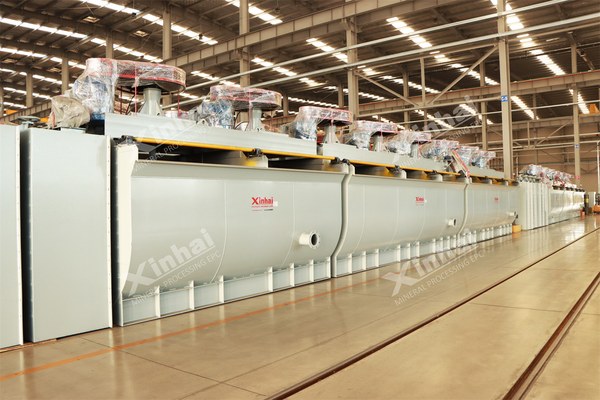
An air-inflation flotation train — selectivity lives or dies on its condition.
Signature: recovery loss concentrated in specific size classes; selectivity degrades before throughput does. Fatty-acid collectors used in reverse flotation against silica respond to water temperature, hardness ions and emulsification quality — none of which appear on a daily assay sheet.
Two cheap diagnostics catch most of it: a temperature log through winter months, and monthly chemistry checks on reagent make-up water. Circuits tuned for summer feed routinely under-collect in cold water until someone overlays the two charts.
Signature: concentrate stays high in P₂O₅ but acid-soluble performance or downstream phosphoric-acid reaction suffers; MgO creeps upward bench by bench. Siliceous ores float away from silica; calcareous ores demand a different chemistry — positive flotation removing carbonates, or a route carrying both problems. If the ore body mixes both types, blending policy becomes a metallurgical document, not a stockpile habit — plants get punished hardest when bench selection quietly changes the blend while the flowsheet stays what it always was.
Gangue complexity can also rewrite the product logic: on that Ugandan ore, phosphate was not the only target — magnetite rode in the same intergrown lattice, and both had to be upgraded before either could be sold. Characterisation that maps only the payable mineral you expect misses the one the deposit actually hands you.
Signature: thickening underflow density swings; flocculant dose creeping up; wash water tightening just when the circuit wants dilution most. Phosphate tailings carry fine clays that resist settling and steal process water from circulation.
Check the wet end like a circuit element, not a utility: flocculant trials on current (not original-design) slurry, mud-bed depth discipline, water-return rate measured monthly. Recovering 60–80% of process water at the thickener — more after filtration — is what lets a flotation plant hold its dilution ratios through a dry season. The Ugandan project closed exactly this loop: concentrate and tailings each ran their own dewatering system, dry stack cake hauled to the pond, all filtrate returned to the front — with clay-rich feed, that return water is where desliming and flotation get their dilution.
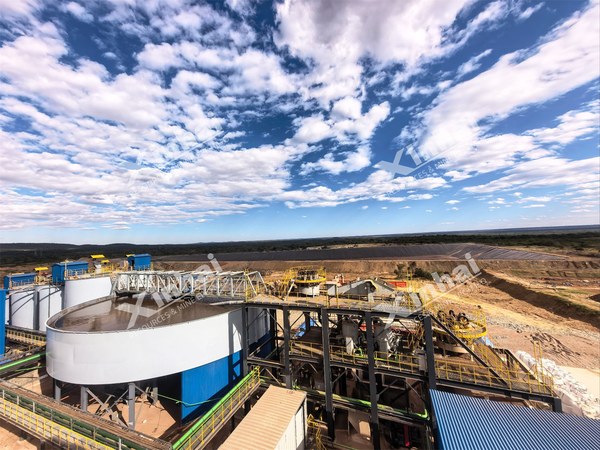
Thickeners and cyclones in the plant profile — the wet end, in plain sight.
Signature: everyone optimises locally — operators protect their own stage — and nobody can say what the circuit would do today if started from scratch. The most expensive failure mode on this list, because it shows no symptom until the annual report.
The remedy is a mass balance, done properly: campaign sampling around the full circuit, closure within a few percentage points, and a fresh accounting of where mineral goes. Owners who commission this before buying equipment almost always find the bottleneck is a setpoint, not a machine. Xinhai's EPC+M+O model (engineering, procurement and construction plus mine management and operation) treats the survey as the entry point because design assumptions age faster than steel — on that 720 t/d line, one roughing, one scavenging and two cleaning stages came from testwork and held through dewatering.
Usually grade instability tied to ore source — bench changes and vintage mixing show in concentrate assays long before anything mechanical fails. If grade noise coincides with mining maps changing, suspect characterisation gaps before touching the flotation stage.
Five of the six are observational or lab-side: characterisation sampling, grind audits, temperature and water chemistry logs, blend records and a mass-balance campaign all run alongside normal operation. Only desliming or wet-end hardware changes need windows — and data narrows those cases last.
Batch flotation checks weekly during bench transitions, quarterly otherwise; a full mass balance annually or after any major flowsheet change. Layered deposits justify the tighter rhythm — the test costs a fraction of the margin it protects.
Structurally yes — the sequence (ore knowledge, grind, reagent regime, gangue type, wet end, periodic re-baselining) generalises across flotation-driven industrial minerals such as fluorite or barite. The numbers inside each step are ore-specific, which is why the first item on any version of this list is knowing your own ore.
An underperforming phosphate plant is rarely broken. It is usually answering a question the ore stopped asking months ago. The checklist simply asks who last updated the answer.
Sources
Xinhai Mining project file — 720 t/d phosphate processing plant, Uganda (desliming–grinding–flotation–dewatering scope)
Site reference: Complex Phosphate Beneficiation
 +86 13811510145