If you want to know more information (such as product/process price, etc.), please contact us 24-hour telephone
On 15 October, Uzbekistan's president commissioned AMMC's Copper Plant No.3 at the Yoshlik-1 deposit — $4.6 billion invested, 60 million tonnes of ore a year in phase one, roughly 917,000 tonnes of copper concentrate plus molybdenum equivalent of 2,500 tonnes, lifting AMMC's daily concentrate output from 2,400 to 5,000 tonnes (Embassy of Uzbekistan; Tashkent Times). Phase two would take throughput to 160 Mt/y.
Commissioning answers whether Central Asia can grind that much rock. The harder question arrives with the first shipment: at copper-moly deposits, quality is not won by tonnage — it is decided in the separation stage. Scale gets you into the market; separation discipline decides what it pays.
Sixty Mtpa is about 164,000 tonnes of ore a day, around the clock. At that scale the plant stops being an equipment list: spare-warehouse depth, power contracts and water permits become industrial systems with their own budgets. An EPC partner who designs, manufactures and installs under one contract changes the risk shape — grinding liners and pump spares ship with the first machines instead of surfacing as emergency air freight two quarters later.
Copper-molybdenum ores float together first: bulk flotation pulls both metals into one concentrate because neither is easy to scavenge selectively from raw pulp. The real metallurgy starts downstream — conditioning at high pH with lime to hold copper down while molybdenum floats, then repeated cleaning to drive residual copper below contract limits.
This is where an EPC+M+O design partner earns its fee before commissioning ends: setting the separation-stage count against the buyer's impurity limits during testwork, rather than chasing headline recovery on a flowsheet smelters will penalise. Locked-cycle tests should mirror the penalty table, not just grade and recovery columns. A circuit tuned to "90% recovery" can still deliver concentrate that fails spec twice a month.
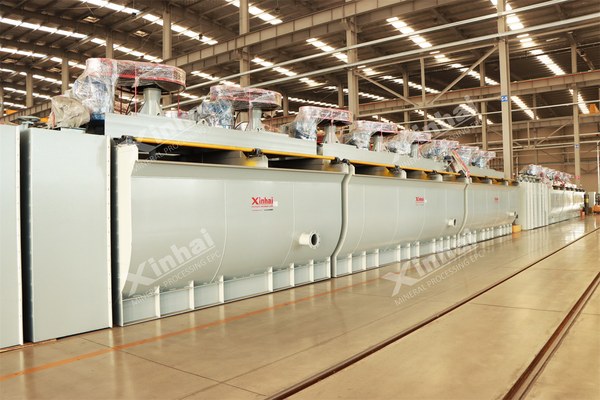
An XCF/KYF flotation train — where separation is actually won
Smelter contracts price concentrate by what is wrong with it. Beyond treatment charges, per-unit penalties for excess molybdenum — and arsenic, bismuth or silica riding along — quietly define the plant's real target function.
| Impurity | Where it comes from | Commercial consequence |
|---|---|---|
| Molybdenum in Cu concentrate | Incomplete Cu-Mo suppression during separation cleaning | Per-unit penalty; repeat exceedances trigger rejection rights |
| Arsenic / bismuth | Locked in sulfide lattices; needs selective circuits or blending | Escalating penalty scales, often stepwise |
| Silica / gangue | Over-grinding or poor desliming upstream | Discounts plus higher slagging costs back to the mine |
| Moisture | Underperforming thickening or filtration | Freight paid on water; handling losses |
Running against that table week after week is a production-management job, not a design handout. Monthly mass-balance audits with tighter assay frequency catch Mo creep before it reaches the shipping lot; middling-loop settings and cleaner residence time get adjusted by the same process engineers who read the assay sheet — instead of drifting between a designer who has left site and an operator told only to protect throughput.
Five thousand tonnes of concentrate a day carries a water bill most owners underestimate. Moisture above contract spec means paying freight on water and eating handling losses; the fix sits in the thickeners and filters, not the mine plan. High-efficiency thickening returns a large share of process water directly, and filtration lifts recovery further — dry-stack layouts push thickener underflow recovery of 60–80% up to 85–95% once filtered, cutting both dam risk and makeup water. A properly sized high-efficiency thickener keeps that loop honest through a dry season.
In Uzbekistan's climate the loop has to close twice over: flocculant selection should be re-trialled on current slurry, not the original design sample — clay content drifts with every bench change. A dewatering train sized on stale data throttles the plant from the tailings end.
Xinhai's delivery record in the region covers both halves of this story. In Kazakhstan, a 1.5 Mtpa copper flotation plant is under EPC construction — testwork first, with the flowsheet fixed on drill-core samples before any equipment list closed, then civil works sequenced backwards from the winter window: fifty days placed roughly 15,000 m³ of earthwork, 260 t of rebar and 2,700 m³ of concrete with about 100 people (project progress report, August 2026). Testwork on the submitted material ran to a 22% Cu concentrate at 90% recovery; those figures apply only to the tested sample.
In Uzbekistan itself, a 1 Mtpa tungsten-tailings processing project moved into installation in July 2026 under the same integrated model — engineering, procurement, construction plus management and operation. Together the two projects map a Central Asian concentrator programme's route: laboratory before steel, one accountable chain through commissioning, the operating ledger watched after handover.
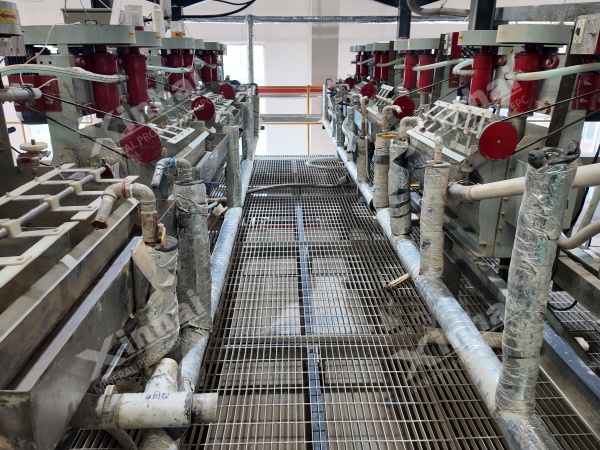
Locked-cycle testwork: the penalty table, mirrored before steel
Neither metal separates cleanly from raw pulp — molybdenum grades are too low and copper too dispersed for selective capture in one pass. Bulk flotation concentrates both cheaply, then the harder task moves to a smaller stream where reagents and cleaning stay economically controllable.
Through per-unit penalties written into smelter contracts. Excess molybdenum raises the melt's treatment cost, so buyers deduct by the percentage point beyond the free limit; repeated exceedances can convert a discount into rejection rights. Residual Mo is a flowsheet design variable, not an operator's afterthought.
Conventionally lime-driven high alkalinity, often assisted by small doses of cyanide or thiophosphate-type modifiers, plus aggressive depression of copper surfaces through repeated cleaning. The regime is ore-specific — which is why it belongs in locked-cycle testwork on your own concentrate, not a generic recipe.
Sustained attention to the separation stage after handover. Recovery headlines get reviewed weekly; cleaner setpoints drift for months until the first smelter claim arrives. Plants that schedule mass-balance audits from quarter one avoid paying for the learning curve in penalties.
Commissioning photographs fade. Twelve months later the reconciliation tells the truth: tonnage wins the construction award, but the separation stage — watched, assayed and balanced every month — is what wins the smelter contract.
Sources
Embassy of Uzbekistan in China — AMMC Copper Plant No.3 commissioning (15 October 2026)
Tashkent Times — AMMC's Copper Concentrator No.3 inaugurated
Xinhai Mining project records — Kazakhstan 1.5 Mtpa copper EPC progress (August 2026); Uzbekistan 1 Mtpa tungsten-tailings project (July 2026)
 +86 13811510145